

Last updated:
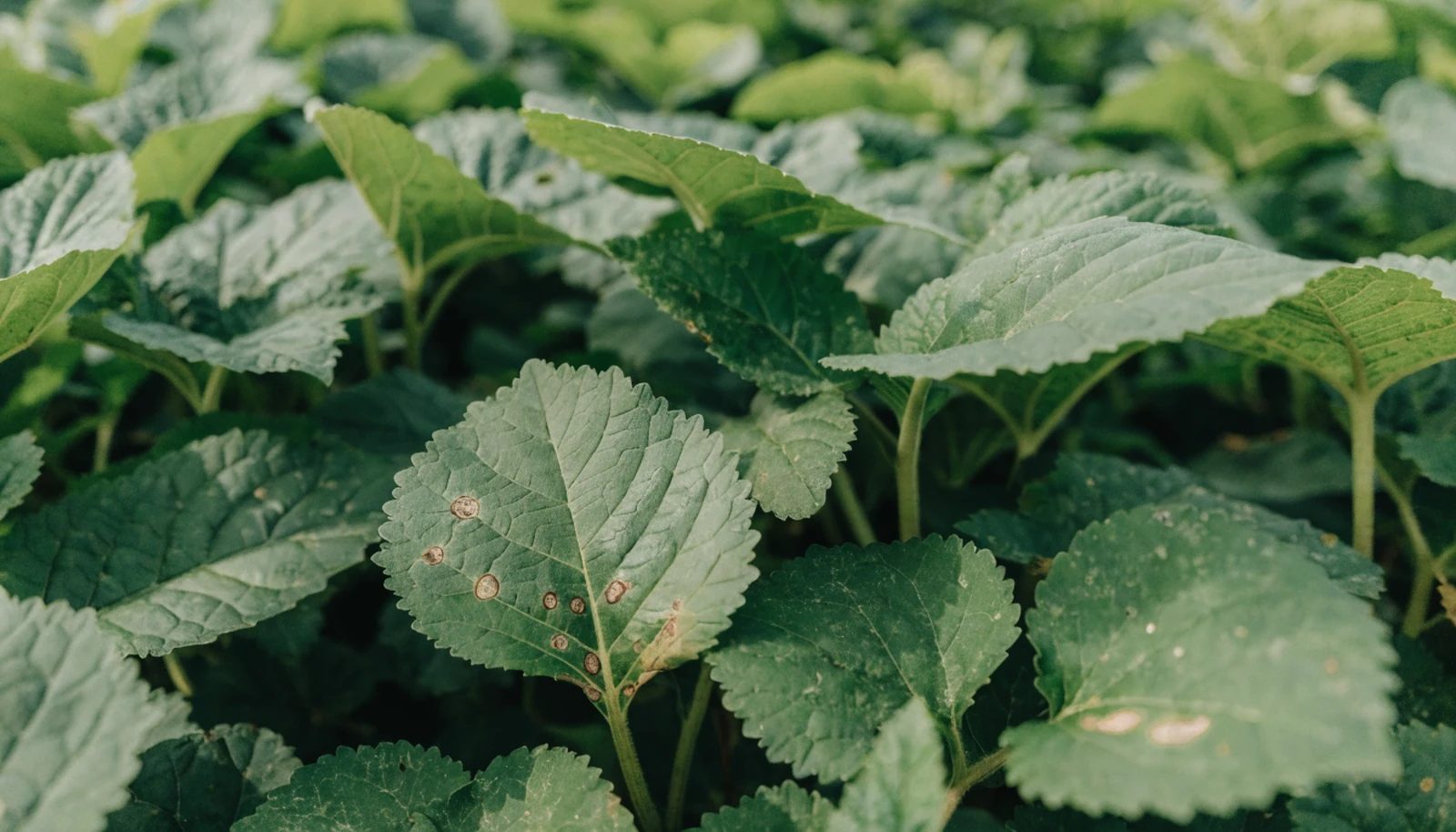
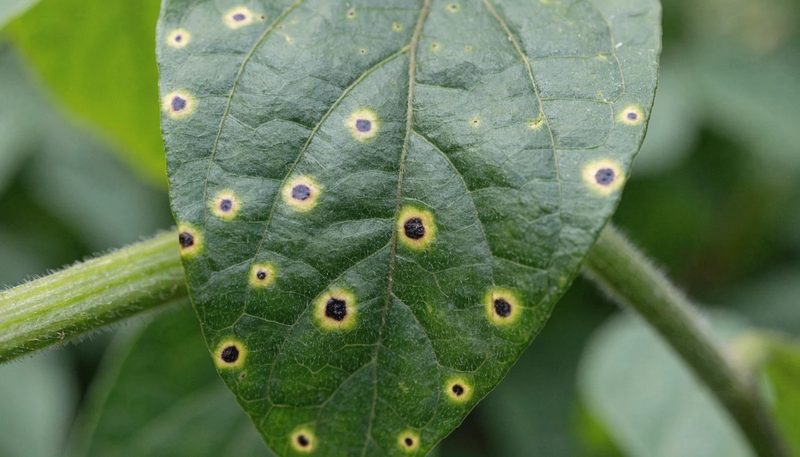
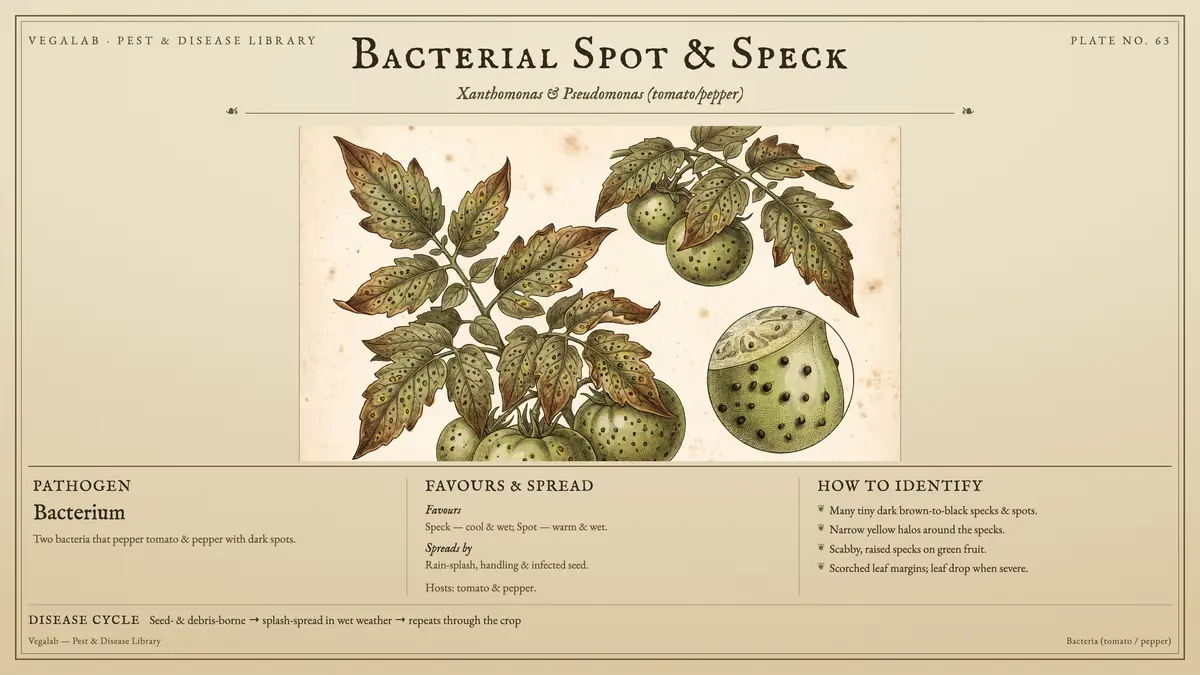
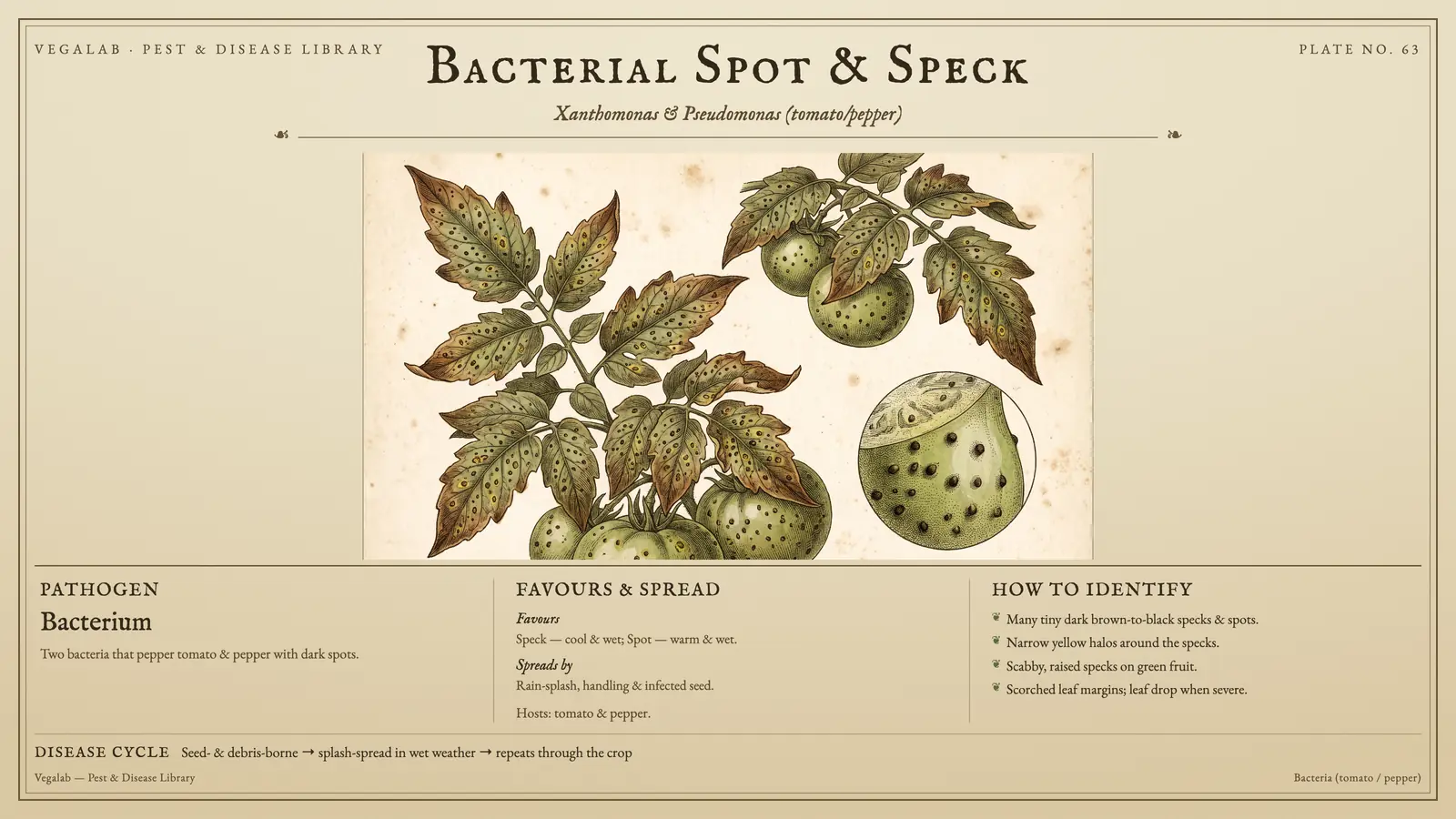
Bacterial spot shows as small, dark, water-soaked leaf spots, often with a yellow halo, and raised, scabby fruit lesions. It is caused by Xanthomonas species and favors warm, wet weather of roughly 24 to 30 °C, so it peaks mid to late season. Bacterial speck, caused by Pseudomonas syringae pv. tomato, favors cool, wet conditions of 18 to 24 °C and leaves tiny, superficial raised black specks on fruit.
Crops affected
How do you identify bacterial spot and speck?
- Narrow yellow halos around the specks.
What is it?
These are bacterial pathogens that enter through stomata and wounds and multiply in wet conditions, producing spots on leaves, stems and fruit. Because they're bacterial, the goal is protection of healthy tissue and slowing spread - not cure.
What are the symptoms of bacterial spot?
- Small, dark, water-soaked spots on leaves, often with a yellow halo; spots may merge and tatter the leaf.
- Raised, scabby or sunken spots on fruit, downgrading quality.
- Rapid spread after rain, overhead irrigation, wind-driven storms or handling.
- Defoliation and fruit blemishing in severe outbreaks.
How does bacterial spot spread?
Survives on debris, seed and volunteers; spreads in water (splash, overhead irrigation, storms) and on hands/tools; enters through natural openings and wounds; multiplies fast in warm, humid weather.
What conditions favor bacterial spot?
Warm, wet, humid weather; overhead irrigation; wind-driven rain and hail wounds; contaminated seed/transplants and handling.
What damage does bacterial spot cause?
Leaf spotting and defoliation cut photosynthesis and yield; fruit lesions downgrade or cull produce; once established it can move quickly through a crop.
How do you scout for bacterial spot?
Watch after warm wet/stormy weather; scout new growth and fruit; act preventively and tighten sanitation rather than expecting a cure.
What are the basic steps to control bacterial spot?
- Use clean seed/transplants, avoid working plants when wet, switch to drip from overhead, remove infected debris, and apply protectant programs preventively to protect healthy tissue and support plant defense.
How do you manage bacterial spot and speck?
- Start with clean seed and transplants. Both pathogens are seed-borne, and infected transplants are the most common way the disease enters a block. Certified seed and hot-water or approved seed treatment where appropriate.
- Do not work a wet crop. Bacteria are spread in water films by hands, clothing, tools and machinery, and working wet foliage moves the disease along the row faster than rain does.
- Switch to drip irrigation and avoid overhead watering, which both wets the leaf and splashes bacteria between plants.
- Rotate away from solanaceous crops for two to three years and control solanaceous weeds and volunteers.
- Remove and destroy crop debris after harvest · the bacteria survive on residue.
- Avoid injury. Bacteria enter through wounds and natural openings, so wind-blown sand, insect damage, pruning and mechanical injury all increase infection. Windbreaks genuinely reduce bacterial spot in exposed fields.
- Use resistant varieties where available and match them to the local races, which differ regionally.
- Apply protectants preventively where warranted, understanding they suppress rather than cure, and observe copper resistance status locally.
Bacterial diseases are fundamentally harder to manage than fungal ones, and it is worth being direct about why: there is no equivalent of a curative fungicide for a bacterial infection in the field. Copper-based materials are protective and suppressive at best, resistance to copper is widespread, and once bacteria are inside the tissue nothing reaches them. Everything effective is exclusion, sanitation and reducing the conditions for spread.
If a bacterial disease is present and the weather is warm and wet, the realistic objective is slowing it, not stopping it. Decisions about harvest timing and market often matter more than additional applications.
Bacterial or fungal? The distinction that changes everything
- Lesion appearance: bacterial lesions are angular, water-soaked and greasy-looking, often bounded by veins, frequently with a yellow halo; fungal lesions are more circular with defined margins and often visible fruiting structures
- Fruiting bodies: fungal lesions may show pycnidia, spore masses, concentric rings or surface mold; bacterial lesions show none - no powder, no fuzz, nothing to rub off
- Halo: a bright yellow halo around a small angular water-soaked spot strongly suggests bacterial
- Ooze: in humid conditions bacterial lesions may exude a sticky bacterial ooze; a cut stem of a bacterial wilt suspended in water gives a milky streaming
- Response: fungal disease responds to appropriate fungicide; bacterial disease does not, and a lack of response to a well-chosen fungicide is itself diagnostic information
See Anthracnose, Early Blight and Septoria Leaf Spot for the fungal look-alikes on the same crops.
Spot or speck · and does it matter?
Bacterial spot (Xanthomonas species) and bacterial speck (Pseudomonas syringae pv. tomato) produce similar symptoms on tomato and pepper and are routinely lumped together. There is one difference with real management consequence: temperature preference.
Bacterial speck favors cool, wet conditions - roughly 18–24 °C - and is therefore an early-season and cool-climate problem. It produces small dark specks, often with a pronounced yellow halo, and on fruit it makes tiny raised black specks that stay superficial.
Bacterial spot favors warm, wet conditions - roughly 24–30 °C - and is therefore a mid- and late-season problem in warm climates. Its fruit lesions are larger, raised and scabby, and more damaging commercially.
The practical value of the distinction is predictive. A wet cool spring points to speck; a hot wet summer points to spot. Resistance is race-specific for both, so variety choice depends on which is prevalent locally, and a variety selected for speck resistance is not necessarily protected against spot.
Both are managed with the same cultural measures, so a precise identification matters more for variety selection and for anticipating when in the season the risk peaks than for immediate decisions.
Does copper still control bacterial spot?
- Protective only · no activity against bacteria inside tissue
- Apply ahead of infection periods, not after symptoms appear
- Expect reduced performance where copper tolerance is established locally
- Do not raise rates to compensate · phytotoxicity and soil accumulation follow
- Never substitute for clean seed and dry-weather working, which carry the program
Copper has been the mainstay of bacterial disease management in horticulture for over a century, and it is worth being clear about both its mechanism and its declining usefulness, because growers frequently expect more from it than it can deliver.
Copper ions disrupt bacterial cell function on contact. That makes copper protective - it reduces the population of bacteria living on the plant surface before they infect - and it does nothing whatever to bacteria already inside the tissue. So an application made when lesions are already present is treating the surface population, not the disease, and the visible lesions will continue to develop regardless.
The larger problem is resistance. Copper-tolerant strains of Xanthomonas and Pseudomonas are now widespread in tomato, pepper and stone fruit production worldwide, having been selected by decades of repeated use. In many regions the field performance of copper against bacterial spot is now modest at best, and where tolerance is established, increasing rates achieves little except phytotoxicity risk - copper accumulates in soil and can cause its own damage.
Where copper still contributes it is as one component of a preventive program, applied ahead of infection periods, often in combination with other materials, and always alongside the cultural measures that do the real work: clean seed, dry-weather working, drip irrigation and rotation.
If copper appears to have stopped working on your farm, copper tolerance is the most likely explanation and the response is to lean harder on exclusion and sanitation, not on more copper.
Recommended Vegalab solution: Spore Control
Spore Control · natural broad-spectrum product (thymol) used preventively to help protect healthy tissue and slow spread; pair with clean seed, sanitation, drip irrigation and handling hygiene.
| Role | Product | Use |
|---|---|---|
| Primary control | Spore Control |
How do you prevent bacterial spot next season?
Clean seed/transplants, drip vs overhead irrigation, sanitation and tool hygiene, avoid handling wet plants, resistant varieties where available, and rotation.
Key takeaways
- Both pathogens are seed-borne, and infected transplants are the most common way they enter a block.
- Working a wet crop spreads bacteria along the row faster than rain does.
- Bacterial diseases cannot be cured once established; the goal is protecting healthy tissue and slowing spread.
- Copper is protective only, and copper-tolerant strains are widespread.
- Resistance is race-specific, so a variety resistant to speck is not necessarily protected against spot.
Claims and product availability vary by jurisdiction. Always read and follow the product label.