

First-Pass Metabolism
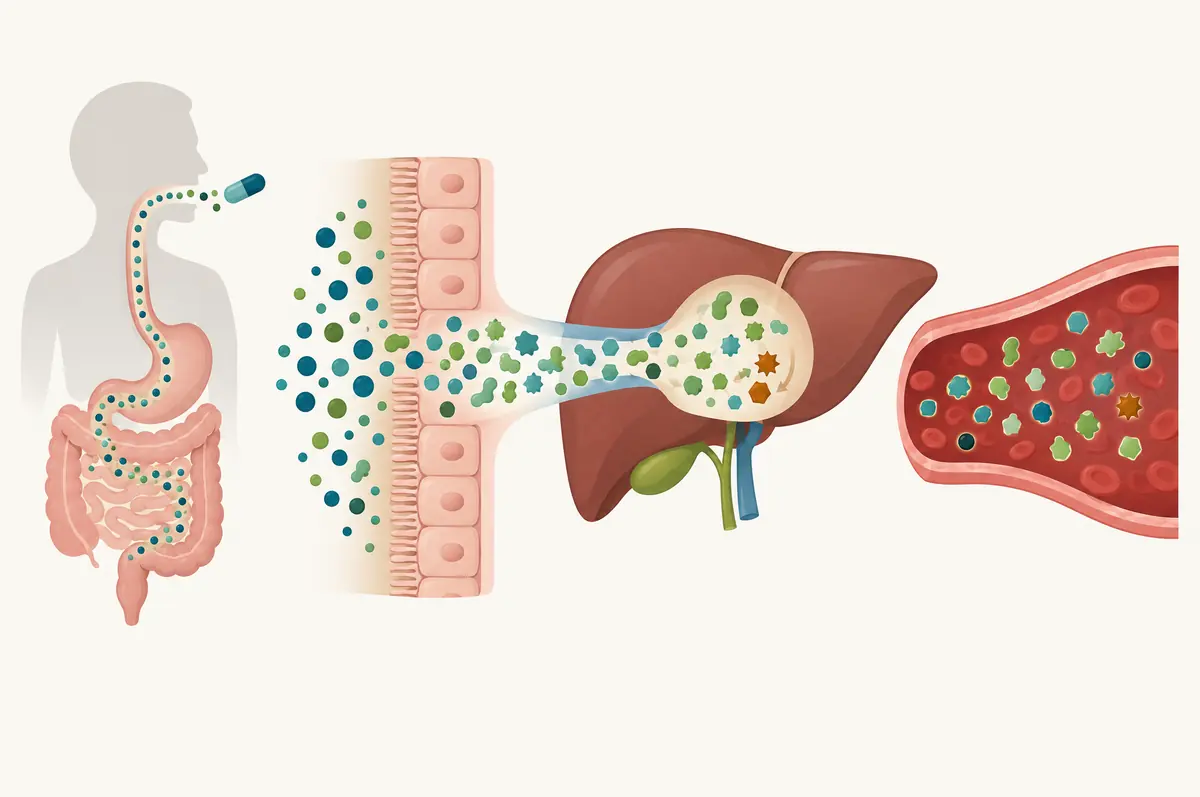
A compound can be well absorbed and still barely reach the bloodstream. First-pass metabolism in the gut wall and liver transforms much of an oral dose before it circulates, which is why resveratrol, NAC and many polyphenols show low parent-compound levels despite good absorption.
Where the loss happens
After crossing the intestinal wall, an absorbed compound passes through enterocytes rich in cytochrome P450 3A4 and conjugating enzymes, then travels via the portal vein to the liver before reaching systemic circulation. Glucuronidation and sulfation are particularly important for polyphenols: resveratrol is roughly 70% absorbed, yet nearly all circulating material is conjugated metabolites. Oral bioavailability equals the fraction absorbed times the fractions escaping gut and liver metabolism. Each of these fractions can be the limiting one for a given compound.
How formulators avoid it
Routes that bypass the portal vein avoid first-pass effects: sublingual, buccal, intranasal, transdermal and parenteral delivery. On the oral route, highly lipophilic compounds formulated with long-chain lipids can enter intestinal lymph and reach the circulation via the thoracic duct, bypassing the liver. Enzyme inhibition, as with piperine, is another approach but raises interaction concerns because the same enzymes clear many drugs. Choosing a route is often more effective than trying to fix first-pass loss within an oral format.
Why metabolites still matter
Low parent-compound bioavailability is not always a failure. For some actives, metabolites carry activity of their own or act as a circulating reservoir that is converted back in tissues. For NMN and NR, the relevant readout is the NAD+ metabolome, not the precursor itself. A useful formulation study therefore measures the species that matter biologically, not only the parent molecule, and compares them with an unformulated reference. Otherwise gains are misread.
Key facts
- Resveratrol is about 70% absorbed but parent-compound oral bioavailability is near zero due to rapid conjugation (Walle et al. 2004, Drug Metab Dispos)
- Oral NAC bioavailability is roughly 6 to 10% because of first-pass metabolism (Borgstrom et al. 1986, Eur J Clin Pharmacol)
- Lipid-based formulations can promote intestinal lymphatic transport that bypasses hepatic first-pass metabolism (Trevaskis et al. 2015, Nat Rev Drug Discov)
- Piperine inhibits hepatic and intestinal glucuronidation and raised curcumin exposure in humans (Shoba et al. 1998, Planta Med)
How our delivery technology applies
Encapsulation can reduce first-pass loss in two ways. Lipid-rich layers designed around long-chain triglyceride chemistry can favor lymphatic uptake for highly lipophilic actives, a route that bypasses the liver. Mucoadhesive formats for buccal or sublingual use can place the active in tissue drained directly to systemic circulation. Neither applies to every compound, and hydrophilic actives such as NAC are poor lymphatic candidates.
Ask for a route analysis of your active's first-pass profile.
Related reading
Last updated: