


Poor Water Solubility
If an active does not dissolve in gut fluid, it cannot be absorbed, no matter how permeable it is. Poor solubility is the most common delivery barrier in both drug pipelines and supplements, and it is the main reason curcumin, CoQ10 and astaxanthin show low and variable blood levels.
How solubility limits absorption
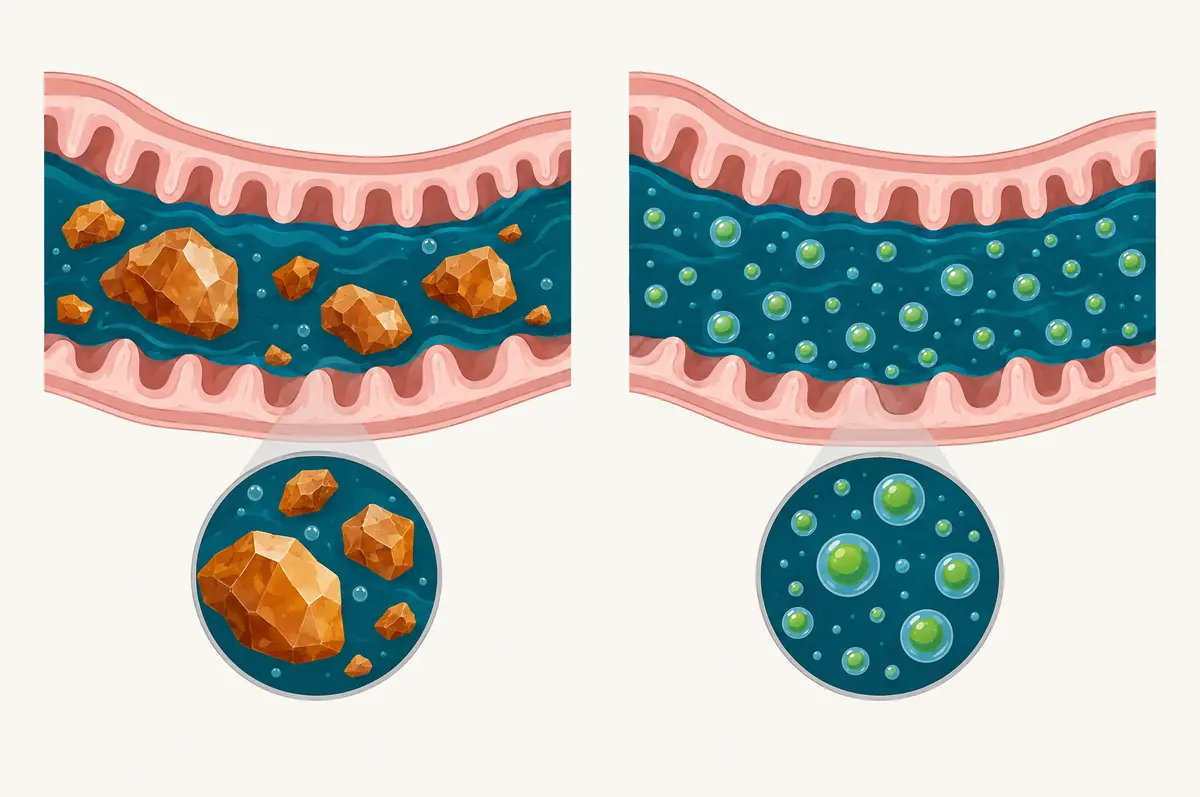
Absorption requires a compound to be in solution at the intestinal wall. Lipophilic actives with logP above about 3 and aqueous solubility below 0.1 mg/mL dissolve slowly and incompletely, so much of the dose passes through unabsorbed. In the Biopharmaceutics Classification System these are Class II (low solubility, high permeability) or Class IV (low solubility, low permeability) compounds. Exposure also becomes highly dependent on food, since dietary fat and bile help solubilize them.
Established approaches
Formulators use particle size reduction and nanocrystals, amorphous solid dispersions, cyclodextrin complexes, salt forms, and lipid-based systems such as self-emulsifying drug delivery systems. Each has trade-offs: amorphous forms can recrystallize, cyclodextrins add bulk, and lipid systems can be unstable in capsules. For curcumin, co-administration with piperine increased exposure in a small human study by inhibiting metabolism rather than improving solubility. Choosing among them depends on dose, stability and whether first-pass metabolism is also a factor.
Compounds commonly affected
In our library, poor solubility is the leading barrier for curcumin, CoQ10, astaxanthin, resveratrol and pterostilbene, quercetin and fisetin, and for many porphyrins. Several of these are both poorly soluble and extensively metabolized after absorption, so improving dissolution alone may not raise plasma levels of the parent compound. A useful screen therefore measures dissolution and metabolism together before choosing a format. Delivery formats should therefore be chosen per compound, not per category.
Key facts
- Roughly 40% of marketed drugs and up to 90% of development candidates are poorly water soluble (Kalepu and Nekkanti 2015, Acta Pharm Sin B)
- The Biopharmaceutics Classification System defines four classes by solubility and permeability (Amidon et al. 1995, Pharm Res)
- Curcumin shows poor absorption, rapid metabolism and rapid elimination in humans (Anand et al. 2007, Mol Pharm)
- Piperine increased curcumin bioavailability about 2000% in a small human study (Shoba et al. 1998, Planta Med)
How our delivery technology applies
Encapsulation addresses solubility by presenting the active already dispersed. A lipophilic core holds the compound in molecular or nanoscale form, and hydrophilic outer layers keep particles suspended in gut fluid, so absorption no longer waits on crystal dissolution. Layers also slow recrystallization during storage, a common failure of amorphous forms. Where first-pass metabolism is the larger loss, dispersion alone is not enough, and we say so.
Send us a poorly soluble active for a dispersion and stability screen.
Related reading
Last updated: