


How Bioavailability Is Measured
Last updated:
Most bioavailability claims in the supplement and cosmetic trade are relative comparisons dressed as absolute numbers. The distinction decides whether a formulation result is meaningful, and it costs nothing to check.
Absolute versus relative
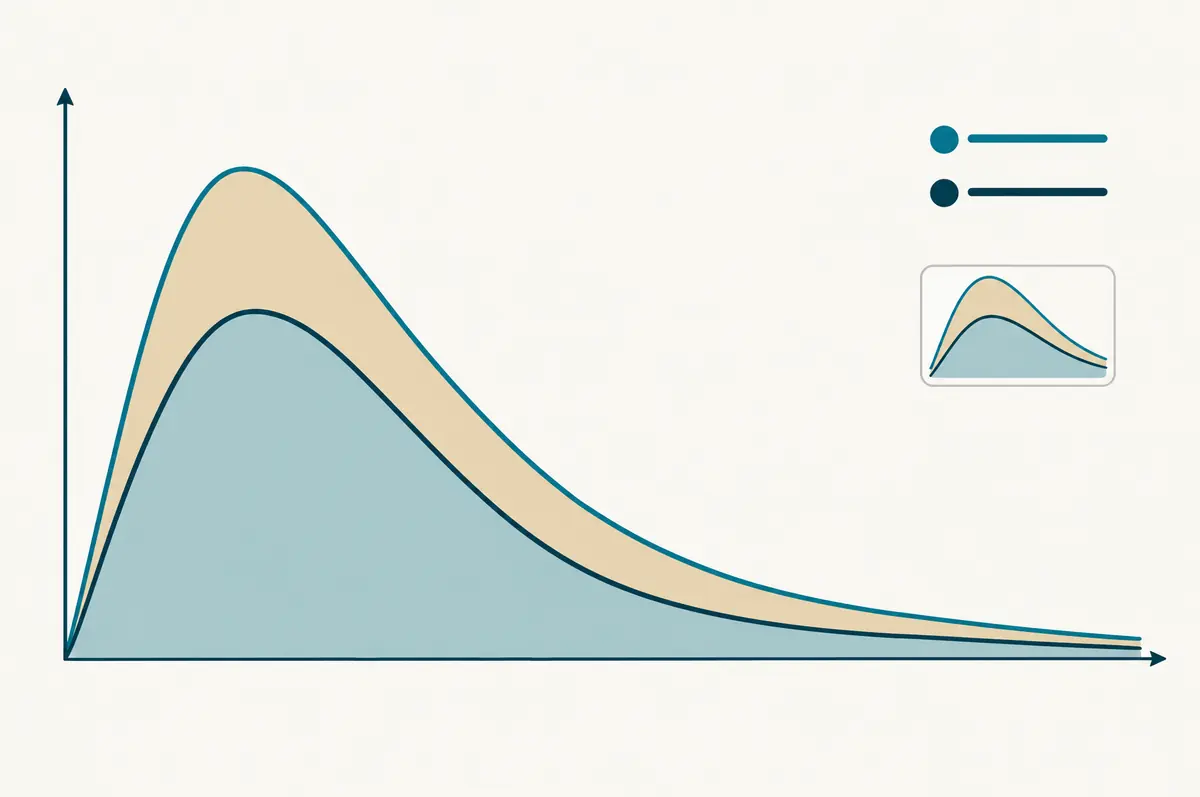
Absolute bioavailability is the fraction of an administered dose reaching systemic circulation intact, calculated from the dose-normalized area under the plasma concentration curve against an intravenous reference arm. Without that arm, only relative bioavailability exists, meaning one formulation compared with another. A claim of, for example, six times higher absorption almost always means six times a poorly performing comparator, which may still be a fraction of a percent of the dose. Regulators require the intravenous comparison before an absolute figure is used, and a formulation partner should ask for the study design before accepting the number.
What to measure and how
Measure the intact molecule, by liquid chromatography with tandem mass spectrometry where possible, since immunoassays may detect fragments or metabolites and overstate exposure. Report the full set: Cmax, Tmax, AUC to the last quantifiable point and extrapolated to infinity, half-life, and inter-subject variability. Variability is often the commercial issue, because a formulation with an acceptable mean and wide spread is hard to label and harder to defend. Validate the assay against a matrix-matched calibration curve, and report the lower limit of quantification.
When plasma is the wrong compartment
For compounds acting inside cells or in a specific tissue, plasma exposure can be a poor surrogate. Cofactor precursors are the standard example, since a circulating precursor concentration says little about intracellular cofactor pools, which is why whole blood or tissue measurement, or a downstream pharmacodynamic marker, is more informative. For topical products, plasma is not the target at all and skin-layer recovery by tape stripping or ex vivo diffusion cell work answers the actual question.
Study designs that hold up
A defensible program moves in order: in vitro release and stability, then a simulated gastrointestinal or ex vivo permeation model, then a crossover pharmacokinetic study in animals with an intravenous arm, then a human study only if the regulatory pathway supports it. Randomization, washout adequate to the half-life and a fasted or fed condition matched to the intended use are non-negotiable. Where the target market is a supplement or cosmetic rather than a medicine, the same sequence applies at a lower cost, and the resulting data still has to carry the claim that appears on the label.
Key facts
- Absolute bioavailability requires an intravenous reference arm; otherwise only relative bioavailability can be reported (FDA guidance, Bioavailability Studies Submitted in NDAs or INDs: General Considerations, 2022)
- Bioequivalence assessment relies on AUC and Cmax with prespecified confidence-interval limits (ICH M13A, 2024)
- Ex vivo skin diffusion cell testing is the standard method for topical penetration, not plasma sampling (OECD Test Guideline 428)
- Analytical methods for pharmacokinetic samples must be validated for selectivity, accuracy and lower limit of quantification (ICH M10 bioanalytical method validation, 2022)
How our delivery technology applies
Vegalab designs feasibility work so the formulation question is answered before the animal question. Encapsulation changes release rate, protection and residence, and each of those is measurable in vitro first. When we do run pharmacokinetics for a partner, we specify the intravenous arm, mass spectrometry for intact analyte, and reporting of variability, because a program that skips those steps produces numbers nobody can build a label on.
Ask for our standard feasibility and pharmacokinetic study outline.