


Stomach Acid Degradation
The stomach is built to break things down. At pH 1 to 3 with pepsin active, acid-labile compounds such as proton pump inhibitors, many probiotics and most peptides can be degraded before they reach the small intestine, where absorption mainly happens.
What happens in the stomach
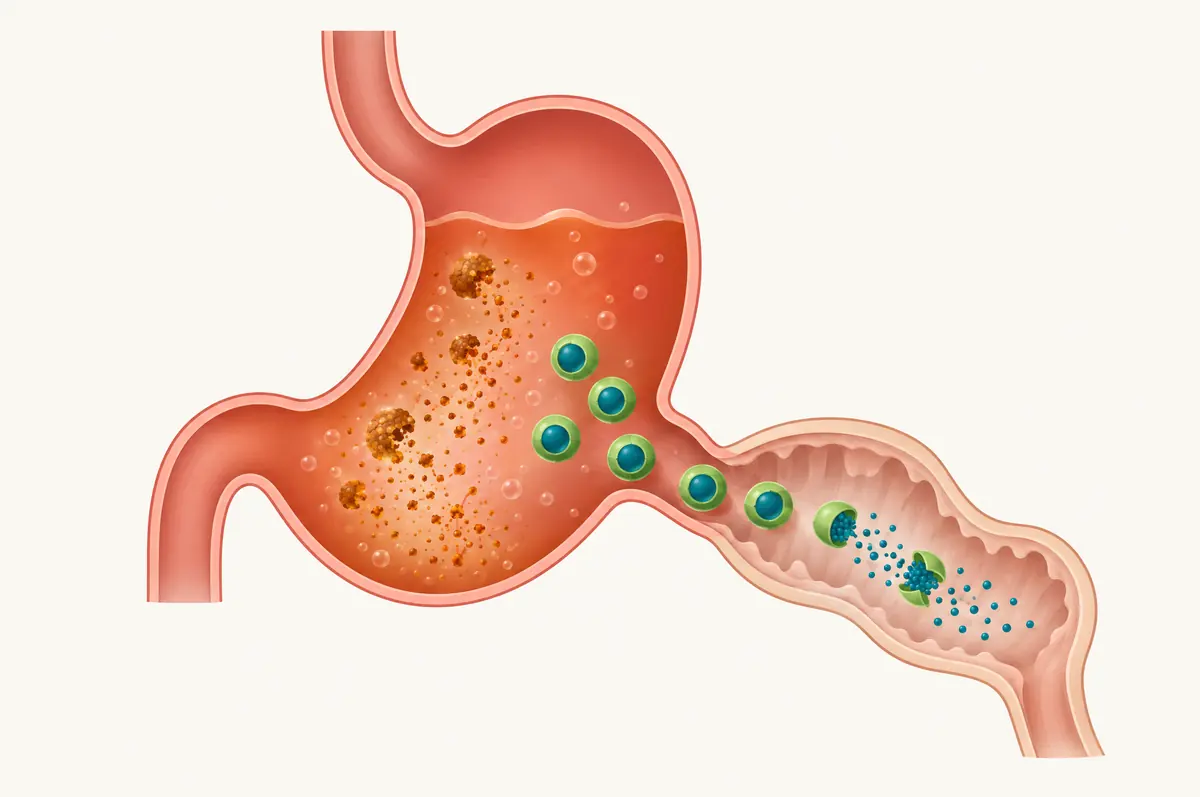
Fasting gastric pH is typically 1 to 3 and residence time ranges from under an hour to several hours depending on food. Acid catalyzes hydrolysis of esters, amides and glycosidic bonds, while pepsin cleaves peptides. Omeprazole, for example, degrades rapidly in acid and is supplied in enteric-coated pellets or with buffers. Live microorganisms lose viability, and some polyphenols and vitamins isomerize or hydrolyze. The degree of loss depends on how long the active sits in acid and whether food buffers the contents.
Standard protection
Enteric coatings made of methacrylic acid copolymers or cellulose derivatives stay intact below about pH 5.5 and dissolve in the higher pH of the duodenum. Acid-resistant capsule shells, buffering agents and delayed-release pellets are also used. Limits include variable gastric emptying, coating cracks during manufacture, and the fact that surviving the stomach does not protect against intestinal proteases or improve absorption. Coating quality therefore needs checking batch by batch, not only during development.
Testing gastric survival
Pharmacopeial delayed-release dissolution testing exposes a product to 0.1 N hydrochloric acid for two hours, then transfers it to a pH 6.8 phosphate buffer. Enteric formulations are expected to release little or nothing in the acid stage and to release fully in the buffer stage. For peptides and enzymes, simulated gastric fluid containing pepsin gives a more realistic picture of enzymatic loss than acid alone, and results should be reported as intact active recovered.
Key facts
- Delayed-release dosage forms are tested with an acid stage in 0.1 N HCl followed by a buffer stage at pH 6.8 (USP General Chapter 711 Dissolution)
- Omeprazole is acid-labile and is formulated as delayed-release enteric-coated granules (FDA label, Prilosec)
- Oral peptide therapeutics must overcome gastric acid, pepsin and intestinal proteases (Drucker 2020, Nat Rev Drug Discov)
How our delivery technology applies
An enteric outer layer is the simplest part of our design and the one most formulators already use. What multi-layer encapsulation adds is what sits underneath: once the enteric shell dissolves at intestinal pH, inner layers continue to shield the active from proteases and can hold it near the mucosa. The outer trigger pH can be tuned for duodenal, jejunal or ileal release depending on where absorption is best.
Test your acid-labile active in our simulated gastric screen.
Related reading
Last updated: