


Oral Capsules and Tablets
Last updated:
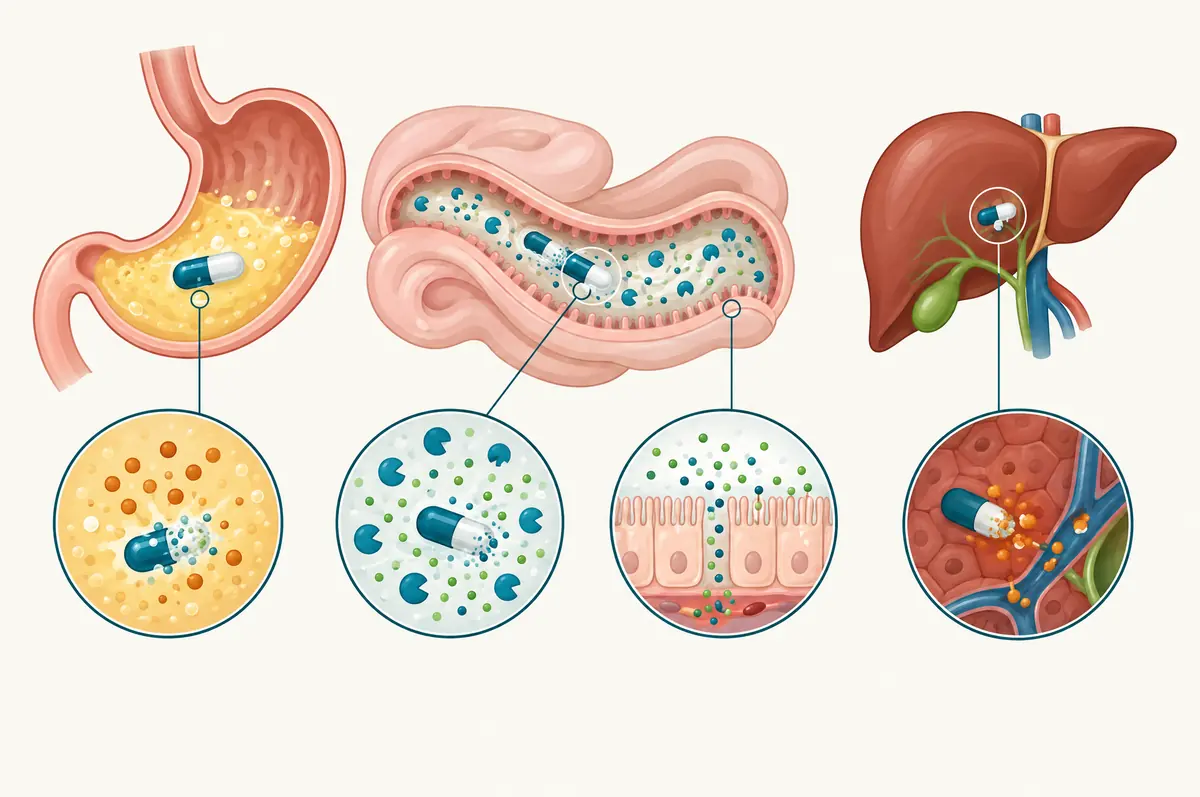
Oral solids are the default format because they carry the most active per dose and patients accept them. They also expose the payload to the most hostile path: stomach acid, pancreatic enzymes, the intestinal epithelium and the liver. Two approved oral peptides show what is possible and how little reaches the blood.
The path an oral dose travels
A capsule or tablet disintegrates in the stomach at pH 1 to 3 within minutes unless coated. The active must then dissolve, survive pepsin, trypsin and chymotrypsin, cross or pass between epithelial cells, avoid efflux transporters, and survive first-pass metabolism in the gut wall and liver. Small, moderately lipophilic molecules manage this well. Hydrophilic molecules above 500 Da and peptides do not; their oral bioavailability is typically below 1 to 2% even with enhancers.
Reference products
Oral semaglutide (Rybelsus) uses SNAC, which raises local pH and transiently increases permeability in the stomach; bioavailability is about 0.4 to 1%, and the label requires dosing on an empty stomach with limited water. Oral octreotide (Mycapssa) uses a transient permeability enhancer in an enteric capsule. Budesonide multi-matrix tablets release in the colon by design. Each shows a different lever: enhancer, enteric protection, or site-targeted release. None of these is a supplement pathway; each required a full drug program.
Formulation considerations for encapsulated powders
Encapsulated actives enter oral solids as dry powders. Tablet compression forces can fracture shells, so direct compression pressure, excipient choice and hardness targets must be set to preserve particle integrity; capsules avoid that stress. Moisture uptake in hard gelatin or HPMC shells affects stability of hygroscopic actives such as NMN. Enteric coating can be applied at the particle level, the dosage level, or both. Particle size distribution, flow and blend uniformity are checked before scale-up so each unit carries the intended amount of encapsulated active.
Key facts
- Oral semaglutide with SNAC has bioavailability of about 0.4 to 1% and must be taken fasting with up to 120 mL of water (FDA label, Rybelsus 2019)
- SNAC acts locally in the stomach, buffering pH and enabling transcellular absorption of semaglutide (Buckley et al. 2018, Sci Transl Med 10:eaar7047)
- Oral octreotide capsules were FDA approved for acromegaly maintenance in 2020 (FDA label, Mycapssa 2020)
- Oral drug absorption is predicted by solubility and permeability under the Biopharmaceutics Classification System (Amidon et al. 1995, Pharm Res 12:413)
How our delivery technology applies
In oral solids, multi-layer encapsulation provides acid protection at the particle level, so protection does not depend on a single tablet coat that can crack. It can co-locate an absorption enhancer with the payload so both release at the same site, which is the principle behind SNAC. For lipophilic actives it provides dispersion, raising dissolution rate. Each claim is tested by staged dissolution and, where warranted, pharmacokinetic study.
Test your active in an oral solid format: request a Vegalab feasibility study.