


Hyaluronic Acid
Last updated:
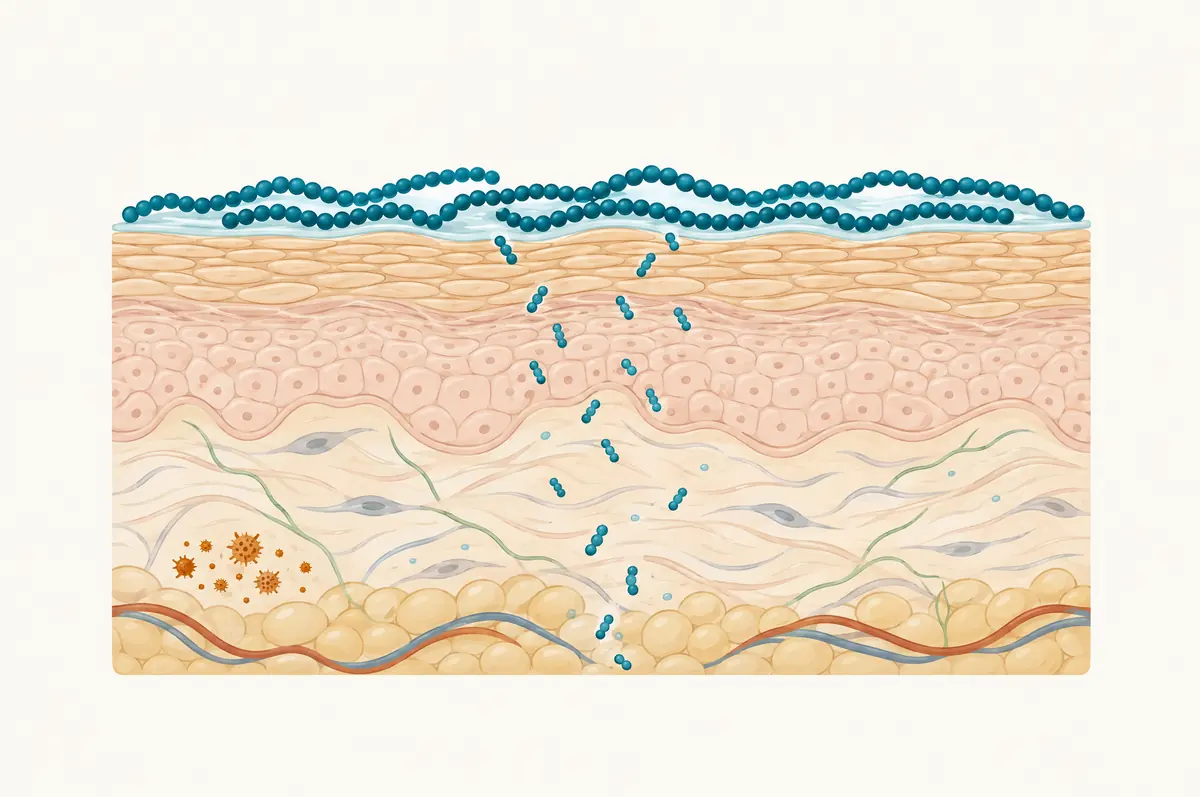
Hyaluronic acid (HA) behaves as a different ingredient at every molecular weight: high molecular weight HA hydrates the skin surface but does not penetrate it, while low molecular weight fragments penetrate further and have different biology. Formulation starts by choosing the weight range for the job, then protecting it from degradation.
Structure and molecular weight
HA is a linear glycosaminoglycan of repeating disaccharides of D-glucuronic acid and N-acetyl-D-glucosamine. Commercial grades range from oligomers under 10 kDa to high molecular weight material above 1,000 kDa, usually as sodium hyaluronate. It is highly hydrophilic and binds large volumes of water, which is the basis of its surface hydration effect. In the body HA is turned over rapidly: an adult holds roughly 15 g, and about a third of it is degraded and replaced daily by hyaluronidases and reactive oxygen species. Chain scission by heat, acid, oxidants and enzymes lowers molecular weight during processing and storage.
Regulatory status
Sodium hyaluronate is a listed cosmetic ingredient in the EU CosIng database and used widely in skin care, with claims limited to appearance and hydration. Injectable HA dermal fillers and intra-articular HA products are regulated as medical devices (Class III in the United States, requiring premarket approval). Oral HA is sold as a dietary supplement ingredient in the United States. In the EU, EFSA has not authorized a health claim for oral HA. Classification is set by route and intended use, not by the molecule.
Evidence by route
Topically, Raman spectroscopy studies on human skin show that high molecular weight HA stays largely at the surface and upper stratum corneum, while lower molecular weight fractions penetrate deeper into the epidermis. Orally, radiolabeled HA studies in rats and dogs showed absorption and distribution to skin and joints, largely after degradation to smaller fragments; human pharmacokinetic data are limited. Small human trials of oral HA report skin moisture endpoints, but study sizes are modest and often industry funded. In summary: surface hydration is well supported, deeper effects depend on molecular weight and remain less established.
Key facts
- An adult body contains about 15 g of hyaluronan, of which roughly one third is turned over daily (Stern 2004, Eur J Cell Biol)
- Penetration into human skin increases as HA molecular weight decreases (Essendoubi et al. 2016, Skin Res Technol)
- Orally administered radiolabeled HA was absorbed and distributed to skin and joints in rats and dogs (Balogh et al. 2008, J Agric Food Chem)
- HA dermal fillers are Class III medical devices requiring premarket approval in the United States (FDA, Dermal Fillers (Soft Tissue Fillers); FDA PMA database, product code LMH)
How our delivery technology applies
Encapsulation lets a formulation carry low molecular weight HA past the surface layer while shielding it from hyaluronidase and oxidative chain scission in the base, preserving the specified weight through shelf life. A multi-layer particle can also pair a high molecular weight outer layer for surface hydration with a lower weight core released more slowly. For oral formats, an enteric layer limits acid hydrolysis before the intestine.
Tell us the molecular weight range and format you need to scope an HA formulation.