


What are exosomes?
Last updated:
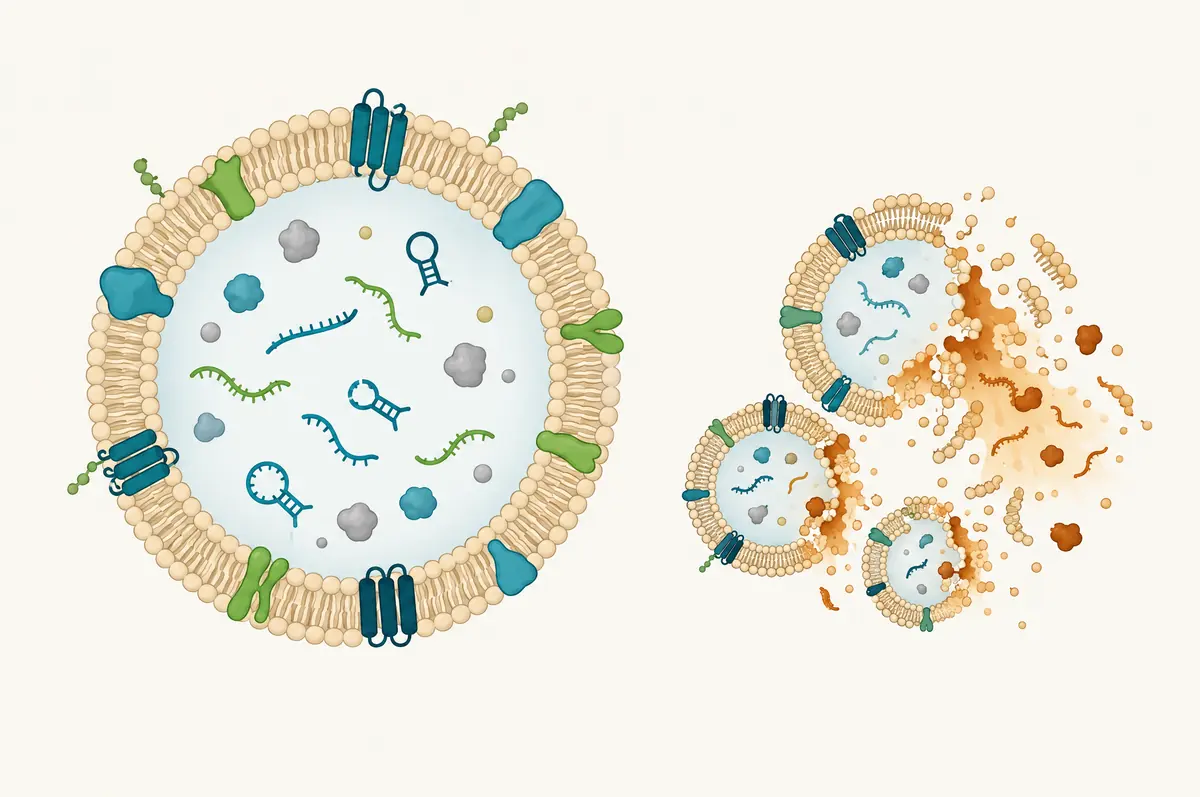
Exosomes are small extracellular vesicles, typically under 200 nm, released by cells and carrying proteins, lipids and RNA. They form inside multivesicular endosomes and are released when those endosomes fuse with the plasma membrane. Because exosomes and microvesicles overlap in size and markers, the International Society for Extracellular Vesicles recommends the neutral term small EVs unless biogenesis is shown.
Exosomes are small extracellular vesicles, typically under 200 nm, released by cells and carrying proteins, lipids and RNA. No exosome product is approved as a medicine by the FDA, EMA or Health Canada, and the practical problem for any formulator is keeping a fragile lipid vesicle intact and characterized from production to use.
How do exosomes form?
Extracellular vesicles (EVs) are membrane-bound particles shed by virtually every cell type. Exosomes form inside multivesicular endosomes and are released when those endosomes fuse with the plasma membrane; microvesicles bud directly from the membrane. Because the two overlap in size and markers, the International Society for Extracellular Vesicles recommends the neutral term "small EVs" unless biogenesis is demonstrated. Cargo includes tetraspanins (CD9, CD63, CD81), heat shock proteins, lipids and microRNA. Source matters: mesenchymal stem cell, platelet, milk and plant-derived vesicles differ in composition, and plant-derived nanovesicles are not exosomes in the strict mammalian sense.
Are exosome products approved?
In the United States, EV products intended to treat or prevent disease are regulated as biological products under section 351 of the Public Health Service Act and need an approved biologics license; none has one. The FDA has issued public warnings about unapproved exosome products marketed by clinics. In the EU, therapeutic EVs fall under medicinal product law. In cosmetics, vesicle-derived ingredients (commonly plant-derived or cell-culture conditioned media fractions) are sold in Korea and elsewhere as cosmetic ingredients, with claims limited to appearance. Human-derived material raises separate cosmetic restrictions in the EU, where substances of human origin are prohibited in cosmetics.
What does the evidence show?
Evidence for therapeutic effects of EVs is predominantly in vitro and in animal models, with a small number of early-phase human trials. Reproducibility is the central weakness of the field: isolation method (ultracentrifugation, size-exclusion chromatography, precipitation, tangential flow filtration) changes purity and yield, and many products are poorly characterized for particle count, protein contaminants and vesicle integrity. MISEV guidelines set minimum reporting requirements for exactly this reason. For cosmetic use, published data are largely manufacturer studies of appearance endpoints. Every partner program begins with characterization.
Why are exosomes hard to formulate?
An exosome is already a carrier, so the formulation question is preservation rather than encapsulation of a payload. EVs aggregate, fuse and lose cargo under freeze-thaw cycling, shear, pH shifts and surfactants, which rules out many standard cosmetic and supplement bases. Lyophilization with sugars such as trehalose helps but does not fully prevent size drift. Topically, a 100 nm vesicle does not cross intact stratum corneum in meaningful quantity, so claims of dermal delivery need penetration data. Stability, shelf life and dose definition (particles per milliliter) are unresolved for most commercial products.
Key takeaways
- Exosomes are vesicles usually under 200 nm that carry proteins, lipids and RNA.
- No exosome or EV product is approved as a medicine by FDA, EMA or Health Canada.
- Substances of human origin are prohibited in EU cosmetic products.
- Evidence for therapeutic effects is mostly in vitro and in animal models, with a small number of early-phase human trials.
- EVs aggregate, fuse and lose cargo under freeze-thaw cycling, shear, pH shifts and surfactants.
Key facts
- The ISEV recommends the generic term "extracellular vesicle" and operational terms such as "small EVs", with size ranges defined by the authors, when biogenesis is not demonstrated (Welsh et al. 2024, J Extracell Vesicles 13:e12404)
- No exosome or EV product holds FDA approval; EV products for disease treatment are regulated as biologics requiring a biologics license (FDA Consumer Alert on Regenerative Medicine Products Including Stem Cells and Exosomes, 2020)
- Isolation method changes EV purity, yield and characterization, which drives poor reproducibility across studies (Théry et al. 2018, J Extracell Vesicles, MISEV2018)
- Substances of human origin are prohibited in EU cosmetic products (Regulation (EC) 1223/2009, Annex II entry 416)
How our delivery technology applies
Here the multi-layer shell serves as a protective housing for the vesicle. A biopolymer outer layer can buffer the vesicle against surfactants, pH shifts and shear in a finished base, and a sugar-rich inner matrix can act as a lyoprotectant during drying. The measurable endpoints are vesicle size distribution, particle count and marker retention before and after encapsulation and across shelf life. EV stabilization programs cover plant-derived and cosmetic-grade vesicles.
Questions
What are extracellular vesicles?
Extracellular vesicles are membrane-bound particles shed by virtually every cell type. Exosomes form inside multivesicular endosomes, while microvesicles bud directly from the cell membrane. Their cargo includes tetraspanins such as CD9, CD63 and CD81, heat shock proteins, lipids and microRNA.
Is exosome therapy approved?
No. In the United States, EV products intended to treat or prevent disease are regulated as biological products and need an approved biologics license, and none has one. FDA has issued public warnings about unapproved exosome products marketed by clinics, and in the EU therapeutic EVs fall under medicinal product law.
Are plant-derived nanovesicles exosomes?
Not in the strict mammalian sense. Source matters: mesenchymal stem cell, platelet, milk and plant-derived vesicles differ in composition.
Can exosomes penetrate the skin?
A 100 nm vesicle does not cross intact stratum corneum in meaningful quantity. Claims of dermal delivery therefore need penetration data.
Send your vesicle source and characterization data to scope a stability feasibility study.
Related reading
- Life Sciences compound library
- hyaluronic acid compound profile
- GHK-Cu copper peptide
- SNAP-8 cosmetic peptide
- oxidation and instability as a delivery challenge
- skin barrier penetration
- liposomes, lipid nanoparticles and polymer shells compared
- where the supplement, NHP and drug line sits
- Beauty Science aging and firmness concern
- Beauty Science ingredient library
- vesicles as carriers
- stem cells: types, approved uses and regulation