


Ubiquinol vs ubiquinone
Last updated:
Ubiquinone is the oxidized form of coenzyme Q10 and ubiquinol the reduced form, and the body converts one into the other constantly. Whichever form is swallowed, CoQ10 travels in the blood mainly as ubiquinol. Small trials disagree on which absorbs better: some found ubiquinol raised blood levels more, others found no difference, and formulation changed absorption as much as the form did.
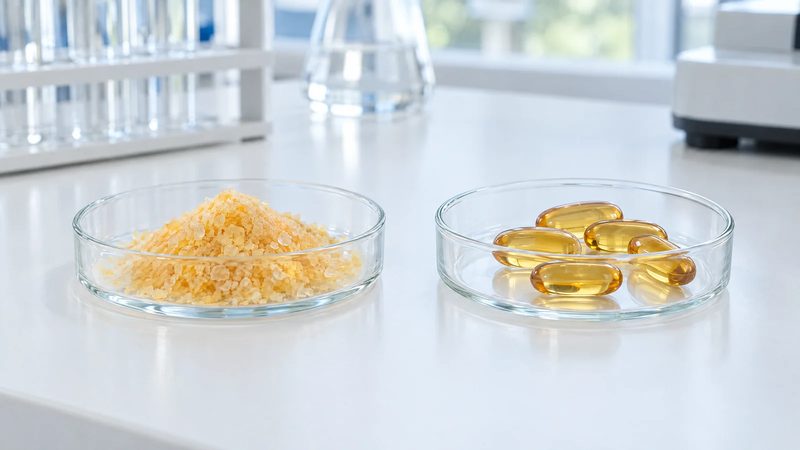
What is the difference between ubiquinol and ubiquinone?
Coenzyme Q10 (ubidecaquinone) is a fat-soluble compound that the body makes and that the diet also supplies6. It can exist in three oxidation states: the fully reduced ubiquinol form, a radical semiquinone intermediate, and the fully oxidized ubiquinone form6. Inside cells the two main forms are continually interconverted as part of CoQ10's normal function1.
The two forms do different jobs. In mitochondria, CoQ10 carries electrons in the chain that produces ATP, and in membranes and lipoproteins its reduced form, ubiquinol, acts as an antioxidant6. The antioxidant function depends on ubiquinol being constantly regenerated from ubiquinone1.
CoQ10 is found naturally throughout the body, with the highest levels in the heart, liver, kidneys and pancreas, and it is sold in the United States as a dietary supplement5. Tissue concentrations decline with age, although it is unclear whether this decline amounts to a deficiency6.
Which form of CoQ10 absorbs better?
The studies split. Several small trials, mostly in older adults, found higher blood CoQ10 after ubiquinol, while others found no significant difference between the forms1. The table summarizes the human comparisons in the cited sources; product amounts are omitted.
| Study design | Participants | Finding |
|---|---|---|
| Three formulations over 6 weeks | 11 healthy volunteers | No significant difference in plasma CoQ10 between ubiquinone and ubiquinol; large variation between individuals1 |
| Single doses, 2-week washout | 9 healthy adults | No significant difference in peak level or total exposure1 |
| Single doses, 2-week washout | 10 healthy adults over 60 | Higher bioavailability with ubiquinol1 |
| 2 weeks each form, 2-week washout | 10 men over 55 | Ubiquinol raised plasma CoQ10 more, but not plasma ubiquinol1 |
| 4 weeks each form, 4-week washout | 12 healthy adults | Higher plasma CoQ10 with ubiquinol1 |
| Single-dose, three-period crossover | 21 healthy adults aged 65 to 74 | Ubiquinol capsules 1.7-fold versus standard ubiquinone capsules, not significant; a water-soluble ubiquinone syrup 2.4-fold, significant2 |
| Single-dose crossover of seven formulations | 14 young healthy adults | The two best absorbed were soft-gel capsules containing ubiquinone or ubiquinol3 |
Why does the formulation matter as much as the form?
CoQ10 is a crystalline, fat-soluble molecule, and how a product dissolves it changes how much reaches the blood1,3. A 2020 review reports that skipping a heat step that disperses CoQ10 crystals reduced bioavailability by about 75%1. In the same comparison, ubiquinol gave roughly twice the exposure of ubiquinone without crystal dispersion, but only 52% of the exposure of ubiquinone with it1.
A crossover study of seven commercial formulations found large, statistically significant differences between products, and the oil matrix and preservatives such as vitamin C affected absorption3. Even though every product contained the labeled amount, some volunteers absorbed CoQ10 well and others poorly, pointing to individual physiological factors3. Because CoQ10 is fat-soluble, its absorption is tied to dietary fat6.
This is why the review argues that the case for ubiquinol rests on comparisons against ubiquinone that had not been crystal-dispersed1. Read together, the trials show that product design and the individual matter alongside the oxidation state1,2,3.
Does ubiquinol survive the stomach?
This is the core of the disagreement. The 2020 review states that in studies simulating gastric conditions, ubiquinol oxidizes to ubiquinone, usually over about 90 minutes, and that the two extra hydrogen atoms in ubiquinol have a negligible effect on water solubility1.
A 2023 study in mice found the opposite pattern in a living animal: ubiquinol and ubiquinone both reached the small intestine mostly without converting, and both were absorbed by intestinal tissue in almost their original forms4.
After absorption the question largely disappears. CoQ10 enters intestinal cells, is packed into chylomicrons and travels through the lymph to the blood, a transit that typically lasts 5 to 8 hours1. In the blood it is carried mainly as ubiquinol, bound to LDL and VLDL, whatever form was swallowed1. In the trial of older adults, absorbed CoQ10 appeared in the blood mostly as ubiquinol even after ubiquinone2.
Who funds ubiquinol and ubiquinone research?
Funding is worth reading on both sides. The authors of the 2020 review that questions ubiquinol's advantage declare that both are employees of Pharma Nord1. The first author of the 2023 mouse study is employed by Kaneka Corporation, which manufactures coenzyme Q10 products4. The 2020 trial in older adults was funded by the Slovenian Research Agency and Valens Int., and its authors declare no conflicts of interest2.
Industry involvement does not by itself make a result wrong; it is one more reason to read the design and formulation behind each headline finding.
Key takeaways
- Ubiquinone is oxidized CoQ10 and ubiquinol is reduced CoQ10; the body interconverts them, and blood CoQ10 is mainly ubiquinol whichever form is swallowed.
- Small human trials disagree: some, mostly in older adults, found more absorption with ubiquinol, others found no significant difference.
- Formulation, including crystal dispersion, carrier oil and solubilization, changed absorption as much as the form did.
- Individual variation in CoQ10 absorption is large in every study design.
References
- Bioavailability of Coenzyme Q10: An Overview of the Absorption Process and Subsequent Metabolism
- Comparative Bioavailability of Different Coenzyme Q10 Formulations in Healthy Elderly Individuals
- Bioavailability of coenzyme Q10 supplements depends on carrier lipids and solubilization
- Orally ingested ubiquinol-10 or ubiquinone-10 reaches the intestinal tract and is absorbed by the small intestine of mice mostly in its original form
- Coenzyme Q10
- Coenzyme Q10 (Micronutrient Information Center)
Frequently asked questions
What does water-soluble CoQ10 mean?
It refers to formulations that make CoQ10 disperse in water, such as the inclusion complex of CoQ10 with beta-cyclodextrin tested in a 2020 trial2. In adults aged 65 to 74, that syrup produced 2.4 times the CoQ10 exposure of standard ubiquinone capsules, although the difference from ubiquinol capsules was not statistically significant2. The study was partly funded by Valens Int., which supplied the syrup2.
Is ubiquinol less stable than ubiquinone?
Yes. Ubiquinol is inherently unstable and oxidizes to ubiquinone, which is why CoQ10 supplements could only be made as ubiquinone until encapsulation methods improved1. That instability is also why the review argues that ubiquinol cannot go through the same crystal-dispersion process as ubiquinone1.
Does age change which form absorbs better?
Do statins lower CoQ10?
Statins inhibit HMG-CoA reductase, an enzyme shared by the cholesterol and CoQ10 pathways, and they decrease circulating CoQ10 concentrations6. The lower blood level may reflect lower circulating lipids, and it remains unproven that it has clinical implications6. NCCIH notes that the overall evidence does not support CoQ10 for statin-related muscle pain5.