


Why is CoQ10 hard to absorb?
Last updated:
Coenzyme Q10 is an electron carrier in the inner mitochondrial membrane and a lipid-soluble antioxidant. At about 863 Da and almost completely insoluble in water, it absorbs slowly and erratically: crystalline CoQ10 must dissolve first, uptake depends on bile and dietary fat, and absorption varies widely between individuals, so a large fraction passes through unabsorbed.
Coenzyme Q10 is one of the hardest supplement ingredients to absorb: at 863 Da and almost completely water-insoluble, a large fraction of an oral dose passes through unabsorbed. PQQ is the opposite case, a small polar molecule whose delivery questions are stability and dose rather than solubility. Both are sold as supplement ingredients, and neither is an approved drug in the US or EU.
What are CoQ10 and PQQ?
CoQ10 (ubiquinone, reduced form ubiquinol) is an electron carrier in the inner mitochondrial membrane, shuttling electrons from complexes I and II to complex III, and a lipid-soluble antioxidant in membranes and lipoproteins. The body synthesizes it through the mevalonate pathway, the same pathway statins inhibit. Pyrroloquinoline quinone (PQQ, 330 Da) is a redox cofactor found in trace amounts in foods such as natto, parsley and kiwi. Its proposed roles in mammals, including signaling linked to mitochondrial biogenesis, rest mainly on cell and rodent data.
What is their regulatory status and evidence?
CoQ10 is a dietary supplement ingredient in the US and is covered by a Health Canada natural health product monograph. Human trial evidence exists, including a randomized trial in chronic heart failure (Q-SYMBIO), but Vegalab makes no treatment claims and a trial in one population does not transfer to general supplement use. PQQ disodium salt is authorized in the EU as a novel food following an EFSA safety opinion. Human data for PQQ are limited to small trials on biomarkers and subjective endpoints. Neither compound is on the WADA Prohibited List.
What limits CoQ10 and PQQ delivery?
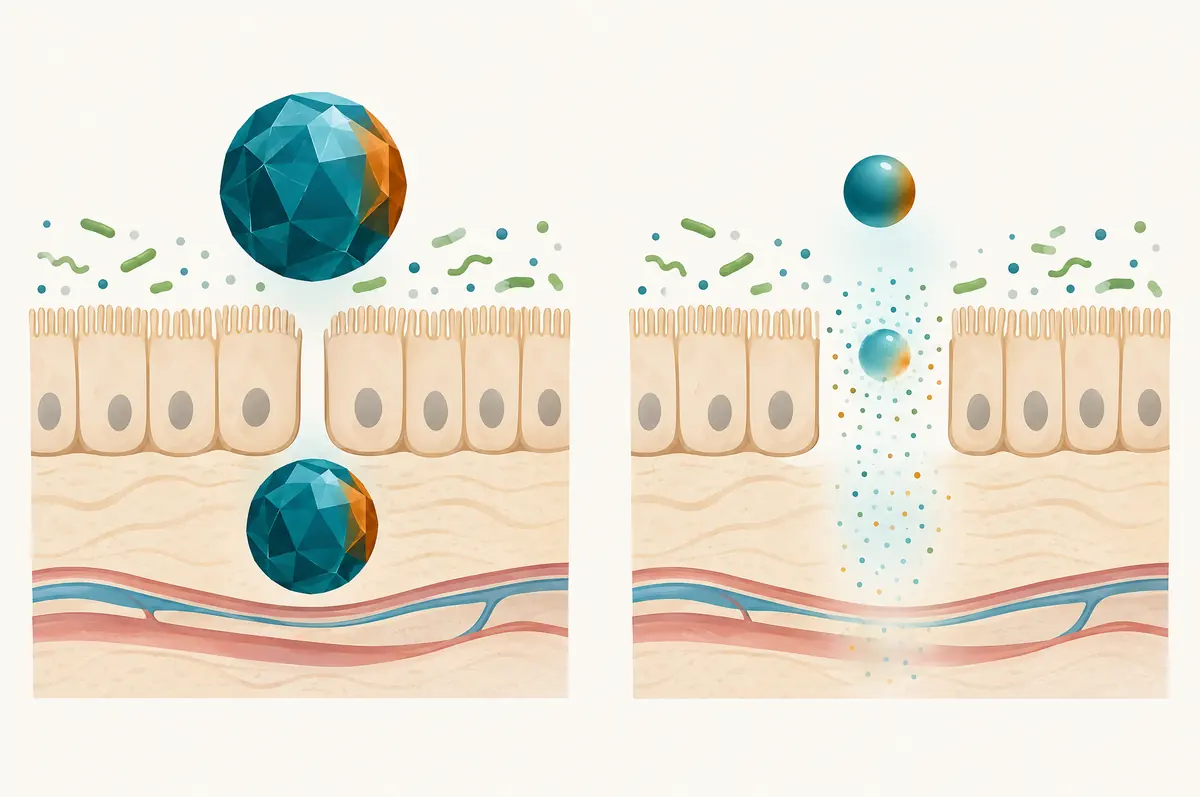
CoQ10 absorption is slow (peak plasma around 6 hours), dose-dependent and highly variable between individuals, and it depends on bile and dietary fat for micellar solubilization. Crystalline CoQ10 must dissolve before it can be absorbed, and ubiquinol, while better absorbed in some studies, oxidizes readily on exposure to air, which complicates manufacture and shelf life. PQQ is water-soluble but reactive: it can undergo redox cycling and interact with amino acids, so matrix compatibility and dose accuracy in multi-ingredient products are the practical issues.
Which formulation routes are in use?
Commercial approaches for CoQ10 include oil-filled softgels, solubilized forms with polysorbate or cyclodextrin complexes, and emulsified or nano-dispersed forms. Published comparisons show that formulation changes exposure several-fold, which means product claims based on one form cannot be assumed for another. For PQQ, the main levers are salt form, moisture protection and separation from reactive co-ingredients. For combination products, CoQ10 and PQQ are best kept in separate phases, since their optimal carriers differ.
Key takeaways
- CoQ10 absorption is slow, with peak plasma levels around 6 hours, and highly variable between individuals.
- Absorption depends on bile and dietary fat for micellar solubilization.
- Ubiquinol, the reduced form, was better absorbed in some studies but oxidizes readily on exposure to air.
- Formulation changes CoQ10 exposure several-fold, so claims based on one form cannot be assumed for another.
- PQQ is small and water-soluble; its delivery questions are stability and dose accuracy.
Key facts
- CoQ10 has a molecular weight of about 863 Da, very high lipophilicity and slow, variable oral absorption with peak plasma levels around 6 hours after dosing (Bhagavan and Chopra 2006, Free Radic Res 40:445)
- In the Q-SYMBIO randomized trial, CoQ10 was studied as an adjunct in chronic heart failure; this is a trial result, not an approved indication (Mortensen et al. 2014, JACC Heart Fail 2:641)
- PQQ disodium salt is authorized as a novel food in the EU after an EFSA safety assessment (EFSA NDA Panel 2017, EFSA Journal)
- Health Canada publishes a natural health product monograph for coenzyme Q10 (Health Canada NHPD monograph, Coenzyme Q10)
How our delivery technology applies
For CoQ10 the target is dissolution, not permeation. Holding CoQ10 in an amorphous, lipid-rich core inside a multi-layer biopolymer shell presents it to the gut already dispersed, reducing dependence on meal fat and bile, while an outer barrier layer limits oxygen contact for ubiquinol. For PQQ, a separate shell isolates the quinone from reactive amino acids in combination products. We treat this as a formulation program with bioavailability to be measured, not assumed.
Questions
What is the difference between ubiquinol and ubiquinone?
Ubiquinone is coenzyme Q10, and ubiquinol is its reduced form. Ubiquinol was better absorbed in some studies, but it oxidizes readily on exposure to air, which complicates manufacture and shelf life.
What is CoQ10's bioavailability?
CoQ10 absorption is slow, dose-dependent and highly variable between individuals, with peak plasma levels around 6 hours. Published comparisons show that formulation changes exposure several-fold.
What is PQQ?
Pyrroloquinoline quinone (PQQ) is a small redox cofactor found in trace amounts in foods such as natto, parsley and kiwi. Its proposed roles in mammals rest mainly on cell and rodent data, and PQQ disodium salt is authorized in the EU as a novel food after an EFSA safety opinion.
Is CoQ10 an approved drug?
No. CoQ10 is a dietary supplement ingredient in the US and is covered by a Health Canada natural health product monograph. The Q-SYMBIO randomized trial studied it as an adjunct in chronic heart failure, which is a trial result, not an approved indication.
Developing a CoQ10 or PQQ product? Request a feasibility study for an encapsulated form.
Related reading
- Life Sciences compound library
- Urolithin A and mitophagy
- SS-31 (elamipretide), a cardiolipin-targeting peptide
- Astaxanthin, another oxidation-sensitive lipophile
- poor water solubility as a delivery challenge
- oxidation and instability in formulations
- mitochondrial function health area
- oral capsule and tablet formats
- Vegalab multi-layer encapsulation platform