


Multi-Layer Nano-Encapsulation
Last updated:
Vegalab's platform builds a particle in sequence rather than in one step: a payload core, then discrete biopolymer layers, up to 20, each selected for one job. The design question is never how many layers, it is which barrier each layer is being asked to solve.
Architecture
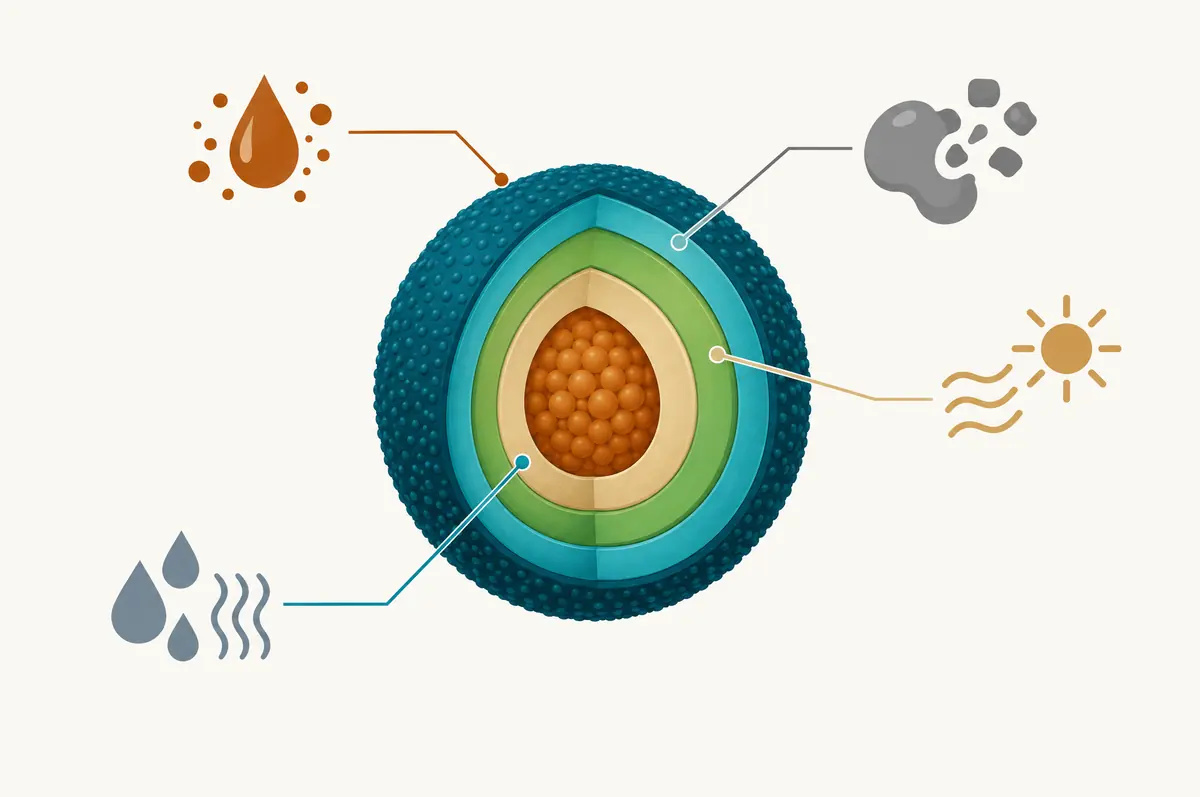
Conventional encapsulation gives a payload one shell and therefore one compromise between protection and release. A multiple-sphere construction separates those functions. An outer layer can be chosen for acid resistance or for mucoadhesion, a middle layer for controlled swelling and diffusion rate, an inner matrix for oxidation protection or protease exclusion. Because each layer is deposited on a defined precursor, the resulting release profile is a function of layer sequence and thickness rather than of a single polymer's properties. Vegalab manufactures the platform under GMP conditions in Korea, and the architecture is patent pending.
What the layers control
Four properties are engineered directly. First, stability: an oxygen and moisture barrier extends shelf life for labile actives such as thiols and reduced cofactors. Second, timing: pH-responsive and erosion-controlled layers shift release from stomach to intestine or spread it over hours. Third, contact: a mucoadhesive surface increases residence at the absorptive epithelium instead of being swept along. Fourth, compatibility: a hydrophilic exterior can disperse a lipophilic core in water without a cosolvent. None of these change the payload molecule itself.
Where it fits in a program
The platform protects, times and positions a payload. It works alongside a molecule's intrinsic properties: for large hydrophilic payloads, protection from degradation is paired with a permeation strategy, and transdermal programs are designed around the molecular weight window of the skin. Program design assigns each of those jobs explicitly and measures the result at each step, so a partner can see which layer delivered which gain.
How a program runs
A feasibility study starts with the payload's molecular weight, logP, ionization, degradation route and target route of administration. Vegalab screens layer combinations, characterizes particle size distribution and encapsulation efficiency, and runs accelerated stability and in vitro release. Only then does an in vivo pharmacokinetic arm make sense, since a formulation that fails release testing will fail in an animal at greater cost. Deliverables at each step are a written report, the raw data and the methods, so a partner can hand the package to a regulator or a certifier without reconstructing the work. Decision gates sit between stages.
Key facts
- The platform supports up to 20 programmable biopolymer layers around a single core (Vegalab SA technical disclosure, patent pending)
- Enteric and pH-responsive coatings are established pharmacopeial technology for shifting release from stomach to intestine (USP <711> Dissolution; Ph. Eur. 2.9.3)
- Pharmaceutical development should identify critical quality attributes, such as particle size, that affect release, and link them to formulation and process parameters (ICH Q8(R2))
- Molecules above roughly 500 Da rarely cross intact skin in useful amounts, a limit that carriers do not remove (Bos and Meinardi 2000, Exp Dermatol 9:165)
How our delivery technology applies
The mechanism is layer assignment. Each barrier in a route gets its own layer instead of one shell compromising across all of them: acid resistance outside, mucoadhesion at the interface, diffusion control in the middle, oxidation exclusion at the core. That is why the same platform serves a thiol antioxidant, a lipophilic polyphenol and an essential oil, with different layer stacks and the same manufacturing line.
Ask for a feasibility scope on your payload and route.
Related reading
- delivery technology overview
- how polymer shells compare with liposomes and LNPs
- limits of oral peptide delivery
- measuring bioavailability properly
- oxidation and instability
- protease degradation of peptides
- contract development and feasibility studies
- Vegalab platform technology
- Beauty Science ingredient library