


Liposomes, Lipid Nanoparticles and Polymer Shells Compared
Last updated:
Carrier choice follows the payload and the route, not fashion. Liposomes suit amphiphilic and hydrophilic payloads with modest stability demands, lipid nanoparticles exist because nucleic acids need endosomal escape, and polymer shells win where shelf life, sequencing and dry-format manufacturing matter.
Liposomes
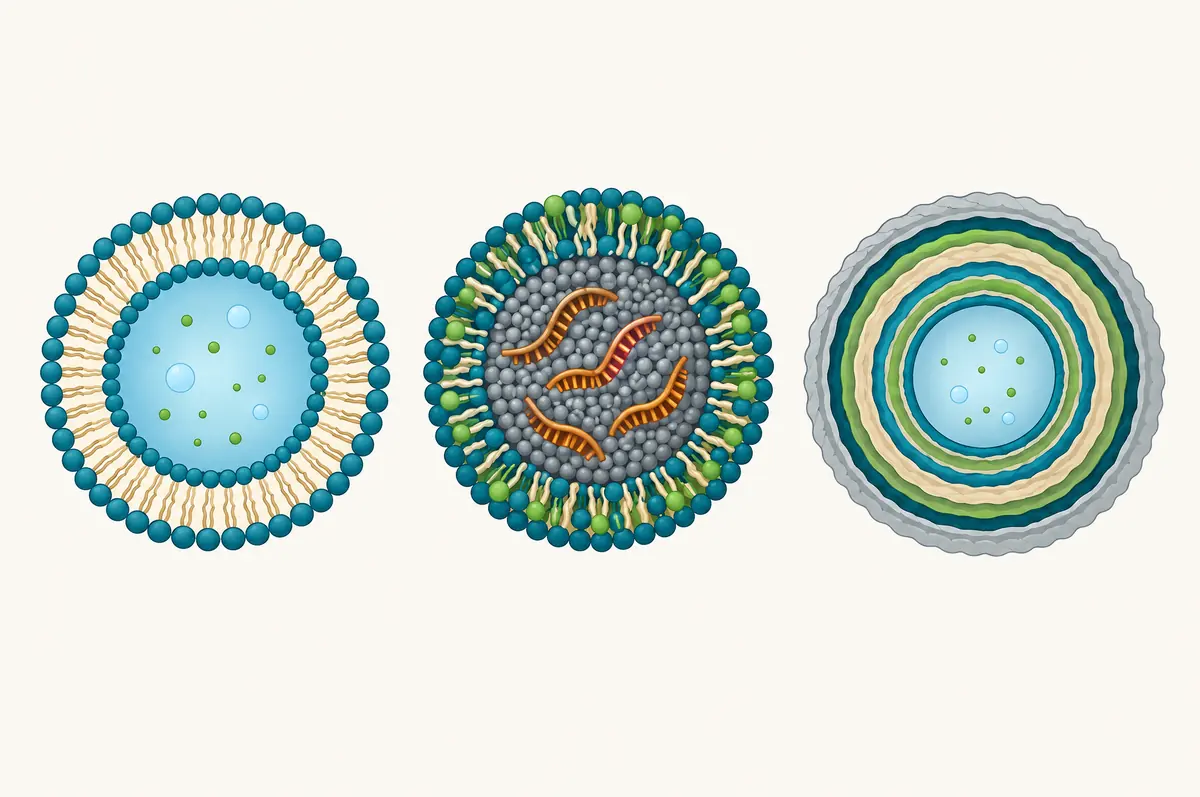
A liposome is one or more phospholipid bilayers enclosing an aqueous core, so hydrophilic payloads sit inside and lipophilic ones partition into the bilayer. Approved injectable liposomal products, including liposomal amphotericin B and liposomal doxorubicin, show the format works clinically when manufactured and stored properly. The weaknesses are practical: oxidation and hydrolysis of phospholipids, fusion and leakage during storage, sensitivity to freeze-thaw, and low physical stability in gastric conditions. Many consumer products described as liposomal are unclassified emulsions with no vesicle characterization at all.
Lipid nanoparticles
Lipid nanoparticles use an ionizable lipid, a helper phospholipid, cholesterol and a PEG-lipid to condense nucleic acid payloads and to protonate in the endosome, which drives release into the cytosol. This architecture is why mRNA vaccines and siRNA products work. It is also specialized: cold-chain requirements are common, ionizable lipid supply and characterization are demanding, and the endosomal escape mechanism brings no benefit to a small-molecule antioxidant. Choosing an LNP for a polyphenol is over-engineering with a cold chain attached.
Multi-layer polymer shells
Biopolymer layers deposited in sequence give a dry, handleable particle with independently assigned functions: acid resistance, diffusion control, mucoadhesion, oxidation exclusion. Shelf life is usually better than for phospholipid vesicles because there is no bilayer to oxidize or fuse. Payload flexibility is wide, covering thiols, cofactors, polyphenols, essential oils and peptides. The tradeoffs are encapsulation efficiency for very hydrophilic small molecules and the need to characterize release for each layer stack rather than relying on a platform default.
Choosing between them
Match the carrier to the dominant failure mode. Oxidation in storage and a dry format point to polymer layers. A nucleic acid needing cytosolic delivery points to an LNP. An injectable requiring an established regulatory precedent may point to a liposome. Route matters as much as payload, since an oral product must survive conditions an injectable never meets. Cost and supply chain finish the decision. A cold-chain carrier raises the landed cost of every unit, and a dry layered particle can be filled into several formats from one intermediate, which matters when a partner serves more than one market.
Key facts
- Liposomal amphotericin B and liposomal doxorubicin are approved injectable liposome products, establishing the format clinically (FDA labels, AmBisome 1997; Doxil 1995)
- Ionizable lipid nanoparticles enable endosomal escape of nucleic acid payloads, the basis of approved siRNA and mRNA products (FDA labels, Onpattro 2018; Comirnaty 2021)
- Phospholipid oxidation and hydrolysis are the principal chemical stability failure routes for liposome formulations (Grit and Crommelin 1993, Chem Phys Lipids 64:3)
- Approved liposome drug products are specified for vesicle size distribution, encapsulation and lipid quality, parameters that supplement labeling rules do not require (FDA guidance, Liposome Drug Products, 2018)
How our delivery technology applies
Vegalab's format is the multi-layer polymer shell, chosen because most of our payloads fail on oxidation, gastric survival or residence rather than on cytosolic entry. A dry, layered particle also ships without a cold chain and can be filled into capsules, sachets, ampoules or a cosmetic base with the same core, which matters to partners who must supply several markets from one batch.
Send us your payload profile and we will recommend the carrier class that fits.