


Vital Porphyrin Nano (In Development)
Vital Porphyrin Nano is a specialty nano-delivered active from the porphyrin class, the ring structures behind heme and chlorophyll. Porphyrins are hard to formulate because they stack into aggregates, react with light and dissolve poorly. The program is in development and not on sale; compound details are shared with partners under confidentiality.
Why porphyrins are difficult
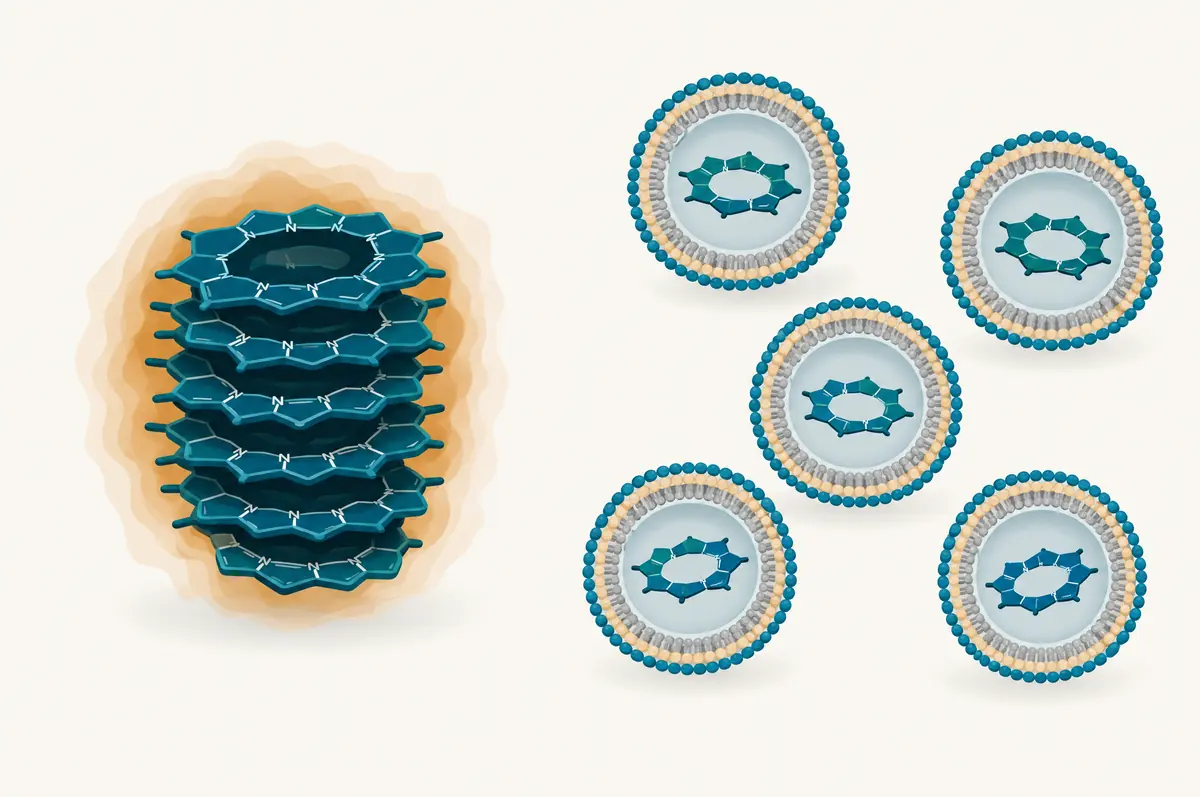
Porphyrins are flat, conjugated macrocycles. In water they self-associate by pi-stacking into aggregates that lose their characteristic activity and absorb light differently. Many are photosensitizers: when they absorb visible light they generate reactive oxygen species, which is the basis of photodynamic therapy but a stability and handling problem in consumer or nutritional formats. Metalloporphyrins also vary in stability with pH and chelation. Most porphyrins are also poorly water soluble, so conventional aqueous formats struggle to hold them at useful concentration.
How the class is used today
Porphyrin chemistry spans approved drugs and everyday ingredients. Verteporfin is an approved photosensitizer used in ophthalmology, aminolevulinic acid is approved to generate protoporphyrin IX in skin for photodynamic therapy, and sodium copper chlorophyllin is a permitted color additive in foods in several jurisdictions. These examples illustrate the chemistry of the class. Each illustrates a different formulation answer: liposomal infusion, topical gel and water-soluble salt, respectively.
Program status
The program is at formulation screening, measuring monomer retention in aqueous dispersion, photostability under standardized light exposure and release in simulated fluids. The regulatory route will depend on the final active and intended use, and is decided with the licensing partner. Statements have not been evaluated by the FDA and are not intended to diagnose, treat, cure or prevent any disease. Partners receive the screening data package and the proposed layer design under a confidentiality agreement.
Key facts
- Porphyrins aggregate in aqueous media, which alters their photophysical behavior and complicates formulation (Ethirajan et al. 2011, Chem Soc Rev)
- Verteporfin is FDA approved as a photosensitizer for photodynamic therapy (FDA label, Visudyne 2000)
- Aminolevulinic acid is FDA approved for photodynamic therapy of actinic keratoses (FDA label, Ameluz 2016)
- Sodium copper chlorophyllin is listed as a color additive exempt from certification (21 CFR 73.125)
How our delivery technology applies
The design goal is to keep porphyrin molecules apart and in the dark. A hydrophobic inner layer can host monomeric porphyrin and limit stacking, while an outer layer with UV and visible light attenuation slows photodegradation in the finished product. Because encapsulated porphyrins still interact with light at the target, the release profile and any light-triggered behavior are characterized before any format decision is made.
Partners can request the Vital Porphyrin Nano brief under NDA.
Related reading
Last updated: