


Oral Liquids and Shots
Last updated:
In a liquid, the problem is shelf life before it is absorption. Water drives hydrolysis, dissolved oxygen drives oxidation, and every off-taste is in direct contact with the tongue. Many popular actives (NMN, glutathione, NAC, vitamin C) degrade measurably in solution within weeks at room temperature.
Why liquids are hard
Water activity near 1 lets hydrolysis proceed; NMN breaks down toward nicotinamide, and glutathione and NAC oxidize to disulfides. Headspace oxygen, light and trace metals accelerate oxidation. Microbial growth requires preservatives or hot fill, and both can interact with actives. Taste matters more than in solids: sulfur notes from NAC and bitterness from berberine or peptides drive rejection. Lipophilic actives need an emulsion or dispersion that stays stable without creaming or phase separation over shelf life.
Shots, ampoules and single-serve formats
Single-serve shots and drinkable ampoules limit oxygen exposure after opening and allow nitrogen flushing and amber glass. They suit high-value actives where a daily fresh dose justifies packaging cost. Powder-in-cap and two-chamber formats keep an active dry until mixing, a practical alternative when liquid stability cannot reach a commercial shelf life. Stability programs follow ICH Q1A(R2) conditions for long-term and accelerated storage. Packaging is part of the formulation: oxygen transmission of the container often decides shelf life as much as the active does.
Regulatory framing
In most markets, oral liquids of nutrients are foods, supplements or natural health products, and some jurisdictions treat certain shot formats as beverages with different ingredient limits. Adding a pharmacologically active compound at drug-level doses moves the product toward medicine status. The Supplement, NHP or Drug page explains where that line sits by market. Beverage and shot formats also face labeling rules on caffeine, sugars and added nutrients that differ by market.
Key facts
- Stability testing uses long-term (25 C / 60% RH) and accelerated (40 C / 75% RH) storage conditions (ICH Q1A(R2) 2003)
- Glutathione readily oxidizes to glutathione disulfide (GSSG), and its oral absorption from plain formats is poor (Witschi et al. 1992, Eur J Clin Pharmacol 43:667)
- EU food supplement law allows liquid forms such as ampoules and drop dispensers (Directive 2002/46/EC, Article 2)
How our delivery technology applies
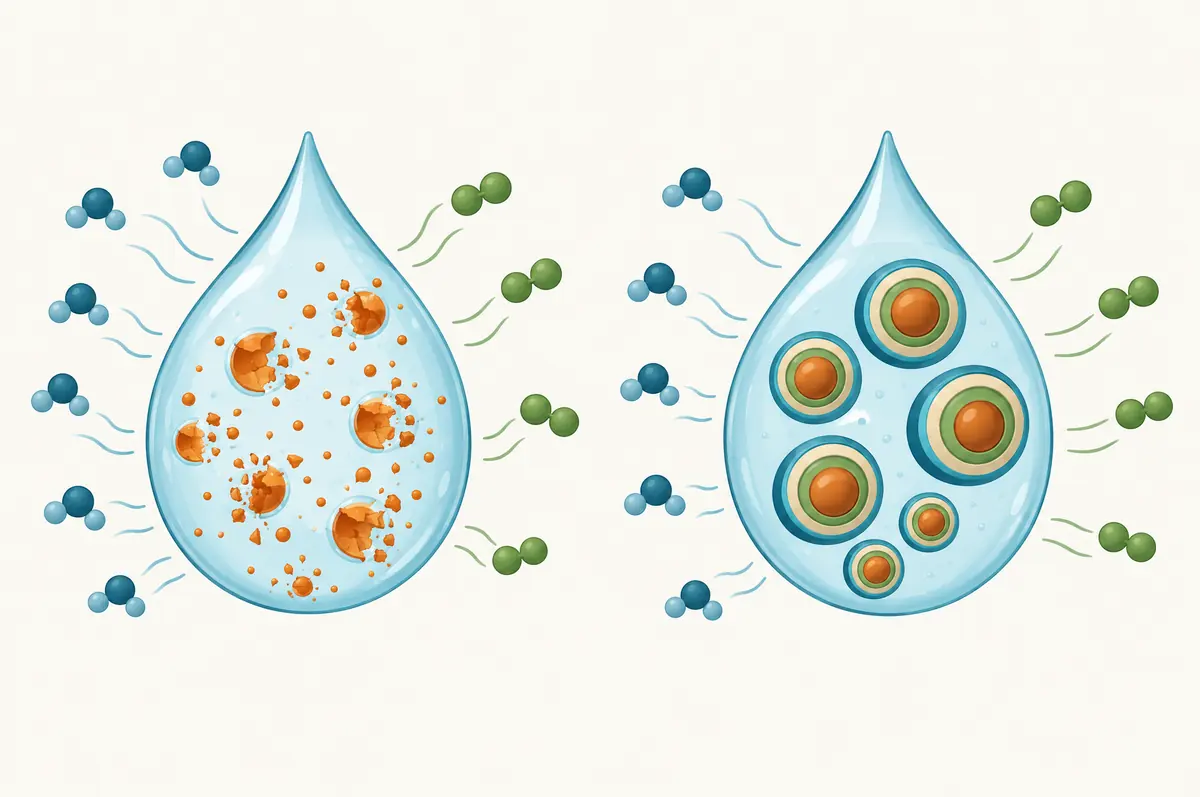
In liquids, the multi-layer shell is a barrier between the active and the water phase. It reduces contact with dissolved oxygen and slows hydrolysis, and an outer layer can mask taste until the particle reaches the gut. For lipophilic actives the encapsulated particle replaces a fragile emulsion with a dispersed solid. Stability gains are verified by assay at ICH time points.
Solve a liquid stability problem with Vegalab: request a feasibility study.