


Livestock Drinking Water Systems
Water quality at the source is rarely water quality at the nipple or bowl. Warm water, low flow, and sugars or vitamins dosed through the line build biofilm that shelters bacteria and blocks drinkers. A water program measures at the end of the line, cleans between batches and holds a steady oxidant residual during production.
Why lines foul
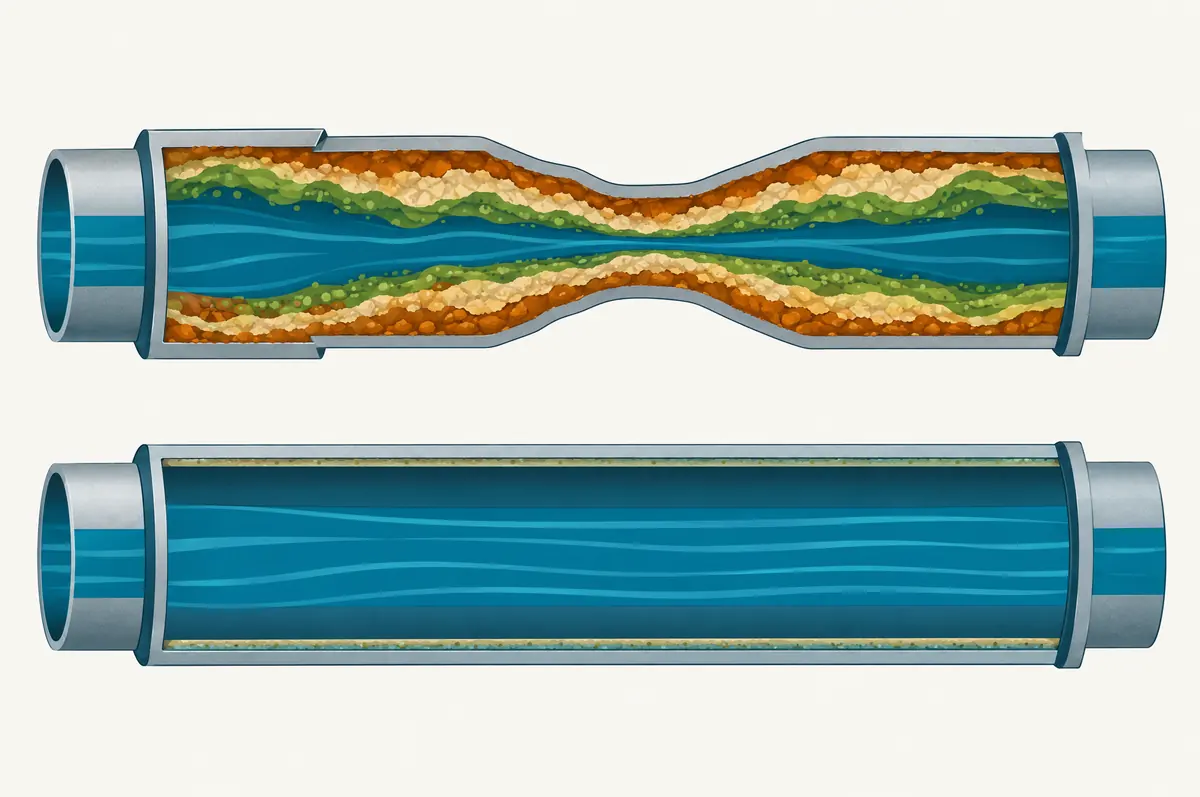
Poultry and pig drinking systems run at low flow through small-bore pipe in warm houses. Minerals scale the lines, and dissolved nutrients from medications, electrolytes and vitamins feed bacterial growth. Biofilm forms on the inner wall within days and protects bacteria from disinfectants that would kill them in open water. Sections of biofilm slough off, reseed the system, and clog nipples and regulators. Iron and manganese add deposits that consume oxidants.
What to measure
Test at the source and at the end of the farthest line: pH, hardness, iron, manganese, total bacteria and oxidant residual. Oxidation-reduction potential (ORP) is a practical proxy for sanitizer activity. pH affects most sanitizers; chlorine loses activity as pH rises above neutral, while chlorine dioxide stays effective across a wider range. Swabbing the inside of a line at a drop point shows biofilm directly. Record results on a fixed schedule, because slow drift in residual or pH is easier to catch than a sudden failure.
Cleaning between batches, residual during production
The high-concentration clean happens with animals absent: flush, fill with a shock solution, hold, then flush thoroughly until residual returns to drinking level. During production, a low continuous residual limits regrowth. Run a flush after any medication or vitamin program. Sanitizer levels during production are limited by palatability and by what animals will accept, so measure water intake when changing programs. Keep acids and oxidants in separate steps and separate dosing equipment, since mixing them can release hazardous gas.
Key facts
- Broilers at about 21 C (70 F) typically drink 1.6 to 1.8 times as much water as feed by weight, so water intake is a key production indicator (Aviagen 2025, AviagenBrief: Water Utilization in Broilers).
- For human drinking water the maximum residual disinfectant level for chlorine dioxide is 0.8 mg/L and the MCL for its by-product chlorite is 1.0 mg/L (40 CFR 141.65 and 141.64).
- Chlorine dioxide disinfection is less dependent on pH than free chlorine, because hypochlorous acid (pKa about 7.5) dissociates to the weaker hypochlorite ion as pH rises (US EPA 1999, Alternative Disinfectants and Oxidants Guidance Manual, EPA 815-R-99-014).
- Chlorine dioxide does not form trihalomethanes or haloacetic acids by reaction with organic matter (US EPA 1999, EPA 815-R-99-014).
How our delivery technology applies
Chlorine dioxide is the preferred oxidant for biofilm but usually requires generation on site from precursors. Vetpure Disinfectant stabilizes it as a nano-encapsulated powder that dissolves to at least 98% ClO2 purity and stays stable in solution for up to one month. Units can prepare a stock at a known concentration for both shock cleans and maintenance dosing, without precursor handling or generator maintenance, and without forming THMs, HAAs or HANs.
Send us your water test results for a line sanitation program.
Related reading
Last updated: