

What is chlorine dioxide used for?
Last updated:
Chlorine dioxide (ClO2) is a selective oxidant disinfectant: a neutral molecule and true dissolved gas rather than a chlorine donor. It is used against bacteria, viruses, fungi and protozoa on hard surfaces, against biofilm in water lines and drinkers, and in municipal water treatment. It forms no trihalomethanes or haloacetic acids and stays active across a wide pH range.
Chlorine dioxide (ClO2, CAS 10049-04-4) is a selective oxidant that disinfects without forming the chlorinated by-products chlorine does. It is a neutral molecule and a true dissolved gas, not a chlorine donor, which is why it stays active across a wide pH range and penetrates biofilm. Its limits are handling and the fact that it leaves no residual once consumed.
How does chlorine dioxide work?
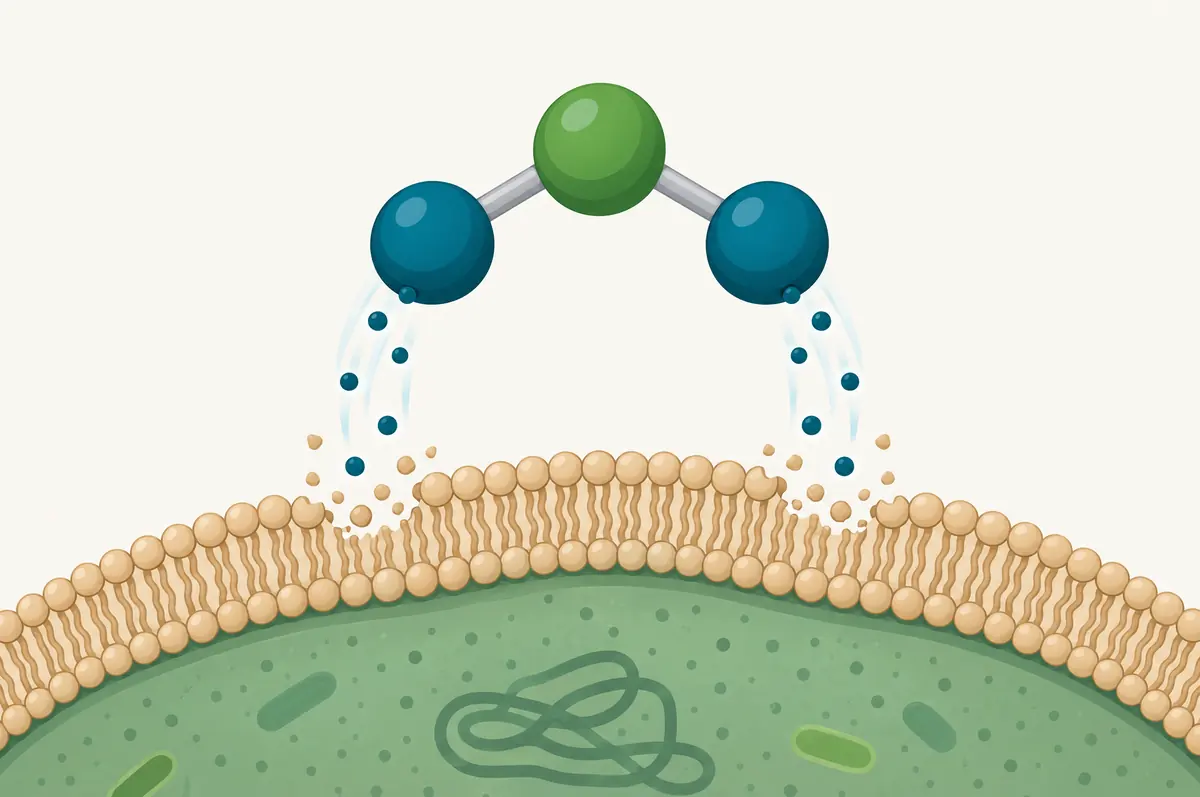
ClO2 accepts five electrons per molecule on reduction to chloride, compared with two for chlorine, though it reacts more selectively. It oxidizes sulfur-containing amino acids such as cysteine and methionine, aromatic amino acids such as tyrosine and tryptophan, and peptidoglycan and membrane structures. Because it reacts by electron transfer rather than chlorine substitution, it does not chlorinate organic matter and forms no trihalomethanes or haloacetic acids. Its activity depends far less on pH than free chlorine's.
Where is chlorine dioxide used?
ClO2 is used against bacteria, viruses, fungi and protozoa on hard surfaces, and against biofilm in water lines and drinkers, where it outperforms free chlorine. It is also used in municipal water treatment. Products on this site include Vetpure Disinfectant for premises and PureTabs, an FDA-registered over-the-counter drug product (NDC 85289-102) for water purification. Pathogen claims depend on each product's registration in the relevant jurisdiction. Water treatment use at municipal scale gives ClO2 a long operating record and published data on by-products and residuals.
What are the limits of chlorine dioxide?
ClO2 does not remove organic soil, provide residual protection once consumed, work instantly without contact time, or compensate for a persistent contamination source. Heavy organic load, sunlight, heat and open containers all reduce concentration. Mixing with acids or other chemicals can release gas at hazardous concentrations. Workplace exposure limits for ClO2 gas are low, so ventilation and label handling instructions matter. Sensitive materials such as some rubbers and metals can be affected by prolonged exposure, so check equipment compatibility.
Key takeaways
- Chlorine dioxide (CAS 10049-04-4) is a selective oxidant, not a chlorine donor.
- It accepts five electrons per molecule on reduction to chloride, against two for chlorine.
- It forms no trihalomethanes or haloacetic acids, and its activity depends far less on pH than free chlorine's.
- It leaves no residual once consumed and does not remove organic soil.
- The OSHA permissible exposure limit for chlorine dioxide gas is 0.1 ppm as an 8-hour TWA.
Key facts
- Chlorine dioxide disinfection is less dependent on pH than free chlorine, and chlorine dioxide does not form THMs or HAAs (US EPA 1999, Alternative Disinfectants and Oxidants Guidance Manual, EPA 815-R-99-014).
- The maximum residual disinfectant level for chlorine dioxide in US public drinking water is 0.8 mg/L, and the chlorite MCL is 1.0 mg/L (40 CFR 141.65 and 141.64).
- The OSHA permissible exposure limit for chlorine dioxide is 0.1 ppm as an 8-hour TWA (29 CFR 1910.1000, Table Z-1).
- Chlorine dioxide has been shown to inactivate bacteria in drinking water biofilms (Gagnon et al. 2005, Water Res 39:1809).
How our delivery technology applies
ClO2 is normally generated on site from sodium chlorite and acid because the gas cannot be shipped or stored as a solution for long. Vegalab nano-encapsulates it as a stabilized powder that dissolves to at least 98% ClO2 purity, with solutions stable for up to one month. That removes generator equipment and precursor handling, and gives a known working concentration, without forming THMs, HAAs or HANs.
Questions
How is chlorine dioxide different from chlorine?
It reacts by electron transfer rather than chlorine substitution, so it does not chlorinate organic matter and forms no trihalomethanes or haloacetic acids. Its activity depends far less on pH than free chlorine's, and it outperforms free chlorine against biofilm in water lines and drinkers.
What are the drinking water limits for chlorine dioxide?
In US public drinking water, the maximum residual disinfectant level for chlorine dioxide is 0.8 mg/L. The maximum contaminant level for chlorite, the residual of concern, is 1.0 mg/L.
Is chlorine dioxide gas hazardous to breathe?
Concentrated chlorine dioxide gas is a respiratory irritant and hazardous at elevated airborne concentrations. The OSHA permissible exposure limit is 0.1 ppm as an 8-hour TWA, so ventilation and label handling instructions matter, and mixing it with acids or other chemicals can release gas at hazardous concentrations.
Why is chlorine dioxide usually generated on site?
The gas cannot be shipped or stored as a solution for long, so it is normally generated on site from sodium chlorite and acid. Heat, sunlight, open containers and heavy organic load also reduce its concentration once made.
Request a Vetpure Disinfectant technical data sheet or sample.
| Who or what | Rating | Why |
|---|---|---|
| Applicator | caution | Concentrated chlorine dioxide gas is a respiratory irritant and hazardous at elevated airborne concentrations. Occupational exposure limits exist; enclosed-space application requires ventilation and monitoring. |
| Children | caution | Use-dilution water treatment has a long regulatory history. Chlorite is the residual of concern and is separately regulated in drinking water. |
| Fish and aquatic life | avoid | Oxidant; do not discharge treated water containing residual to surface water without neutralisation. |