


Biofilm in Livestock Drinking Water Lines
Last updated:
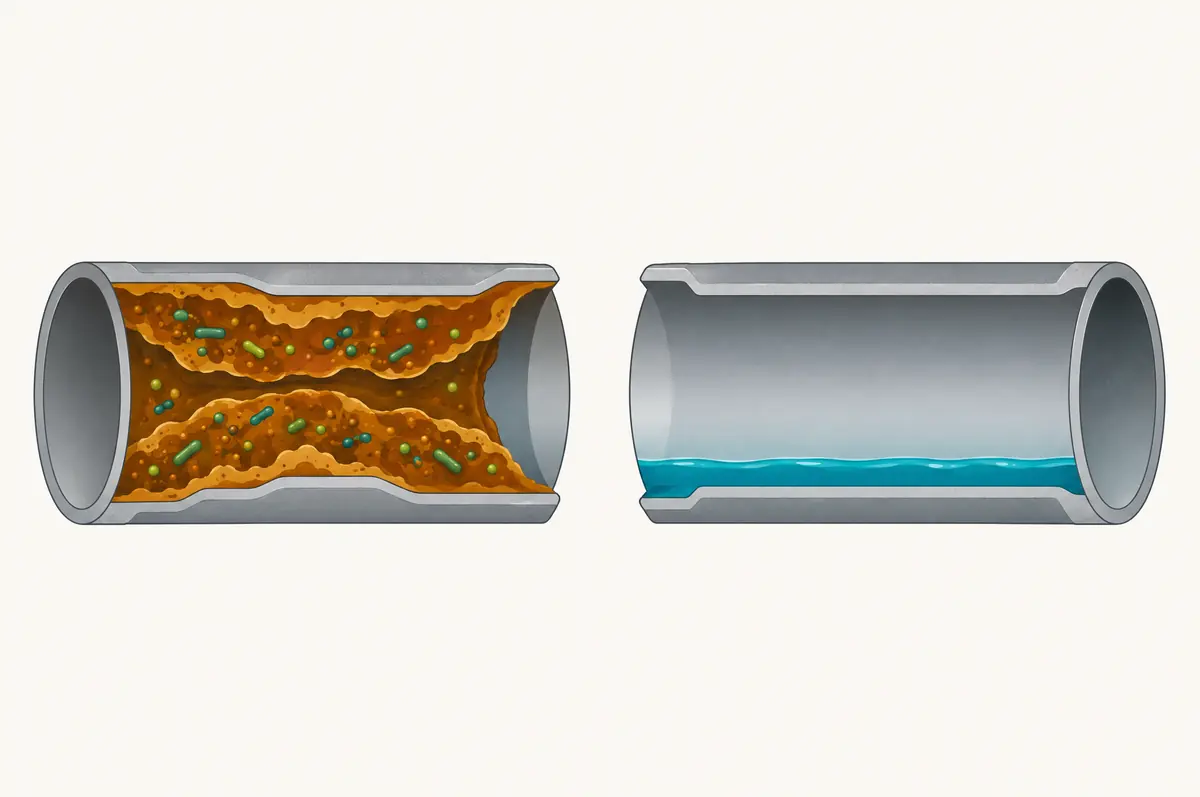
Warm, slow-moving water, vitamins and water-soluble medications feed biofilm inside drinker lines. Biofilm shelters bacteria and fungi from residual sanitizers, blocks nipples and reduces water intake. Removal needs a high-strength cleanout between cycles and a low, steady residual during production.
How biofilm forms
Bacteria attach to pipe walls within hours and secrete an extracellular polymer matrix. In poultry houses, lines run at low flow, water sits near house temperature, and additives such as vitamins, electrolytes, sugars and acidifiers supply nutrients. Mineral scale from hard water gives a rough surface that biofilm colonizes readily. Biofilm sloughs periodically, releasing cells and debris that clog regulators and nipples. Sanitizer residual measured at the end of a line is often far below the level dosed at the header.
Chlorine versus chlorine dioxide
Free chlorine is effective as hypochlorous acid, which dominates below about pH 7.5; above that, activity falls as hypochlorite. Chlorine reacts with organic matter to form trihalomethanes and haloacetic acids. Chlorine dioxide keeps activity across a wider pH range, penetrates biofilm matrix better, and does not form those chlorinated organics. Its principal residual is chlorite, which is regulated in drinking water. Neither works on a line packed with scale unless an acid descale comes first.
Between-cycle and in-cycle programs
Between flocks or groups: flush, descale with an acid product if scale is present, fill lines with a high-strength oxidizer for the labeled contact time, flush again and verify with a swab or visual check at the line end. During production: dose a low residual continuously and measure it at the farthest drinker, not the header. Always check compatibility with vaccines and medications, which chlorine dioxide and chlorine can inactivate.
Key facts
- Chlorine dioxide maximum residual disinfectant level in drinking water is 0.8 mg/L and the chlorite maximum contaminant level is 1.0 mg/L (40 CFR 141.65 and 141.64)
- Hypochlorous acid has a pKa of about 7.5, so free chlorine loses activity as pH rises (EPA 1999, Alternative Disinfectants and Oxidants Guidance Manual, EPA 815-R-99-014)
- Biofilm bacteria show markedly higher tolerance to antimicrobial agents than planktonic cells (Costerton, Stewart and Greenberg 1999, Science 284:1318)
- Chlorine dioxide does not form trihalomethanes with natural organic matter (EPA 1999, Alternative Disinfectants and Oxidants Guidance Manual, EPA 815-R-99-014)
How our delivery technology applies
The obstacle to using chlorine dioxide in water lines on farms is supply: it is conventionally generated on site from chlorite and acid, which needs equipment and training. Vetpure's nano-encapsulated powder dissolves directly to at least 98% pure ClO2, and the solution stays stable for up to one month. A farm can prepare a stock, dose from it with a standard medicator, and hold a consistent residual without a generator.
Ask for a water line sanitation program built around Vetpure for your production system.