


Thymol
Last updated:
Thymol (2-isopropyl-5-methylphenol, CAS 89-83-8) is a phenolic monoterpene from thyme oil with antimicrobial, antifungal and acaricidal activity. It is the active in registered varroacides and some registered disinfectants. Unlike thyme oil, thymol is not on the FIFRA 25(b) list, so products using it as an active require registration.
Properties and mode of action
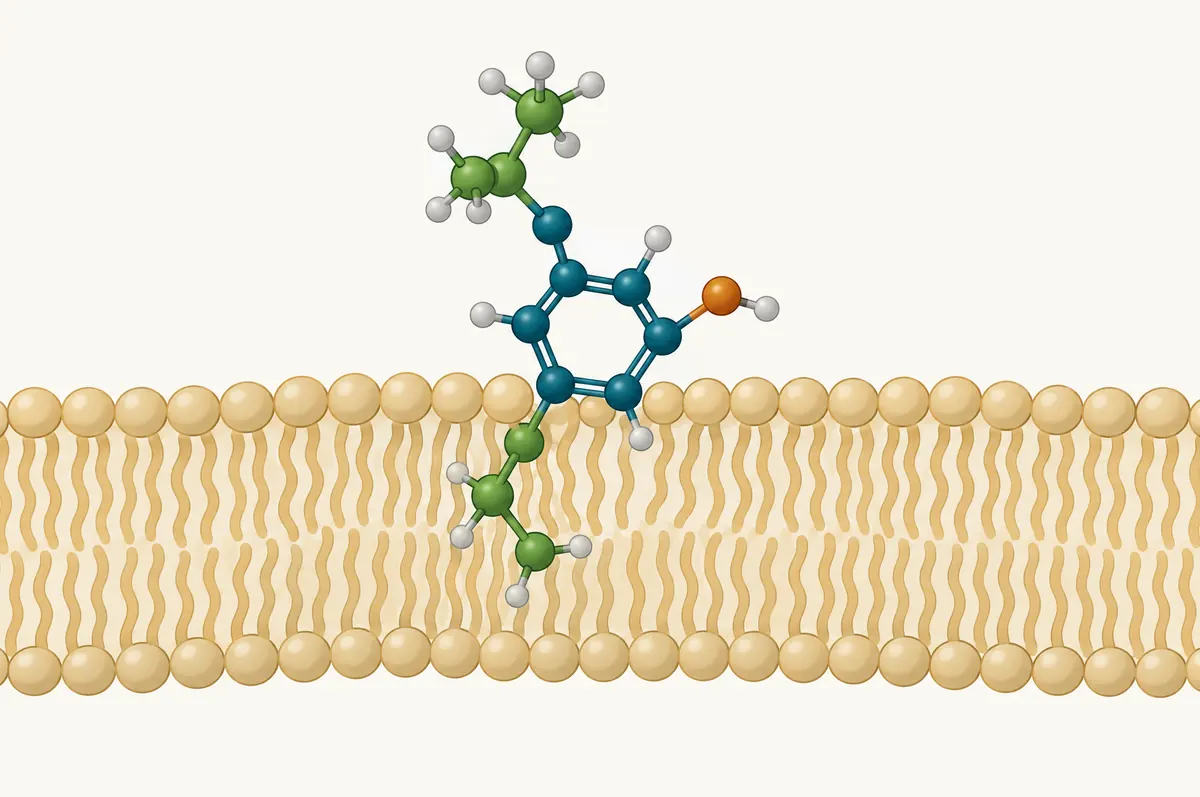
Thymol is a crystalline phenol with low water solubility and a strong odor. It partitions into lipid membranes, increasing permeability and disrupting membrane proteins in bacteria and fungi. In arthropods it acts on GABA receptors and membranes. Its low water solubility and volatility shape how it is delivered: slow-release gels in hives, and solvents or emulsions elsewhere. Vegalab Spore Control uses thymol at 1% for crop fungal disease. Its phenolic structure also explains its antimicrobial breadth.
Registered uses
Thymol is the active in varroacides such as Apiguard, a slow-release gel, and is a component of Api Life Var with eucalyptol, menthol and camphor. In the US, EPA registers thymol-based antimicrobial products for hard surfaces. These uses are registered, product-specific and not transferable to other formulations. None of Vegalab's products is registered for hive use. Hive product dosing is set by the varroacide label and national veterinary authorities. Any Vegalab use of thymol on premises requires its own registration.
Limits and species sensitivity
Thymol is a phenol, and cats clear phenols poorly, so products containing it should not be used where cats are present. At high concentrations it can irritate skin and mucous membranes and harm bee brood. Its antimicrobial activity is reduced by organic matter like other disinfectants. High temperatures increase evaporation from gels and surfaces. Store thymol products cool and sealed, since the crystals sublime and lose strength over time. Keep it out of waterways.
Key facts
- Thymol is not a permitted 25(b) active; only thyme and thyme oil are listed (40 CFR 152.25(f)(1)).
- Thymol is the active substance in Apiguard, authorized for the treatment of varroosis in honey bees (VMD, UK Product Information Database, Apiguard).
- Thymol disrupts bacterial membranes, increasing permeability to ions and small molecules (Lambert et al. 2001, J Appl Microbiol 91:453).
- Cats are deficient in UDP-glucuronosyltransferase isoforms that clear phenolic compounds (Court 2013, Vet Clin North Am Small Anim Pract 43:1039).
How our delivery technology applies
Thymol's delivery problems are low water solubility and sublimation from surfaces. Multi-layer nano-encapsulation disperses it in water as fine particles without high solvent loads, and slows its loss from treated surfaces, extending contact time. This is the delivery system behind Spore Control, and the reason thymol is a candidate for premise antifungal work subject to registration.
Registrants and formulators: discuss encapsulated thymol with our team.