


How do you clean a chicken coop with mites?
Last updated:
Move the birds out, strip all litter, nesting material and manure, scrape every surface, wash with detergent and hot water, and let the coop dry. Then treat every crack, roost end, wall and nest box with a product labeled for poultry premises, and re-treat every 4 to 7 days, because poultry red mites (Dermanyssus gallinae) live in the structure and new mites keep hatching1,5.
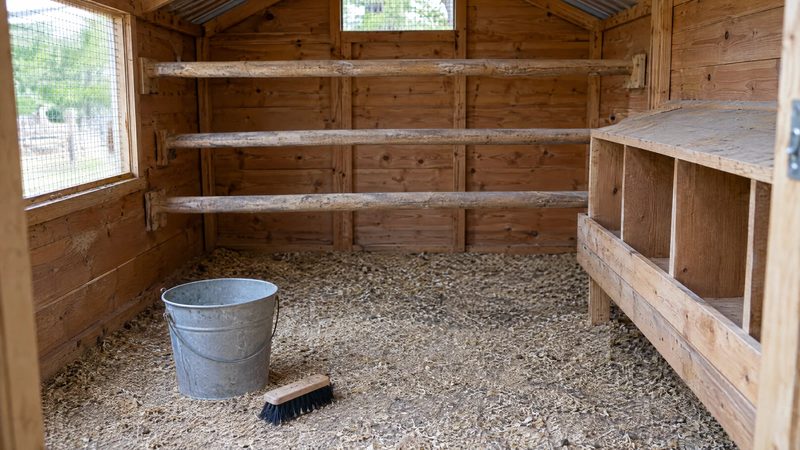
Why does a coop with mites need more than a routine clean?
The poultry red mite, also called the chicken mite, does not live on the birds1. By day it hides in dark cracks and crevices in roosts, walls, ceilings and floors, and it comes out at night to feed1. It lays its eggs in those same hiding places, and its life cycle can be completed in as few as seven days2. Adults resist starvation and can survive without feeding for up to six months1, and some sources report up to eight months2. A poultry house can remain infested for up to 9 months after the birds are removed3, so emptying the coop alone will not clear the mites2.
The northern fowl mite (Ornithonyssus sylviarum) lives on the birds, but it survives off them for a couple of weeks, so the nesting area, roosts, cracks and crevices need treating too1. Scaly leg mites also survive in the poultry house1.
| Mite | Where it hides | Survival without a bird | What the cleanout must reach |
|---|---|---|---|
| Poultry red mite (Dermanyssus gallinae) | Cracks in roosts, walls, ceilings and floors; feeds at night1 | Up to six months1, or up to eight months2 | Every crack, roost, wall and ceiling1 |
| Northern fowl mite (Ornithonyssus sylviarum) | On the birds, mostly near the vent1 | A couple of weeks1, up to 4 weeks3 | Birds plus nest area, roosts and crevices1 |
| Scaly leg mite (Knemidokoptes mutans) | Under leg scales; also survives in the house1 | Not stated in these sources | Nesting area, roosts, cracks and crevices1 |
In North America, plan the deep cleanout for spring, before warm weather speeds up red mite breeding; red mite populations develop rapidly in warmer months3, while northern fowl mites are more active in cooler weather, around 65 to 68 degrees F7. In the Southern Hemisphere, the same cleanout falls in September to November.
How do you clean a chicken coop with mites, step by step?
Plan the deep clean for when the coop is empty, because hiding places that cannot be reached with hens present can then be cleaned thoroughly4. Work in this order:
- Move the birds out and take out feeders, waterers and other equipment5.
- Remove all organic material: manure, litter, feathers, feed and nesting material from the nest boxes5. On a dirt floor, remove the top 3 cm (about 1 inch) of soil with it5. Compost or burn the material as local rules allow, and move it well away from the house5,6.
- Scrape and sweep all surfaces, including walls, ceiling, roosts, floors and ramps5.
- Wash with detergent and hot water, using a pressure washer or a garden hose and scrub brush5. Cleaning with hot water and soap is strongly advised over dry cleaning alone4, and hot water and steam are effective for cracks and crevices8.
- Rinse, then let the coop and equipment dry completely, in the sun if possible5.
- Treat for mites. Apply a product labeled for poultry to the inside of the house, paying special attention to every crack and crevice, roosts, walls and ceilings, and follow the product label1. Mite products can be applied after cleaning and disinfection6.
- If you also disinfect, do it on dry, clean surfaces, because most disinfectants are inactivated by organic material5.
What kills mites in a chicken coop?
Use only a product whose label states it is approved for use in poultry, and follow all label instructions, including protective equipment and any withholding time for eggs and meat1. Spraying or dusting the inside of the house and all hiding places, such as behind nest boxes and in cracks, is how infested houses are brought under control3. Many countries now restrict which acaricides can be used, and red mite populations resistant to acaricides have emerged2.
Inert dusts such as food-grade diatomaceous earth and synthetic amorphous silica can be effective; apply them only in well-ventilated areas and wear a dust mask3. Their effect drops sharply at humidity above 85%, silica alone is often not enough to control red mites, and mechanical cleaning of surfaces before applying silica improves its efficacy4. Heat works too: a temperature above 45 degrees C (113 degrees F) is lethal to red mites, and empty layer houses are heated gradually above that for at least 2 days, though not every structure withstands the heat4,2.
For an essential-oil premise option, Vetpure Miticide is a nano-emulsified concentrate of plant essential oils for mites and lice in poultry and animal housing, applied to structures, perches, nest boxes, bedding and surroundings, not to animals, and its label sets the dilution, application sites and re-treatment interval.
How often should you re-treat the coop, and how do you check it worked?
Recommended treatments do not kill northern fowl mite eggs, and red mites go from egg to adult in 7 to 14 days, so re-treat the flock and the house every 4 to 7 days1.
Monitoring shows when to treat and whether treatment worked4. Red mites are rarely seen on birds by day, so examine the birds closely at night or search the nests, cracks and litter2. Corrugated cardboard traps placed in mite hiding spots are one of the most popular monitoring tools; before counting, traps are sealed in plastic bags and frozen for at least 2 days to kill the mites4. Place traps at exactly the same spots each time so counts can be compared4. On the birds, look for northern fowl mites by parting the feathers around the vent1.
How do you keep mites from coming back after cleaning?
Red mites thrive where there are many crevices, so seal cracks tightly and avoid fittings that are hard to clean4. Easy-to-clean roosts and nest boxes with few hiding places help, and housing should be cleaned and inspected regularly7. Quarantine new birds for 2 weeks and inspect them for mites before they join the flock7.
Mites arrive on wild birds, rodents and other animals1, and they travel on egg flats, crates, coops and people moving between houses3. In commercial houses, the cleaning and treatment done while the house is empty strongly influences when mites first reappear in the next flock: farms that combined dry cleaning, wet cleaning and a treatment saw later re-infestation than farms with less thorough routines4. After drying, leave the coop empty for at least 3 weeks before birds return if you can5, but remember that downtime by itself will not starve red mites2.
How do you protect yourself and other animals while cleaning a mite-infested coop?
Bird mites crawl onto people and bite7, and people are a main route by which mites spread, so dedicated clothing and boots are a basic hygiene measure4. Change and launder them after the cleanout. Wear gloves and eye protection when mixing and applying cleaning and disinfecting chemicals, and wash your hands afterward even if you wore gloves8. Wear a dust mask when applying diatomaceous earth3.
Rinse disinfectants away after their contact time, because most can harm animals, especially around feed and water equipment8. Keep animals out of the treated area until it has dried completely, ideally overnight8. For any mite product, the label sets when birds and pets may return1.
Key takeaways
- Poultry red mites live in the coop structure and survive for months without birds, so the building must be cleaned and treated, not only the flock.
- Clean in order: remove birds and equipment, strip organic matter, scrape, wash with detergent and hot water, dry, then treat.
- Re-treat every 4 to 7 days, because common treatments do not kill northern fowl mite eggs and red mites mature in 7 to 14 days.
- Diatomaceous earth and silica help but weaken in humid coops; heat above 45 degrees C (113 degrees F) kills red mites in an empty house.
- Seal cracks, choose easy-to-clean roosts and nest boxes, and quarantine new birds for 2 weeks.
References
- External Parasites of Poultry
- Chicken Mite (Other Common Names: Poultry Red Mite, Roost Mite) Dermanyssus gallinae (De Geer) (EENY611/IN1070)
- Mites of Poultry
- Possibilities for IPM Strategies in European Laying Hen Farms for Improved Control of the Poultry Red Mite (Dermanyssus gallinae): Details and State of Affairs
- Cleaning and disinfecting backyard poultry flock premises
- Checklist for Effective Poultry House Cleanout (Commercial Egg Tip)
- Bird mites (Pestsense fact sheet)
- Disinfection 101: Key Principles of Cleaning and Disinfection for Animal Settings