

Terminal Cleandown Between Flocks
Last updated:
A terminal cleandown succeeds or fails on sequence and drying, not on the disinfectant. Remove organic matter completely, wash with detergent, let the house dry, then disinfect for full contact time and verify with swabs. The depopulation window is also the best time to treat red mite, darkling beetle and water lines.
Immediately after depopulation
While the house is still warm, treat for insects and mites before they migrate into walls and insulation as it cools. Darkling beetles and poultry red mites move out of litter and into cracks within hours of birds leaving. Drain and begin the water line clean. Remove all litter and manure, then dry clean: scrape, brush and blow down dust from beams, fans, inlets and feed lines. Every gram of residue left consumes disinfectant later.
Wash, dry, disinfect
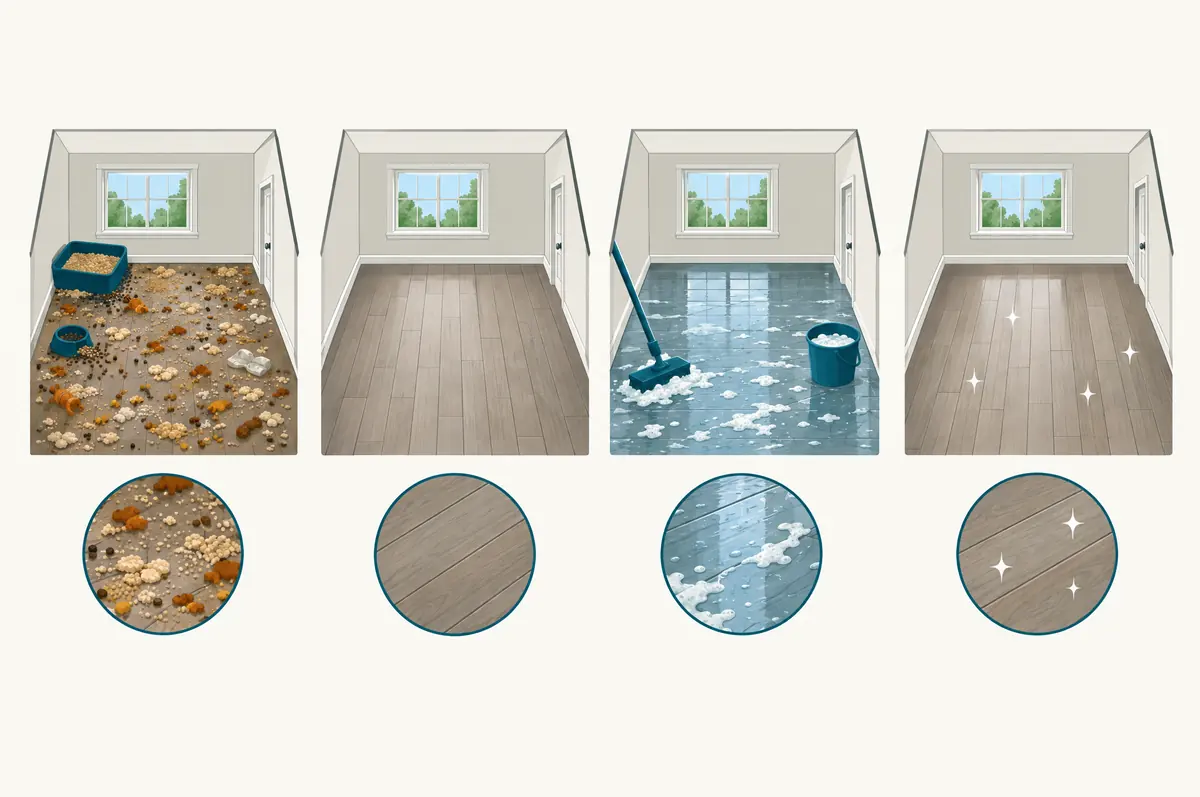
Soak surfaces with a detergent to loosen biofilm and fat, then pressure wash from top to bottom and from the back of the house to the door. Rinse and let the house dry fully; water left on surfaces dilutes the disinfectant below its label concentration. Apply disinfectant at label dilution to all surfaces, including equipment removed for washing, and keep surfaces wet for the full contact time. Seal and dry again before setting fresh litter.
Verify and record
Swab defined points after disinfection: drinkers, feeders, floor cracks, fan housings and door frames. Visual cleanliness is not proof. Where Salmonella control programs apply, sampling follows the national scheme. Record detergent and disinfectant products, dilutions, contact times, dates and swab results, so the next cleandown targets the points that failed. A downtime period after disinfection adds margin before restocking. Review failed swab points with the wash crew before the next flock, since most failures trace back to the dry clean or to surfaces that were not reached by the pressure washer.
Key facts
- EU Salmonella control programs for breeding, laying and broiler flocks set sampling requirements that include testing after cleaning and disinfection in some member-state schemes (Regulation (EC) No 2160/2003).
- Organic matter must be removed before disinfection because it inactivates or shields against disinfectants (WOAH Terrestrial Code, ch. 4.14).
- Poultry red mite hides in cracks and crevices off the host and can survive for months without feeding, which is why treating empty houses matters (Sparagano et al. 2014, Annu Rev Entomol 59:447).
- Darkling beetle (Alphitobius diaperinus) larvae burrow into insulation and soil beneath houses to pupate, causing structural damage (Axtell and Arends 1990, Annu Rev Entomol 35:101).
How our delivery technology applies
Two limits define the disinfect step: the working solution must be at full strength, and surfaces must stay wet long enough. Vetpure Disinfectant dissolves from a stabilized nano-encapsulated powder to at least 98% ClO2 purity and remains stable in solution for up to one month, so a house can be treated from one prepared batch at a known concentration. ClO2 tolerates residual ammonia and forms no THMs, HAAs or HANs on contact with organic matter.
Request a cleandown checklist and swab plan for your houses.