


Does diatomaceous earth work on chicken mites?
Last updated:
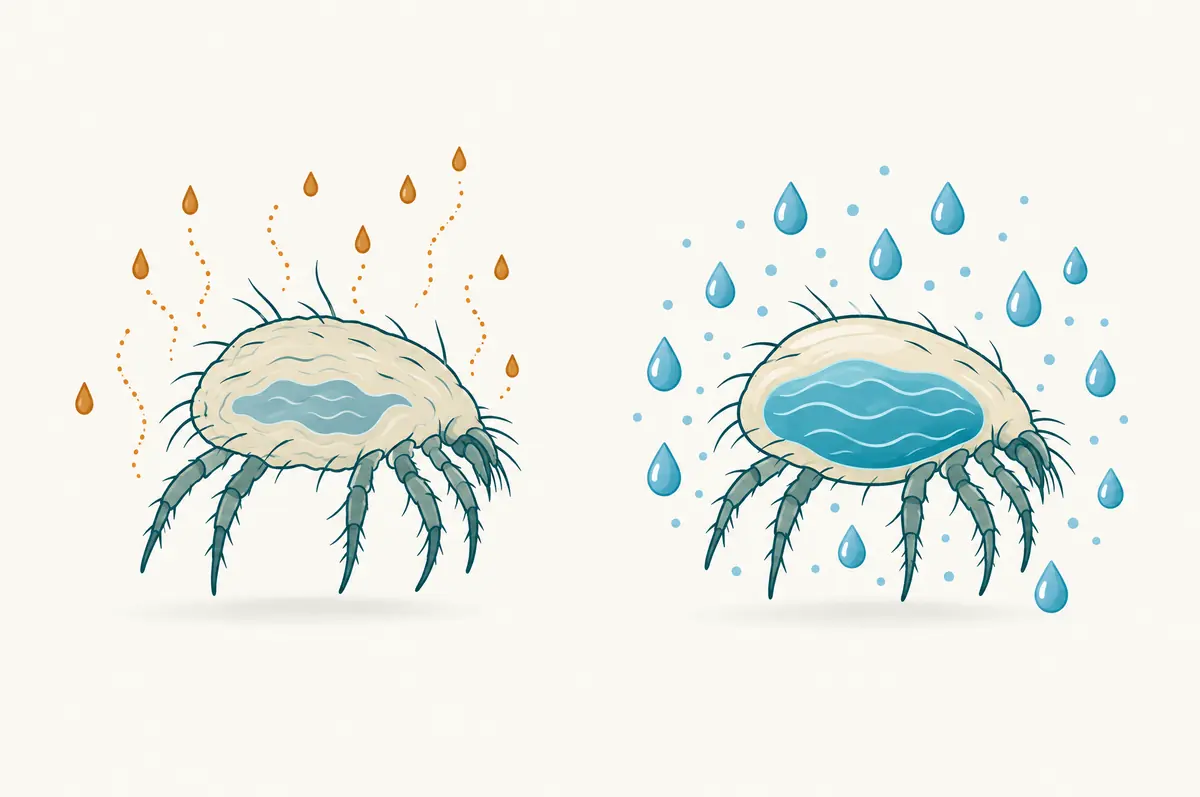
Only in dry conditions. Diatomaceous earth kills poultry red mite (Dermanyssus gallinae) by stripping cuticular wax so the mites dry out over days, which needs dry air. In humid coops and layer houses its efficacy drops sharply, and dust treatments are slower and less complete than chemical options. The fine dust also irritates the airways of birds and keepers.
Diatomaceous earth kills mites by stripping cuticular wax so they dry out, and that only works when the air is dry. In humid coops and layer houses, efficacy against poultry red mite drops sharply, and the fine dust adds respiratory load for birds and keepers.
How is diatomaceous earth supposed to work?
Diatomaceous earth is the fossilized silica skeletons of diatoms. Its particles adsorb lipids from the arthropod epicuticle and abrade it, so the animal loses water faster than it can replace it. Death follows from desiccation over days. The mode of action is physical, which is why resistance is not expected and why DE is widely used by backyard keepers and in organic systems. It is used both as a dust and, in some products, as a liquid suspension that dries onto surfaces.
Why does humidity defeat diatomaceous earth?
Desiccation depends on a gradient between the arthropod and the air. At high relative humidity the gradient shrinks and mites lose water slowly. DE particles also adsorb atmospheric moisture, which fills pore space and reduces their capacity to take up cuticular lipid. Stored-product research consistently shows reduced DE efficacy as humidity rises, and poultry red mite work shows dust treatments are slower and less complete than chemical options. Coops with wet litter, poor ventilation or winter condensation are the worst case.
What are the dust and exposure risks?
Fine DE dust is an inhalation irritant for birds and people, especially during application in enclosed coops. Calcined grades contain crystalline silica. Use natural, uncalcined grades if used at all, apply with birds out, and wear a dust mask. Keep dust away from feed and water. Birds with existing respiratory issues are more affected, and repeated heavy dusting in poorly ventilated coops raises airborne particulate for everyone working inside. Dust also settles on eggs and equipment.
What works instead?
Poultry red mite hides in crevices, perches and nest boxes, so control starts with cleaning and reducing refuges. Combine mechanical cleaning, targeted crevice treatment with a labeled acaricide, monitoring traps, and repeat treatment timed to the mite life cycle. Integrated mite management describes a full program for layer houses and coops. Monitoring with simple cardboard or tube traps tells you whether numbers are actually falling, which DE alone rarely confirms.
Key takeaways
- Diatomaceous earth kills mites physically, by desiccation over days, so resistance is not expected.
- High humidity shrinks the drying gradient and loads the particles with moisture, cutting efficacy.
- Coops with wet litter, poor ventilation or winter condensation are the worst case.
- Fine dust is an inhalation irritant for birds and people, and calcined grades contain crystalline silica.
- Red mite control starts with cleaning and reducing refuges, plus monitoring traps.
Key facts
- Inert dusts including DE were tested against Dermanyssus gallinae with efficacy influenced by humidity and dust type (Kilpinen and Steenberg 2009, Exp Appl Acarol 48:51).
- Diatomaceous earth efficacy against stored-product insects declines at higher relative humidity (Korunic 1998, J Stored Prod Res 34:87).
- Poultry red mite biology and control options, including physical treatments, are reviewed in detail (Pritchard et al. 2015, Avian Pathol 44:143).
- OSHA regulates respirable crystalline silica exposure in workplaces (29 CFR 1910.1053).
How our delivery technology applies
DE fails in humidity because its mechanism needs dry air. Encapsulated contact actives work differently: the biopolymer shell can be designed to open with moisture or cuticular lipid, so humid housing becomes a release trigger rather than a failure condition. Vetpure Miticide applies this logic to crevice and housing treatment, for premise use only.
Questions
What are the risks of diatomaceous earth for chickens?
Its dust is an inhalation irritant for birds and people, especially during application in enclosed coops, and birds with existing respiratory issues are more affected. Calcined grades contain crystalline silica. If it is used at all, choose natural, uncalcined grades, apply with birds out, wear a dust mask and keep dust away from feed and water.
How does diatomaceous earth kill mites?
It is the fossilized silica skeletons of diatoms. The particles adsorb lipids from the mite's outer cuticle and abrade it, so the mite loses water faster than it can replace it and dies of desiccation over days.
Where do poultry red mites hide?
In crevices, perches and nest boxes. That is why control starts with cleaning and reducing refuges, followed by targeted crevice treatment with a labeled acaricide and repeat treatment timed to the mite life cycle.
How do you know if mite treatment is working?
Monitor with simple cardboard or tube traps. They show whether mite numbers are actually falling, which diatomaceous earth alone rarely confirms.
Backyard keepers and layer farms: request the Vetpure Miticide housing guide.