


Brown Dog Tick (Rhipicephalus sanguineus)
Last updated:
The brown dog tick is the one common tick that completes its entire life cycle indoors. Infestations in kennels, shelters and homes build in wall cracks, under baseboards and in bedding, so control is a structural program as much as an animal one.
Biology
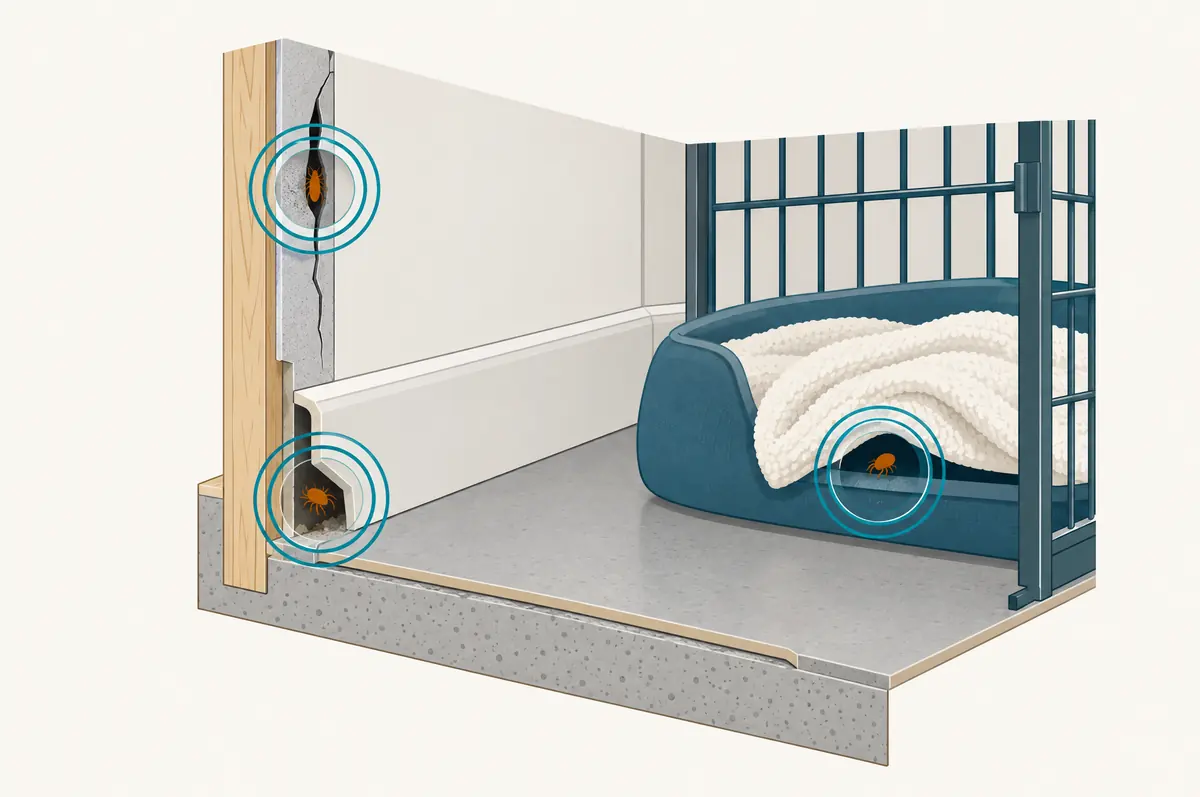
R. sanguineus is a three-host tick that feeds on dogs at every stage. After each meal it drops off, moves upward, and hides in cracks, crevices, behind trim and in ceilings to molt or lay eggs. An engorged female can lay several thousand eggs. Under warm indoor conditions the cycle can complete in a few months, so populations grow year-round in heated buildings, which is why kennels and shelters see sudden heavy infestations.
Where to look
Inspect wall and floor junctions, kennel run seams, door frames, bedding, crates and the undersides of furniture. Ticks often cluster above the level where dogs rest. Adults are reddish-brown and lack white markings; engorged females turn gray-blue. Records of where ticks are found each week guide treatment and show whether the cycle is breaking. Treatment of the building and the dogs must run at the same time, or reinfestation from the other reservoir resets the program.
Structural program
Veterinarians manage treatment of the dogs with registered veterinary products. The premise program runs in parallel: vacuum and discard contents, launder or replace bedding, seal cracks and gaps, clean and disinfect runs, and treat harborages with a product labeled for indoor ticks. Repeat through at least one full cycle. Vegalab tick control is in development and is not labeled for ticks. Geraniol and peppermint oil are toxic to cats, so any essential-oil product in a mixed-species shelter needs cat exclusion.
Key facts
- Rhipicephalus sanguineus can complete its entire life cycle indoors and infests kennels and homes (Dantas-Torres 2010, Parasit Vectors 3:26)
- Brown dog tick females lay up to several thousand eggs in protected crevices (Dantas-Torres 2008, Vet Parasitol 152:173)
- Geraniol larval LC50 against susceptible Rhipicephalus microplus is about 6.6 mg/mL, more than 10 times the Spider Mite Control crop concentration (Singh et al. 2018, Ticks Tick Borne Dis 9:201)
How our delivery technology applies
Indoor harborages are narrow gaps where a coarse spray bridges over the opening. Nano-emulsion droplets wick into cracks, and encapsulation slows evaporation from painted and porous surfaces. The tick program will test whether that gives the residual needed to cover the weeks between tick drop-off and molting.
Set up a structural tick program for your kennel or shelter.