


Salmonella on Farm Premises
Last updated:
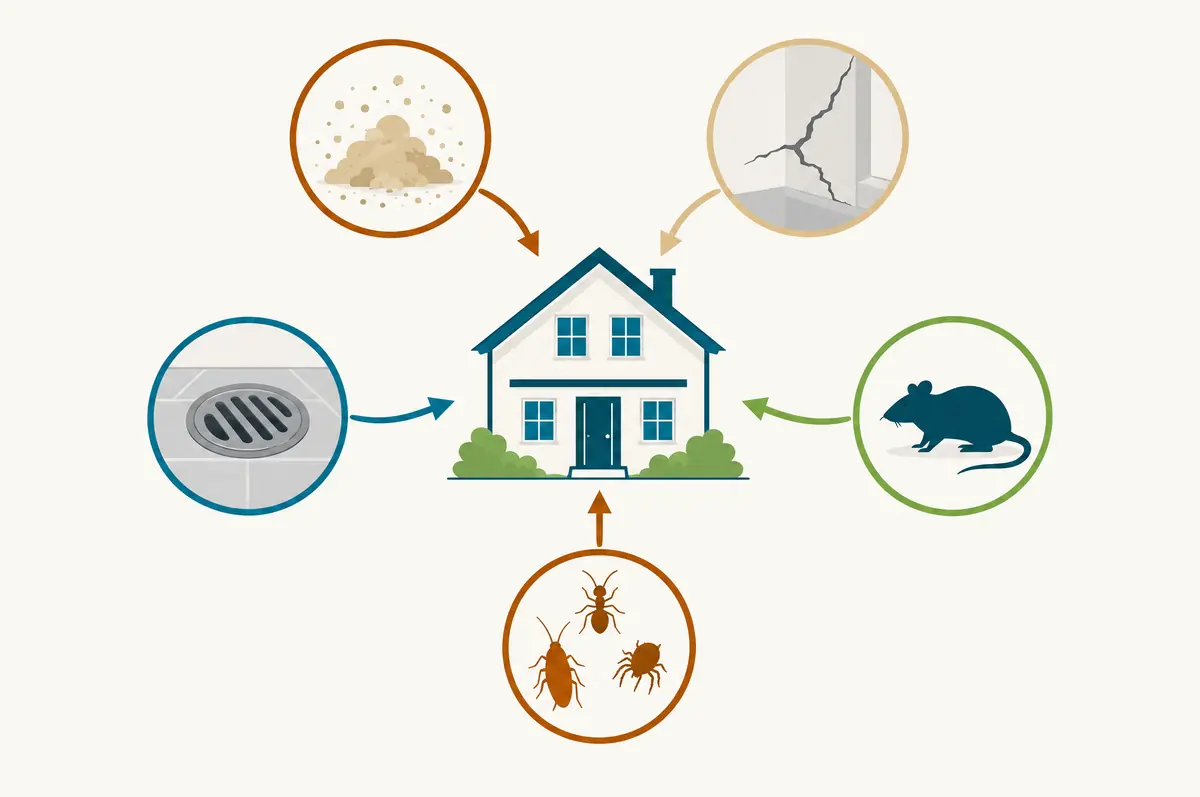
Salmonella survives cleanout in dust, cracks, drains, rodents and insects, then recolonizes the next flock or herd. Premise control depends on removing reservoirs and organic load before disinfection, and on environmental testing to prove it worked. Disinfectant claims against Salmonella apply only where the product label lists them.
Where Salmonella persists
On poultry farms the organism is found in litter, feed residues, dust on ledges and fans, wet floors, drains and egg belts. Rodents and litter beetles carry it between cycles, and studies of empty houses have recovered Salmonella Enteritidis from mice, flies and beetles months after depopulation. In dairy and swine units, wet alleys, calf pens and feed areas act as reservoirs. Biofilm on water lines and wet surfaces protects bacteria from disinfectants that work well against suspended cells.
Testing and regulation
The US Egg Safety Rule requires layer operations with 3,000 or more hens to control rodents and flies, clean and disinfect between flocks after positive tests, and sample the house environment for Salmonella Enteritidis. In the EU, national control programs under the zoonoses regulation set reduction targets for breeders, layers, broilers and turkeys, with official sampling. Environmental swabbing after cleandown and before placement is the practical proof that disinfection was effective.
Chlorine dioxide and bacterial reservoirs
Chlorine dioxide oxidizes cell membrane and protein components and remains active across a wide pH range. It penetrates biofilm more effectively than free chlorine and does not form trihalomethanes or haloacetic acids with organic matter. It is still consumed by manure and dust, so dry cleaning and detergent washing come first. Vetpure Disinfectant may be used and claimed against Salmonella only where its registration in that jurisdiction lists the organism.
Key facts
- Layer operations with 3,000 or more hens must implement Salmonella Enteritidis prevention measures including environmental testing (21 CFR Part 118)
- Salmonella Enteritidis persisted in rodents and arthropods on an empty free-range chicken farm after depopulation (Davies and Breslin 2003, Environmental Microbiology 5:79)
- EU member states run national Salmonella control programs with reduction targets in poultry (Regulation (EC) No 2160/2003)
- Chlorine dioxide does not produce trihalomethanes or haloacetic acids in reaction with organic matter (EPA 1999, Alternative Disinfectants and Oxidants Guidance Manual, EPA 815-R-99-014)
How our delivery technology applies
Oxidizing disinfectants lose strength between preparation and use, so the concentration that reaches a biofilm is often lower than the one mixed. Vetpure stores chlorine dioxide as a nano-encapsulated, stabilized powder that dissolves to at least 98% pure ClO2 and holds concentration in solution for up to one month. That makes the dose at the surface predictable across a multi-day cleandown and removes two-part activation on site.
Layer and breeder operations can request Vetpure registration details for their market.