

What causes brown spots on plant leaves?
Last updated:
Brown spots on garden plant leaves are most often fungal or bacterial leaf spot diseases, such as early blight and Septoria leaf spot on tomato or apple scab on apple trees, which spread in wet weather.1,2,7 On indoor plants, brown spots more often come from sunburn, chilling, overwatering, spray injury or fertilizer salts.3,6 The spot's shape, center and border point to the cause.1,3
How do you tell fungal, bacterial and environmental brown spots apart?
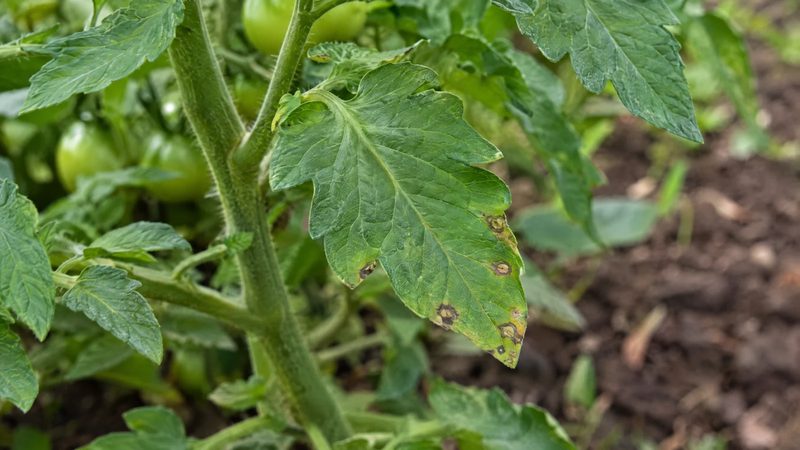
Many brown leaf spots outdoors are caused by fungi whose spores spread in wind and splashing rain, such as Alternaria spp. (early blight) and Septoria lycopersici (Septoria leaf spot) on tomato and Venturia inaequalis (apple scab) on apple.1,3,7 Fungal leaf spots are typically tan to reddish brown to black and roughly circular, and neighboring spots can merge into large, irregular dead patches.3 Many of these fungi need hours of continuous leaf wetness to infect.3
Bacterial leaf spots start differently: dark green, water-soaked spots that look oily or greasy, often easiest to see from the leaf underside, which then turn tan, dark brown or black, frequently with a yellow border.3 Sunburn first bleaches leaf tissue to pale, faded areas that later turn brown and brittle, and too much fertilizer browns leaf tips and margins rather than forming round spots.5,6
| What the spot looks like | Likely cause | Typical setting |
|---|---|---|
| Brown to black with concentric rings like a target | Early blight (fungus) | Older, lower tomato leaves near the soil |
| Small, round, tan to gray center, dark edge, tiny black dots | Septoria leaf spot (fungus) | Lower tomato leaves after first fruit set |
| Water-soaked at first, then dark brown or black, often with a yellow border | Bacterial leaf spot | Wet foliage, splashing water |
| Pale, bleached patch that turns brown and brittle | Sunburn | Plant recently moved into stronger sun |
| Brown tips and margins, white crust on soil | Fertilizer salts | Pots fertilized often or heavily |
In North America, tomato leaf spots usually begin in early summer and continue through the season, with Septoria leaf spot often showing after the first fruit set1, while apple scab's spring infections can occur from the start of growth until mid to late June in wet weather7. In the Southern Hemisphere the same pattern runs from about December to March for tomatoes, with apple scab risk in spring rains from about September to December.
What causes brown spots on tomato leaves?
Early blight and Septoria leaf spot are the most common fungal diseases of tomato in Kentucky, typically starting in early summer and continuing through the season.1 Early blight, caused by one or more Alternaria species, first appears on older leaves close to the ground as small brown-black spots with concentric rings that give a target-like look; spots can reach 1/2 inch and the surrounding tissue may yellow.1 Infection can occur from 60°F, with 82 to 86°F optimal, and spots appear about 7 days after infection.1
Septoria leaf spot, caused by Septoria lycopersici, usually develops after the first fruit set on lower leaves.1 Its spots are smaller, under 1/4 inch, circular with tan to gray centers and dark margins, often with a yellow halo, and they become dotted with black spore-producing structures (pycnidia).1 Target spot, caused by Corynespora cassiicola, can look so much like early blight that a microscope may be needed to tell them apart.1
Bacterial spot appears on older leaves as water-soaked areas that turn from yellow or light green to dark brown or black; older spots are black, slightly raised and up to 0.3 inch across.2 The bacterium is carried on seed and transplants, spreads in splashing rain or sprinkler water, and develops rapidly at 68°F and above, while nights at 61°F or below suppress it.2
How do you manage brown spots on tomato leaves?
The same cultural steps work for early blight, Septoria leaf spot and target spot, which is useful because two or more often occur on the same plant.1 For bacterial spot, pathogen-free seed and disease-free transplants are the best defense, together with avoiding sprinkler irrigation and rotating to a non-host crop.2 Copper sprays give only partial control of bacterial spot, work only as a protectant applied before infection, and copper resistance has been observed.2 For any fungicide or bactericide, choose one that lists the disease and tomato on the label and follow the product label.1
- Stake or cage plants to keep them off the ground and remove lower leaves that touch the soil.1
- Mulch under plants to reduce rain splash of spores from soil to leaves.1
- Avoid overhead irrigation, and give plants full sun, good air circulation and enough spacing.1
- Rotate: avoid tomatoes in the same spot for 2 to 3 years, and for early blight also avoid potato and eggplant.1
- Choose tolerant or resistant cultivars; cherry, grape and hybrid types tend to be more tolerant than slicers and heirlooms.1
- Remove plants and debris promptly after the final harvest.1
What causes brown spots on indoor plant leaves?
Indoors, infectious leaf spots are the less likely explanation. UC IPM lists sunburn after a recent move, chilling injury below 50°F, chemical spray injury and overwatering as causes of leaf spots on houseplants, and notes that fungal or bacterial infections are rare unless the plant has recently come from outdoors or a greenhouse.3 The University of Maryland Extension adds water spots, and advises against splashing water onto fuzzy-leaved plants such as African violets.4
When disease is involved, fungal spots on houseplants are caused by genera such as Cercospora, Colletotrichum, Alternaria and Fusarium, spread by splashing water.3 Bacterial spots from Xanthomonas species are common on dieffenbachia, philodendron and English ivy, and Pseudomonas species occur on Aglaonema, Dracaena, Monstera and Epipremnum (pothos).3 Avoid wetting the foliage, water early in the day so leaves dry quickly, and remove infected leaves as soon as spots appear.3
Brown tips and edges are a separate symptom. They usually come from overfertilization, salt buildup, soil kept too dry or too wet, low humidity, or sun and heat through a window.3 Shade-loving plants moved into full sun scorch, and damage is worse when strong sun combines with dry soil; when moving houseplants outdoors, start with about 2 hours of sun a day and increase gradually.5
What causes brown spots on apple tree leaves?
Three fungal diseases that are common in home apple plantings cause leaf spots.7 Apple scab, caused by Venturia inaequalis, is the most important apple disease in New England and is worst in wet weather; it causes circular, olive-black spots on leaves and fruit, and heavy infection can defoliate the tree.7 The fungus overwinters on fallen leaves, and its spring spores can infect young leaves during rain from the start of growth until mid to late June.7
Cedar-apple rust, caused by Gymnosporangium juniperi-virginianae, produces bright yellow-orange or reddish spots and needs nearby junipers or red cedars to complete its life cycle; on those hosts it forms brown galls 1/4 to 2 inches across that push out orange, jelly-like spore horns in spring rain.7 Frogeye leaf spot, the leaf phase of black rot (Botryosphaeria obtusa), starts as small purple specks that grow to 1/8 to 1/4 inch, with purple margins and light and dark banded centers.7
| Disease | Leaf spot appearance | Where it survives winter |
|---|---|---|
| Apple scab (Venturia inaequalis) | Circular, olive-black spots on leaves and fruit | Fallen, dead leaves |
| Cedar-apple rust (Gymnosporangium juniperi-virginianae) | Bright yellow-orange or reddish spots | Galls on nearby junipers and red cedars |
| Frogeye leaf spot (Botryosphaeria obtusa) | Purple specks growing to 1/8 to 1/4 inch, banded centers | Dead wood, cankers and mummified fruit |
How do you prevent brown spots on apple leaves?
Resistant varieties are the most effective control. The Connecticut Agricultural Experiment Station names Jonafree, Priscilla, Macfree and Liberty as scab-resistant, and Delicious, Empire, Jonamac, McIntosh and Paulared as resistant to cedar-apple rust, though cultivars resistant to one rust are not necessarily resistant to the others.7 Removing red cedars within about a mile of the tree reduces rust spores but is often not practical.7
Sanitation removes the sources of next year's infections: rake up and remove scabby leaves and fruit, and prune out dead or cankered branches and mummified apples to limit frogeye leaf spot.7 Protective fungicide sprays can be added to the program; the label lists the hosts and diseases covered, rates and the days-to-harvest interval, so follow the product label.7
Key takeaways
- Target-like rings point to early blight; small tan to gray spots with dark edges and black dots point to Septoria leaf spot.
- Water-soaked spots that darken and gain a yellow border suggest a bacterial leaf spot.
- Indoors, brown spots more often come from sunburn, chilling, overwatering or spray injury than from disease.
- Keeping leaves dry, mulching and rotating crops limit tomato leaf spots; follow the product label for any spray.
- On apples, resistant varieties and removing fallen leaves and dead wood are the main defenses against scab, rust and frogeye leaf spot.
References
- Foliar Diseases of Tomato: Early Blight, Septoria Leaf Spot, Target Spot (Plant Pathology Fact Sheet PPFS-VG-25)
- Bacterial Spot (UC IPM Pest Management Guidelines: Tomato)
- Pest Notes: Houseplant Problems (UC ANR Publication 74172)
- Diagnose Indoor Plant Problems
- Excess Light on Indoor Plants
- Fertilizer Toxicity or High Soluble Salts in Indoor Plants
- Disease Control for Home Apple Orchards