

NAD+ (Nicotinamide Adenine Dinucleotide)
Last updated:
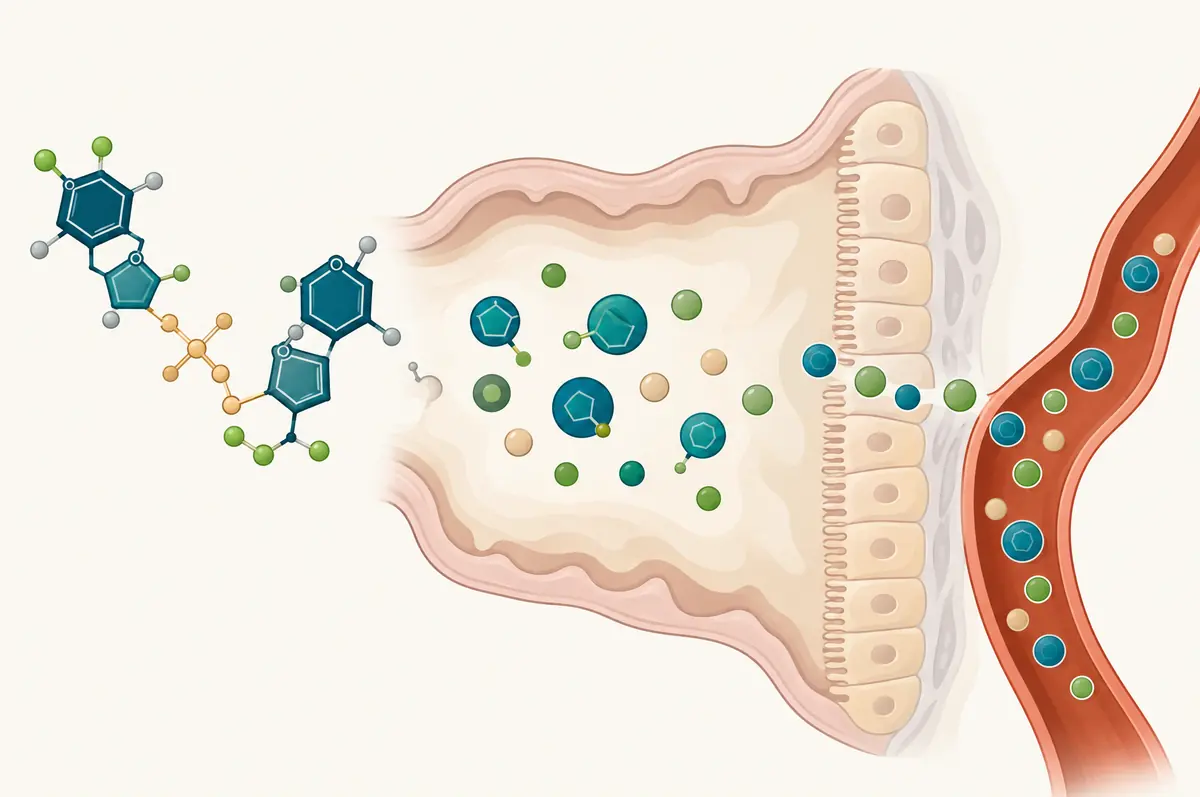
NAD+ is central to energy metabolism and to sirtuin and PARP signaling, and it declines with age in several tissues. Direct oral NAD+ is a poor delivery strategy: the molecule is large, charged and broken down in the gut to smaller precursors. Most research therefore uses NMN or nicotinamide riboside instead.
Molecule and pharmacology
NAD+ (C21H27N7O14P2, 663.4 Da) is a dinucleotide carrying two phosphate groups. It shuttles electrons as NAD+/NADH and is consumed as a substrate by sirtuins, PARPs and CD38. Cells maintain NAD+ mainly through the salvage pathway from nicotinamide. Extracellular NAD+ does not cross membranes intact to a meaningful degree; it is cleaved by ectoenzymes to NMN and nicotinamide riboside, which then enter cells. This is why tissue NAD+ is usually raised indirectly.
Evidence and status
Evidence that raising NAD+ helps comes mostly from animal studies using precursors. Direct NAD+ has little controlled human data. Oral NAD+ is sold as a supplement in some markets. Intravenous NAD+ infusions are offered by clinics but NAD+ is not an FDA-approved drug for any indication. Topically, NAD and related molecules are used as cosmetic ingredients, including in Vegalab Beauty Science products. Not on the WADA Prohibited List, though WADA limits IV infusions above 100 mL per 12 hours regardless of substance.
The delivery problem
Oral NAD+ faces hydrolysis by gut pyrophosphatases and phosphatases before absorption, yielding NMN, NR and nicotinamide. Its size and charge block passive membrane crossing. In solution it degrades with heat and alkaline pH. The What Doesn't Work page on oral NAD+ capsules reviews what plain oral products can and cannot achieve. Topical formats avoid the gut entirely, which is why NAD appears in cosmetic formulations where the target is the skin itself rather than systemic levels.
Key facts
- Extracellular NAD+ and NMN are degraded to smaller precursors, and oral NAD-boosting strategies rely mainly on NR and NMN (Rajman et al. 2018, Cell Metab 27:529)
- Tissue NAD+ decline with age is driven in part by CD38 (Camacho-Pereira et al. 2016, Cell Metab 23:1127)
- Intravenous infusions of more than a total of 100 mL per 12-hour period are prohibited in sport except in specified medical settings (WADA Prohibited List 2026, M2.2)
How our delivery technology applies
For a 663 Da dinucleotide, the most valuable delivery gain is stability. Encapsulation protects NAD+ from hydrolysis and moisture in a product, which matters most in topical and cosmetic formats where the molecule acts at the skin surface. For oral programs, Vegalab directs partners to precursor strategies (NMN+ Nano) where delivery gains are measurable.
Planning an NAD+ program? Talk to Vegalab about precursor and topical routes.