

What is NMN?
Last updated:
NMN (nicotinamide mononucleotide) is a nucleotide formed from nicotinamide and converted to NAD+ by NMNAT enzymes. It raises NAD+ in mouse tissues and in human blood, but human outcome data are modest and mixed: trials so far are short and small and measure NAD+ metabolites and surrogate markers rather than clinical outcomes. It is unstable in water and partly converted to nicotinamide.
NMN is a direct precursor of NAD+ that raises NAD+ in mouse tissues and in human blood, with modest and mixed human outcome data so far. Its practical weaknesses are instability in water and partial conversion to nicotinamide before it reaches tissue. Vegalab's NMN+ Nano pipeline program targets those two points.
How does NMN become NAD+?
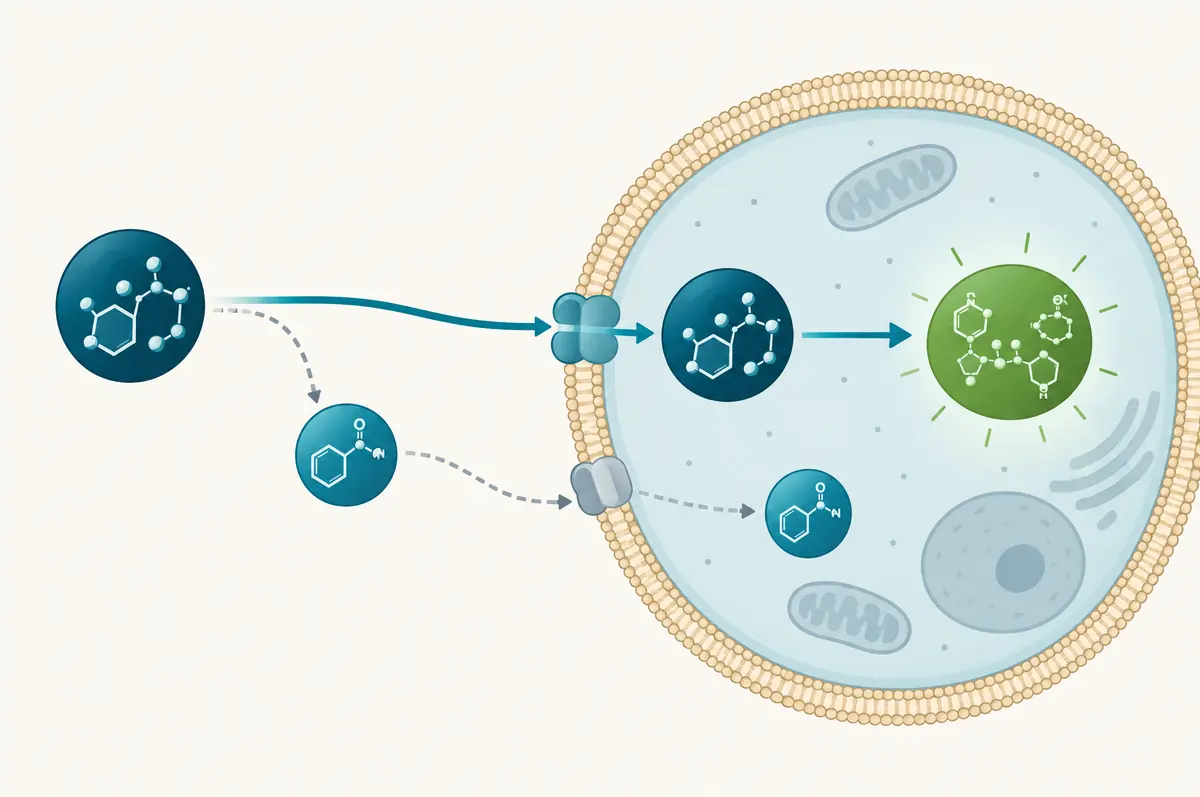
NMN (C11H15N2O8P, 334.2 Da) is a nucleotide formed from nicotinamide by NAMPT and converted to NAD+ by NMNAT enzymes. It is highly water soluble and negatively charged at physiological pH. After oral dosing in mice it appears in plasma within minutes and raises tissue NAD+. How it enters cells remains debated: a dedicated transporter (Slc12a8) has been proposed, while other work suggests conversion to nicotinamide riboside outside the cell. Much oral NMN is likely metabolized to nicotinamide by gut and liver.
What does the evidence show?
Animal: long-term NMN mitigated age-associated physiological decline in mice. Human: small randomized trials show raised blood NAD+ metabolites and, in one trial of prediabetic postmenopausal women, improved muscle insulin sensitivity; effects on other endpoints are inconsistent. There is no approved drug use. Human trials to date are short, small and mostly industry funded, and they measure NAD+ metabolites and surrogate markers rather than clinical outcomes. Evidence tier: human trial, early stage.
What is NMN's regulatory status?
United States: FDA stated in 2022 that NMN was excluded from the dietary supplement definition because of prior drug investigation, then reversed that position in September 2025 following litigation, confirming NMN may be marketed as a supplement. European Union: NMN requires novel food authorization; EFSA published a positive safety opinion on one beta-NMN source in 2026, and Commission authorization governs market entry. Check current status in each market before launch. Not listed on the WADA Prohibited List.
Key takeaways
- NMN is converted to NAD+ by NMNAT enzymes, and much oral NMN is likely metabolized to nicotinamide by the gut and liver.
- How NMN enters cells is debated; Slc12a8 has been proposed as a transporter in the mouse small intestine.
- Long-term NMN mitigated age-associated physiological decline in mice.
- FDA confirmed in September 2025 that NMN may be marketed as a dietary supplement, reversing its 2022 position.
- In the EU, NMN requires novel food authorization; EFSA published a positive safety opinion on one beta-NMN source in 2026.
Key facts
- Long-term NMN administration mitigated age-associated physiological decline in mice (Mills et al. 2016, Cell Metab 24:795)
- NMN 250 mg/day for 10 weeks increased muscle insulin sensitivity in prediabetic women (Yoshino et al. 2021, Science 372:1224)
- Slc12a8 was proposed as a specific NMN transporter in mouse small intestine (Grozio et al. 2019, Nat Metab 1:47)
- FDA confirmed in September 2025 that NMN is lawful in dietary supplements, reversing its 2022 position (FDA letter to Natural Products Association, 2025)
- EFSA issued a safety opinion on beta-nicotinamide mononucleotide as a novel food (EFSA NDA Panel 2026, EFSA Journal 24(5), doi 10.2903/j.efsa.2026.10007)
How our delivery technology applies
NMN hydrolyzes in water and is hygroscopic as a powder, which limits liquid formats and shortens shelf life in humid conditions. A multi-layer biopolymer shell reduces moisture and oxygen contact in storage and slows release so less NMN meets gut nicotinamidase and first-pass conversion at once. Whether that raises tissue NAD+ compared with plain NMN is the question NMN+ Nano pharmacokinetic work must answer.
Questions
Is NMN legal as a dietary supplement?
In the US, yes. FDA stated in 2022 that NMN was excluded from the dietary supplement definition, then reversed that position in September 2025 following litigation. In the EU, NMN requires novel food authorization, and Commission authorization governs market entry.
Does NMN raise NAD+ in humans?
Small randomized trials show raised blood NAD+ metabolites. In one trial of prediabetic postmenopausal women, NMN improved muscle insulin sensitivity, while effects on other endpoints are inconsistent.
How stable is NMN?
NMN hydrolyzes in water and is hygroscopic as a powder. That limits liquid formats and shortens shelf life in humid conditions.
Is NMN an approved drug?
No. There is no approved drug use for NMN, and the evidence tier is early-stage human trials, mostly industry funded.
Discuss NMN+ Nano licensing or co-development with Vegalab.