

Do oral NAD+ supplements work?
Last updated:
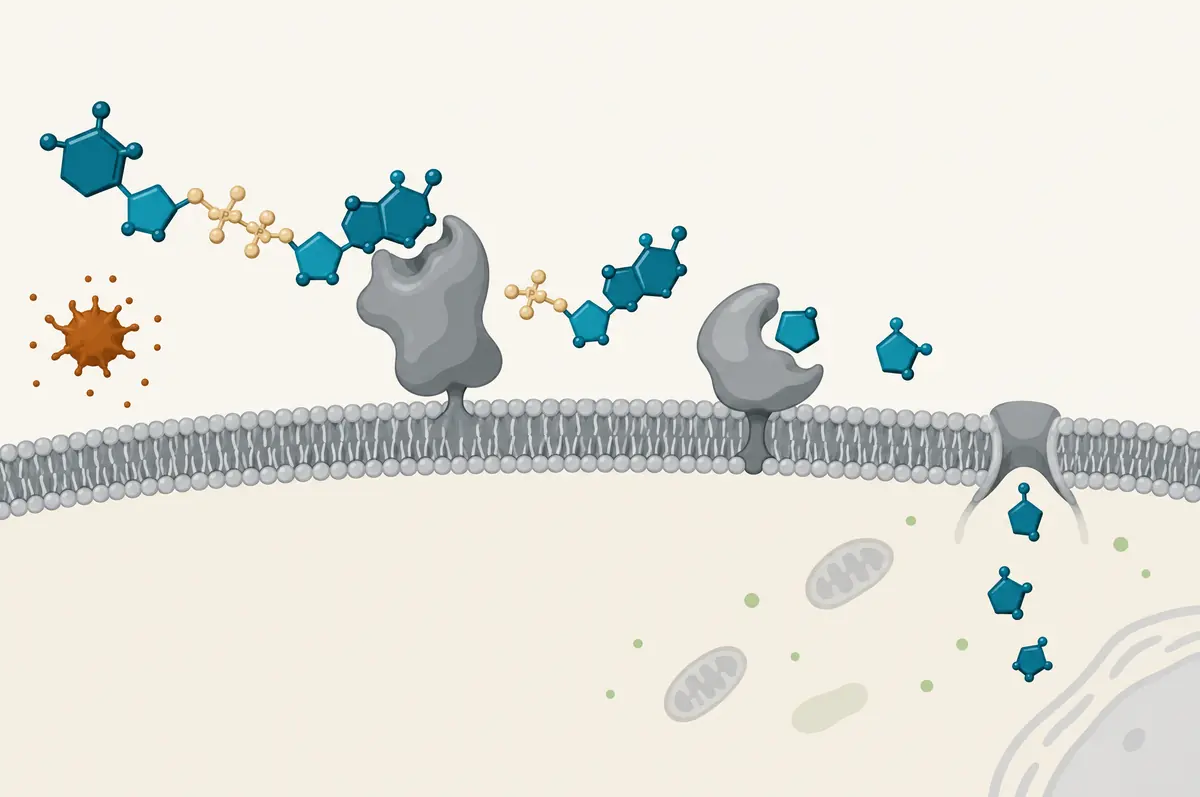
Not as intact NAD+. The dinucleotide is large and charged, surface ectoenzymes such as CD38 and CD73 break extracellular NAD+ down to nicotinamide mononucleotide, nicotinamide riboside and nicotinamide, and mammalian cells have no established transporter for the intact molecule. Cells take up those smaller fragments. Nicotinamide riboside and nicotinamide mononucleotide have shown increases in blood NAD+ measures in controlled studies.
Nicotinamide adenine dinucleotide is not absorbed intact in any useful quantity. Extracellular NAD+ is cleaved by surface ectoenzymes to nicotinamide mononucleotide and then to nicotinamide riboside and nicotinamide, and it is those smaller fragments that cells take up.
Why doesn't intact NAD+ reach cells?
NAD+ is a 663 Da dinucleotide carrying two phosphate groups, so it is large, charged and a poor candidate for passive absorption. More decisively, ectoenzymes including CD38 and CD73 degrade extracellular NAD+ stepwise, and the cell membrane has no established transporter for the intact dinucleotide in mammals. Whatever survives gastric and intestinal conditions is therefore processed to precursors before uptake. Selling the dinucleotide itself is a more expensive route to the same precursors the body would produce anyway.
Why is plasma the wrong readout?
Even with a precursor that is genuinely absorbed, plasma concentration is a weak surrogate. The functional pool is intracellular, and the standard way to show a change is whole blood NAD+ measurement or tissue sampling, reported with a validated mass spectrometry method. A rise in plasma nicotinamide after a dose tells you absorption occurred, not that cellular NAD+ increased. Human studies with nicotinamide riboside used whole blood NAD+ as the endpoint for exactly this reason.
Where do NAD+ precursors stand?
Nicotinamide riboside and nicotinamide mononucleotide are the two precursors with the most human data, and both have shown increases in blood NAD+ measures in controlled studies. Their regulatory status differs by market and has moved, including an amended FDA position on nicotinamide mononucleotide in dietary supplements following citizen petitions. A formulation program should confirm current status in each target market rather than rely on a general statement. Formulators should also treat nicotinamide mononucleotide as a hygroscopic material, since moisture uptake in a capsule or sachet degrades it during shelf life and will be read as poor delivery when it is actually poor packaging.
What does a delivery claim need?
Three elements: a stability-indicating assay showing the precursor survives shelf life, an absorption result for the intact precursor by mass spectrometry, and a whole blood or tissue NAD+ endpoint with a comparator. Anything less is a formulation description, not a delivery claim. Anything less is a formulation description. Where a partner wants a defensible claim, the stability work comes first, because a precursor that decomposes on the shelf cannot be absorbed at any rate.
Key takeaways
- NAD+ is a 663 Da dinucleotide carrying two phosphate groups.
- CD38 and CD73 degrade extracellular NAD+ to smaller precursors before cellular uptake.
- No transporter for intact NAD+ across the mammalian cell membrane has been identified.
- Whole blood or tissue NAD+, not plasma, is the meaningful endpoint.
- Nicotinamide mononucleotide is hygroscopic and degrades with moisture during shelf life.
Key facts
- Extracellular NAD+ is degraded by CD38 and CD73 to nicotinamide mononucleotide, nicotinamide riboside and nicotinamide before cellular uptake (Nikiforov et al. 2011, J Biol Chem 286:21767)
- No established transporter for intact NAD+ across the mammalian plasma membrane has been identified (Nikiforov et al. 2015, Crit Rev Biochem Mol Biol 50:284)
- Oral nicotinamide riboside raised whole blood NAD+ in healthy adults, with whole blood rather than plasma as the endpoint (Trammell et al. 2016, Nat Commun 7:12948)
- FDA amended its position on nicotinamide mononucleotide in dietary supplements following citizen petitions (FDA citizen petition response, 2025)
How our delivery technology applies
The tractable problems here are stability and release, not transport of the dinucleotide. Nicotinamide mononucleotide is hygroscopic and degrades with moisture and heat, so a moisture-barrier outer layer and controlled release address real failure modes in a capsule or sachet. NMN+ Nano is a development program on that basis. It is not on sale, and availability depends on the regulatory pathway per market.
Questions
Which NAD+ precursors have the most human data?
Nicotinamide riboside and nicotinamide mononucleotide. Both have shown increases in blood NAD+ measures in controlled studies.
How should a change in NAD+ be measured?
With whole blood NAD+ or tissue sampling, reported with a validated mass spectrometry method. A rise in plasma nicotinamide shows absorption occurred, not that cellular NAD+ increased, which is why nicotinamide riboside studies used whole blood as the endpoint.
What is the regulatory status of NMN?
It differs by market and has moved. FDA amended its position on nicotinamide mononucleotide in dietary supplements following citizen petitions, so a formulation program should confirm current status in each target market.
Does NMN degrade in storage?
Yes, if moisture gets in. Nicotinamide mononucleotide is hygroscopic, and moisture uptake in a capsule or sachet degrades it during shelf life, which can look like poor delivery when it is actually poor packaging.
Building an NAD precursor product? Ask for the stability and endpoint plan.