


Is oral glutathione absorbed?
Last updated:
Largely not intact. Enzymes on the intestinal brush border, led by gamma-glutamyltransferase, cleave the tripeptide, so most of an oral dose is absorbed as amino acids and resynthesized, if at all, inside cells. A single large oral dose did not meaningfully raise blood glutathione in healthy adults, while months of daily supplementation reported variable increases depending on compartment and assay.
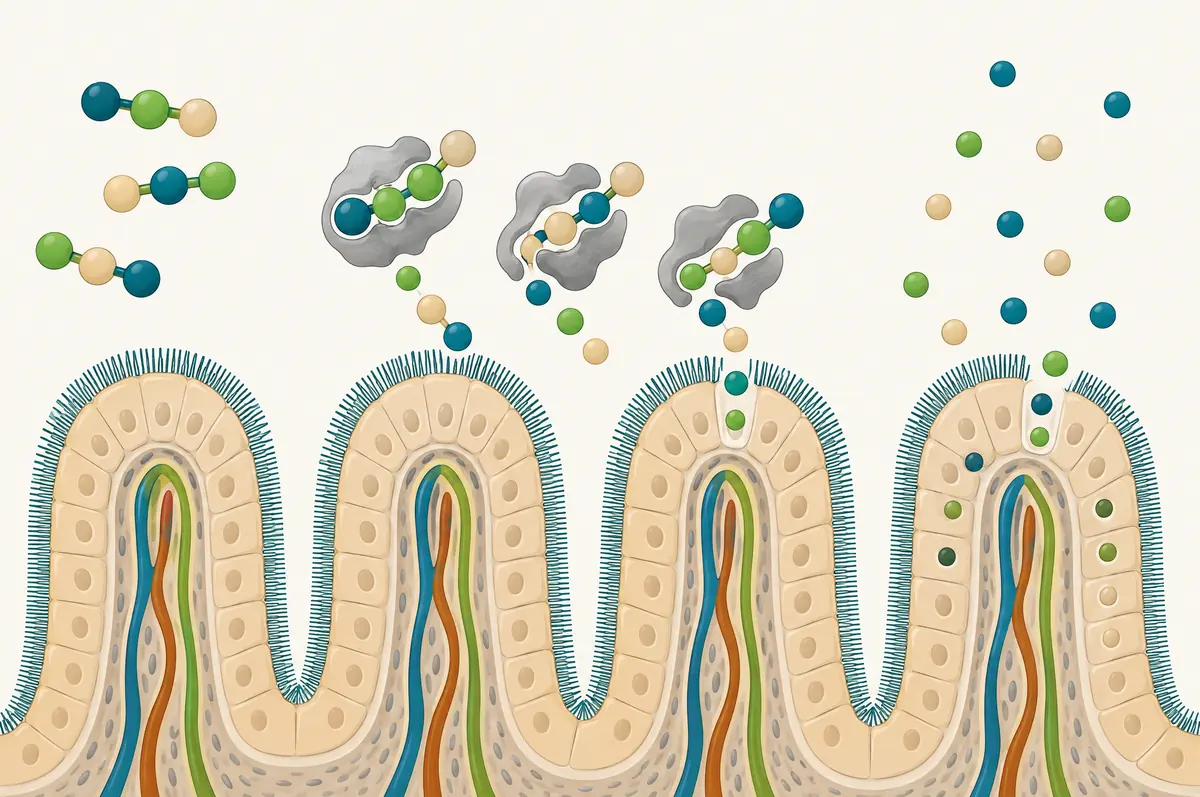
Swallowed glutathione is largely dismantled before it is absorbed. The intestinal brush border carries gamma-glutamyltransferase and peptidases that cleave the tripeptide, so most of an oral dose is absorbed as amino acids and resynthesized, if at all, inside cells.
What happens to glutathione when it is swallowed?
Glutathione is a tripeptide of glutamate, cysteine and glycine, 307 Da, with a gamma-glutamyl bond. Gamma-glutamyltransferase on the enterocyte surface initiates degradation and dipeptidases complete it, which is the normal physiological route for handling extracellular glutathione. The thiol group is also readily oxidized to the disulfide form in a capsule exposed to air and moisture, so a portion of a dose can be oxidized before it is even swallowed. Intracellular synthesis is rate-limited by cysteine availability, not by circulating intact glutathione.
What does the human data show?
Results are mixed and modest. A single large oral dose in healthy adults did not raise blood glutathione markers meaningfully in a controlled study, while longer daily supplementation has reported increases in some blood and buccal compartments with variable effect size and assay-dependent results. Studies that report increases generally use extended dosing and measure total rather than reduced glutathione. Cysteine precursor strategies, including N-acetylcysteine, have a clearer mechanistic basis for raising intracellular synthesis.
What would an oral formulation have to do?
Three things at once. Protect the thiol from oxidation during shelf life, which is a packaging and barrier problem. Shield the tripeptide from brush-border enzymes until past the site of hydrolysis, which is a release-timing problem. And demonstrate the result in the right compartment, meaning whole blood or tissue rather than plasma alone, ideally with the reduced-to-oxidized ratio reported. A product that does only the first has improved its shelf life, not its delivery.
How do you read a glutathione claim?
Ask whether the study measured reduced glutathione or total, which compartment was sampled, whether the assay was mass spectrometry, and what the comparator was. Sublingual and intravenous routes bypass the intestinal step entirely and cannot be used to support an oral claim. Sublingual and intravenous data cannot support an oral claim, and skin-whitening or detoxification claims are outside what the evidence and the labeling rules allow in any of our target markets, whatever the format achieves technically.
Key takeaways
- Glutathione is a 307 Da tripeptide of glutamate, cysteine and glycine.
- Gamma-glutamyltransferase and dipeptidases at the brush border break it down before absorption.
- Its thiol group oxidizes readily in a capsule exposed to air and moisture.
- Intracellular synthesis is limited by cysteine availability, not circulating glutathione.
- Cysteine precursors such as N-acetylcysteine have a clearer mechanistic basis for raising synthesis.
Key facts
- Intestinal and hepatic gamma-glutamyltransferase hydrolyze glutathione, limiting systemic availability of oral doses (Witschi et al. 1992, Eur J Clin Pharmacol 43:667)
- A single 3 g oral dose did not produce a meaningful rise in blood glutathione in healthy subjects (Witschi et al. 1992, Eur J Clin Pharmacol 43:667)
- Daily oral supplementation over months has reported increases in body glutathione stores with variable magnitude by compartment and assay (Richie et al. 2015, Eur J Nutr 54:251)
- Glutathione synthesis is governed mainly by glutamate-cysteine ligase activity and cysteine availability (Lu 2013, Biochim Biophys Acta 1830:3143)
How our delivery technology applies
Glutathione is a two-barrier problem, oxidation in storage and enzymatic cleavage at the brush border, and multi-layer construction lets each be assigned its own layer: an oxygen and moisture barrier at the exterior, an enzyme-excluding inner matrix with release timed past the point of hydrolysis. Glutathione Nano is a development program on exactly that basis, and it is not on sale.
Questions
Does a glutathione supplement work?
Results are mixed and modest. A single large oral dose did not meaningfully raise blood glutathione markers in a controlled study, while longer daily supplementation has reported increases in some blood and buccal compartments, with variable effect size and assay-dependent results.
Does glutathione degrade in the capsule?
It can. The thiol group is readily oxidized to the disulfide form in a capsule exposed to air and moisture, so part of a dose can be oxidized before it is swallowed.
What limits how much glutathione cells make?
Intracellular synthesis is governed mainly by glutamate-cysteine ligase activity and cysteine availability, not by circulating intact glutathione. That is why cysteine precursor strategies have a clearer mechanistic basis.
What should a glutathione study measure?
Check whether it measured reduced or total glutathione, which compartment was sampled, whether the assay was mass spectrometry and what the comparator was. Whole blood or tissue data, with the reduced-to-oxidized ratio, are more informative than plasma alone.
Developing a glutathione format? Ask for the feasibility outline.