

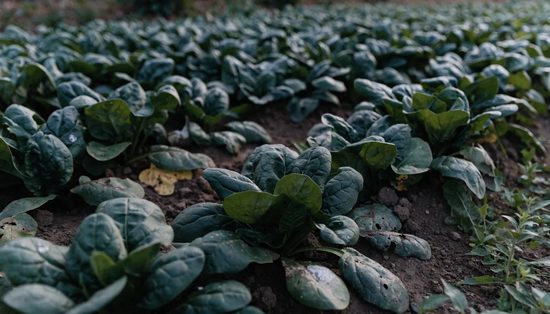
Spinach Pest & Disease Programs - Biological Inputs That Fit Your Spray Window
Low-residue programs for spinach and baby-leaf, a crop where the leaf is the product and the window is measured in days. Downy mildew, aphids, leaf miners and curly top.
Growing spinach with Vegalab
Spinach is the hardest case in leafy greens. The leaf is the product, so there is nowhere to hide a blemish, and a mark that would be cosmetic on a fruit crop is a rejection here. Much of the crop is cut as baby-leaf on a cycle measured in weeks rather than months, and a large share is eaten raw and unpeeled, which puts residue and re-entry under more scrutiny than almost any other field crop.
Those three facts together are what constrain the program. A short cycle leaves very little room between an application and a cut, so anything with a pre-harvest interval is effectively unavailable for most of the crop's life. That is the specific gap Vegalab's platform is built for: plant-extracted actives carried in nano-encapsulation and released on defined conditions, giving low-residue, IPM-friendly programs at zero pre-harvest and re-entry interval.
Four problems are documented on this crop, and they need managing differently. Downy mildew sets the economics and is covered first below. Aphids matter on two separate tracks - contamination of the harvested leaf, and virus transmission at far lower numbers. Leaf miners are a cosmetic problem on a crop sold on appearance, which puts the injury threshold far below what physiology would suggest. And curly top is the one with no cure at all: spinach is the crop where it behaves worst, because low apparent severity still means total loss and the beet leafhopper settles and reproduces on spinach rather than merely probing it.
Rates and registrations follow the applicable label. Use the Product Finder and Rate Calculator to size a program, or talk to an agronomist about your block.
Downy mildew · Peronospora effusa
Downy mildew is the problem that sets the economics of a spinach crop, and it is caused by Peronospora effusa, an obligate oomycete that lives only on spinach. It shows first as pale, angular chlorotic blotches on the upper leaf surface, bounded by the veins, with a grey to violet fuzz of sporulation on the underside directly beneath each blotch. In baby leaf production a single sporulating leaf in a bag is a rejection, which is why the tolerance in that market is effectively zero rather than merely low.
The pathogen runs on cool, wet, still conditions: leaf wetness through the night, temperatures in the low to middle teens Celsius, and dense canopies that hold humidity at the soil surface. High-density baby leaf plantings create exactly that microclimate by design. Spores are wind-borne and move between blocks and between farms, so a neighbour's crop is part of your risk picture whether or not it is part of your management.
Resistance breeding is the primary tool and it is a moving target. New races are denominated as they are characterised by the International Working Group on Peronospora, and a variety resistant at the time it was chosen may not be resistant to the population in a given field two seasons later. Do not publish a race count on the page: it changes, and a stated number dates the page the moment the next denomination is issued. The published guidance should be to choose varieties against the races currently reported in the growing region and to re-check that choice every season rather than every rotation.
Cultural management does real work here. Widen row spacing or reduce seeding density where the market allows it, so the canopy dries. Irrigate so that leaves are dry going into the night - early-morning or mid-morning irrigation rather than evening. Destroy crop residue promptly after harvest rather than incorporating a green mat that keeps sporulating. Avoid planting a new block immediately downwind of a crop approaching harvest. Rotation away from spinach helps with the soil-borne oospore stage but does nothing about airborne inoculum arriving from elsewhere, so it is one component and not a solution.
Scouting is a leaf-underside job, not a canopy-walk job. Turn leaves in the densest, wettest part of the block first - low spots, headlands, the shaded edge - because that is where the first sporulation appears, and it appears before the upper-surface blotch is obvious enough to see from standing height.
| Role | Vegalab product | Use |
|---|---|---|
| Primary control | Spore Control | Broad-spectrum protective fungicide |
| Companion / broader pressure | Mildew Control | Geraniol fungicide for mildews |
| Plant support | Armour Boost | Silica for tissue resilience |
Aphids · Myzus persicae and Macrosiphum euphorbiae
Two species matter on spinach: the green peach aphid, Myzus persicae, and the potato aphid, Macrosiphum euphorbiae. Both feed on phloem and both colonise the growing point and the leaf undersides, where they are hardest to see and hardest to reach with a spray.
On spinach the damage runs on two tracks that need managing separately. The first is contamination of the harvested leaf. In baby leaf and bunched spinach the aphids, their cast skins and their honeydew go into the pack with the crop, and a customer complaint on contamination is as costly as a yield loss. Sooty mould growing on honeydew turns a marketable leaf into a rejected one without any direct feeding injury at all.
The second track is virus transmission, and it matters at far lower aphid numbers than contamination does. Myzus persicae transmits cucumber mosaic virus non-persistently, meaning a probing aphid can inoculate a plant in seconds and does not need to settle or colonise for transmission to occur. It also transmits beet western yellows virus and turnip yellows virus persistently, which produces the interveinal yellowing and thickened, brittle older leaves that are often misread as a nutritional problem. The practical consequence is that a threshold set for contamination is too high to protect against virus, and where virus is the concern the management decision has to be made on the presence of winged aphids arriving rather than on colony counts.
Monitoring should combine yellow sticky traps or water pan traps at the block edge, which catch the incoming winged flight, with in-crop inspection of the growing point and the undersides of the youngest fully expanded leaves. Check the block margins first, particularly downwind of weedy ground or an overwintering brassica or beet crop, since those are the sources that matter most. Weed control on and around headlands removes both the aphid reservoir and the virus reservoir at the same time and is worth more than it looks.
Natural enemies do substantial work in spinach when they are not disrupted - parasitic wasps in the genus Aphidius, plus lacewing and hoverfly larvae and ladybird beetles. Preserving them is a management decision with a real cost when it is got wrong, because a broad-spectrum application made for contamination reasons removes the parasitoids and is regularly followed by a faster rebound than the untreated block.
| Role | Vegalab product | Use |
|---|---|---|
| Primary control | Spider Mite Control | Contact miticide / insecticide |
| Companion / broader pressure | MultiMite Control | Broader mixed mite & insect pressure |
Leafminers · Liriomyza species
Leafminers on spinach are Liriomyza species - principally the American serpentine leafminer, Liriomyza trifolii, and the vegetable leafminer, Liriomyza sativae, with Liriomyza huidobrensis where it occurs. The adult is a small fly; the damage is done by the larva feeding between the upper and lower leaf surfaces.
On a crop where the leaf is the product, the economics are unlike almost any other pest. A mine does not need to reduce photosynthesis or slow growth to cause a total loss on that leaf: it is visible, it is in the pack, and the leaf is unmarketable. That means the injury threshold on spinach is set by appearance rather than by physiology, and it is far lower than on a crop harvested for fruit or root. Adult females also produce feeding and oviposition punctures - small pale stipples in rows along the leaf - which are themselves a cosmetic defect before any mine appears.
Look for the mine first: a pale, winding, progressively widening tunnel with a thin dark line of frass along it, ending at a slightly wider blister where the larva completed feeding. Fresh mines are translucent; older mines dry to a papery tan. Because the tunnel widens as the larva grows, the shape of the mine tells you how far through the generation you are, which is more useful for timing than a raw count.
Parasitoid conservation is the main tactic on this pest and the reason is documented rather than philosophical: Liriomyza populations have a long, well-recorded history of developing resistance to insecticides used against them, and repeated broad-spectrum applications have historically turned leafminers from a minor pest into a primary one by removing their parasitoids. The relevant natural enemies are Diglyphus species, which paralyse the larva in the mine, and Dacnusa and Opius species, which parasitise it internally. Where these are present and undisrupted they routinely hold the population below the cosmetic threshold on their own.
Practical management follows from that. Use yellow sticky traps to detect adult flight and time any intervention to the flight rather than to a calendar. Where a treatment is needed, choose the narrowest-spectrum option available and registered for the crop in the jurisdiction, and rotate mode of action between generations rather than within one. Remove and destroy heavily mined lower leaves and crop residue, which carries pupae. Do not treat on the presence of stipple alone, since stipple without mines means the parasitoids may still be ahead of the population.
| Role | Vegalab product | Use |
|---|---|---|
| Primary control | Larva Control | Natural larvicide (foliar) |
| Companion / broader pressure | Larva BioControl | Biological larvicide / rotation partner |
Frequently asked questions
Why is downy mildew the problem that sets spinach economics?
Because in baby-leaf production a single sporulating leaf in a bag is a rejection, so the tolerance is effectively zero rather than merely low. It runs on cool, wet, still conditions and dense canopies - exactly the microclimate a high-density baby-leaf planting creates by design.
Do I need to treat aphids at the same threshold for contamination and for virus?
No, and this is the most common mistake. A threshold set for contamination is too high to protect against virus, because a probing aphid can inoculate a plant in seconds without settling. Where virus is the concern the decision is made on winged aphids arriving, not on colony counts.
Is there a spray for curly top on spinach?
No. Curly top is a virus with no cure, and insecticides fail on timing: the beet leafhopper needs about a minute to transmit it while a systemic material needs roughly thirty minutes to act. Add the seven-to-fourteen-day symptom lag and a spray triggered by visible disease is answering an event a fortnight old.
Should I pull out infected spinach plants?
Not for curly top. There is no plant-to-plant spread, so removing symptomatic plants removes no inoculum from the field, and Utah State University describes roguing for curly top as ineffective and thus futile. Heavily mined lower leaves and crop residue ARE worth removing, because they carry leaf miner pupae.
Can I use a zero pre-harvest interval program on baby-leaf spinach?
That is the point of the platform. Vegalab's actives are formulated for zero pre-harvest and re-entry interval, which is what makes them usable on a crop cut on a weeks-long cycle. Always confirm against the applicable label for your jurisdiction.
Last updated: