

How to set up a disinfectant footbath
Last updated:
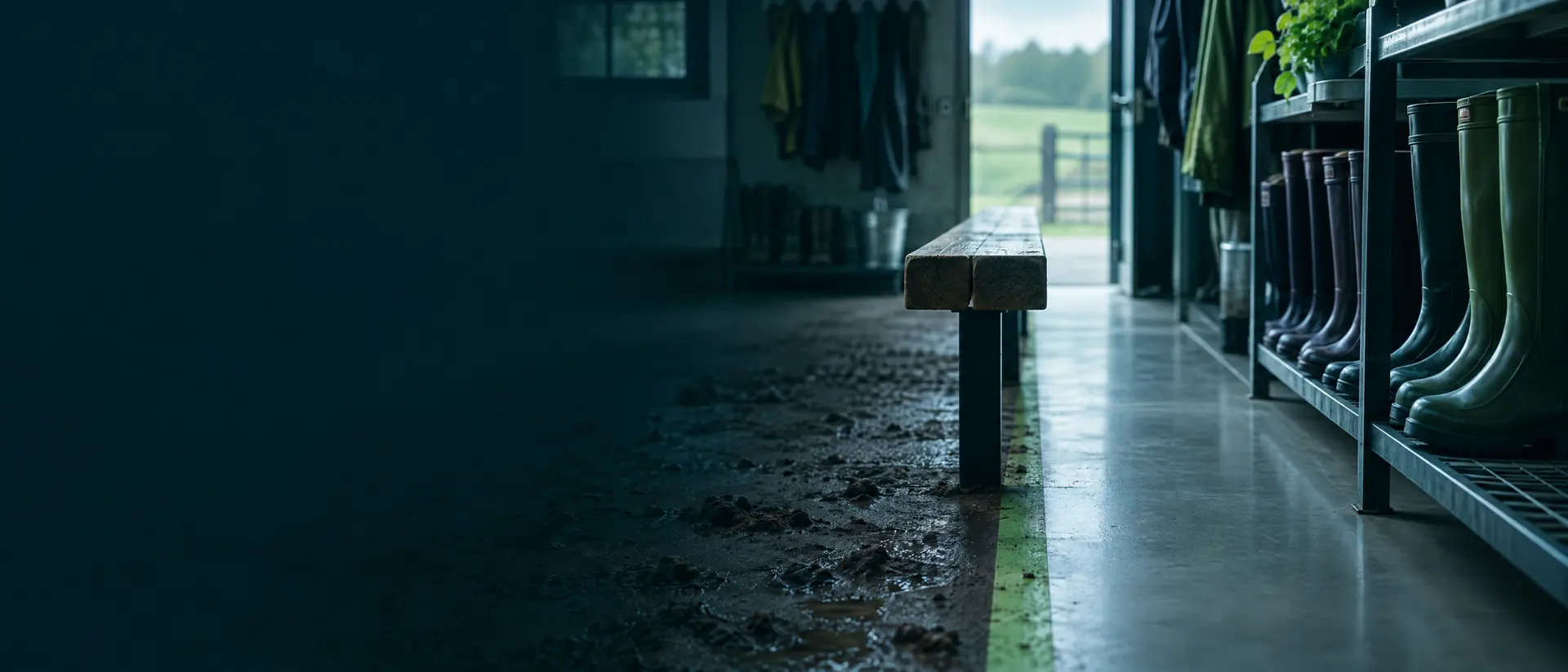
Set the footbath as the last step of a controlled entry, not the only one. Mark one entry per building with a clear line of separation, ideally a bench or Danish entry with building-specific boots. Brush and rinse manure off boots first, then use a disinfectant labeled for footbath use at label dilution, changed on a fixed schedule and whenever it is visibly soiled.
A footbath on its own is a weak barrier, because manure on boots consumes the disinfectant and most people step through in seconds. Entry control works when a clear line of separation, dedicated footwear and boot cleaning come first, and the bath is a final step kept at full strength.
Where should the line of separation go?
Define one controlled entry for each building and mark the line between outside and inside. The most reliable systems are bench or Danish entries: outside footwear stays on one side, and building-specific boots or covers are put on the other. Hand washing or sanitizing belongs at the same point. Where showers are used, the shower is the line. Everything crossing the line, including tools and phones, needs a routine. Post clear signage and keep a visitor log at the entry.
Why clean boots before the footbath?
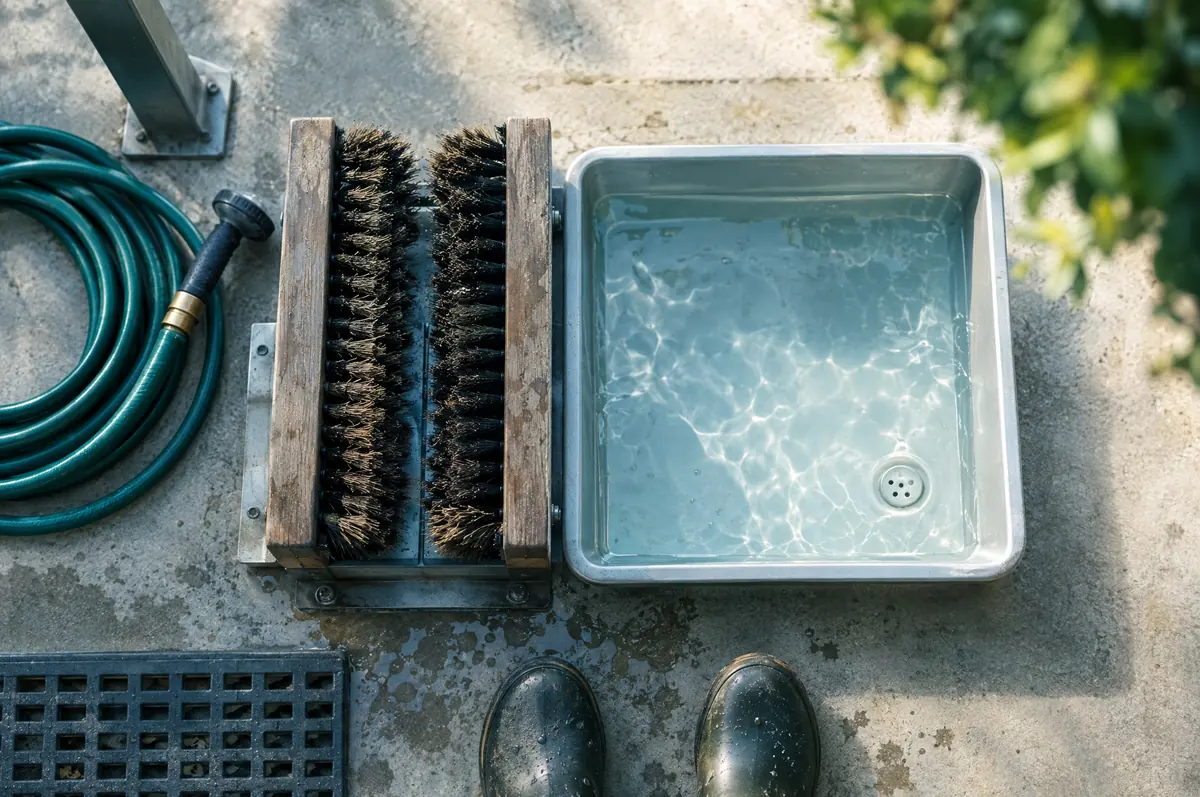
Brush and rinse visible manure and litter off boots before stepping into a bath. Studies of swine boot baths found that soiled boots were not reliably disinfected by brief immersion, and that removing manure and allowing longer contact made the difference. Provide a scrub brush and water point next to the bath. Deep tread soles hold material that no bath reaches, so smooth-soled boots are easier to keep clean. Dedicated boots per building remove most of the problem.
How do you keep a footbath at full strength?
Use a disinfectant labeled for footbath use at label dilution. Change the solution on a fixed schedule and whenever it is visibly soiled, as organic load and rain dilution weaken it quickly. Cover outdoor baths. Check concentration with test strips where available. Record change dates. In freezing conditions, use dry disinfectant mats or powders labeled for that purpose rather than letting the bath ice over. Position baths under cover and out of direct sunlight to slow loss of strength.
Key takeaways
- A footbath alone is a weak barrier: manure on boots consumes the disinfectant and most people step through in seconds.
- A bench or Danish entry keeps outside footwear on one side of the line and building-specific boots or covers on the other.
- Brush and rinse boots before the bath; deep tread soles hold material that no bath reaches.
- Change the solution on a fixed schedule and whenever it is visibly soiled, cover outdoor baths and record change dates.
- In freezing conditions, use dry disinfectant mats or powders labeled for that purpose.
Key facts
- In a swine study, boot baths only reduced bacterial counts when manure was removed first and boots stayed in contact with disinfectant for an extended time (Amass et al. 2000, Swine Health Prod 8(4):169).
- A bench or Danish entry system with a physical barrier between clean and dirty zones is recommended for poultry and swine barns (Secure Poultry Supply and Secure Pork Supply biosecurity plans).
- Organic matter reduces disinfectant efficacy, so footbaths must be kept free of soil and renewed regularly (WOAH Terrestrial Code, ch. 4.14).
How our delivery technology applies
Footbaths lose strength because the disinfectant is spent on organic soil and because stored solutions decay. Chlorine dioxide tolerates organic load and ammonia better than hypochlorite, and Vetpure Disinfectant, as a stabilized nano-encapsulated powder, gives a working solution at a known concentration that stays stable for up to one month. Staff can refresh baths from a prepared stock without generator equipment.
Questions
How do you make a disinfectant footbath?
Use a disinfectant labeled for footbath use and mix it at the label dilution. Place the bath under cover and out of direct sunlight to slow loss of strength, with a scrub brush and water point next to it. Check concentration with test strips where available.
How often should footbath solution be changed?
Change it on a fixed schedule and whenever it is visibly soiled, because organic load and rain dilution weaken it quickly. Record change dates so the schedule can be checked.
Does a footbath disinfect dirty boots?
Not reliably. Studies of swine boot baths found that soiled boots were not reliably disinfected by brief immersion, and that removing manure first and allowing longer contact made the difference. Dedicated boots for each building remove most of the problem.
What can replace a footbath in freezing weather?
Use dry disinfectant mats or powders labeled for that purpose rather than letting the bath ice over. Keep the same line of separation and boot cleaning in place.
Ask for an entry point audit template for your buildings.