

Deer ticks (blacklegged ticks)
Last updated:
Deer ticks, or blacklegged ticks (Ixodes scapularis), are three-host ticks of eastern and upper midwestern North America that live in leaf litter at woodland edges. Adult females feed mainly on white-tailed deer. Nymphs, about the size of a poppy seed, quest in late spring and early summer. The tick needs humidity above roughly 80%, so drying out the lawn edge reduces it.
The blacklegged tick is a three-host tick of eastern and upper midwestern North America that lives in leaf litter at woodland edges. Its nymphs, about the size of a poppy seed, are active from late spring into summer, and they are the stage premise programs most need to reach.
How do you identify a blacklegged tick?
Adult females have a dark brown to black scutum over a reddish-orange body; males are smaller and uniformly dark. The life cycle usually takes two years. Larvae feed in late summer on mice, chipmunks and birds, overwinter, and molt to nymphs that quest in late spring and early summer. Nymphs molt to adults that are active in autumn and on warm winter days, with adult females feeding mainly on white-tailed deer before laying a single large batch of eggs in the leaf litter.
Where do blacklegged ticks live?
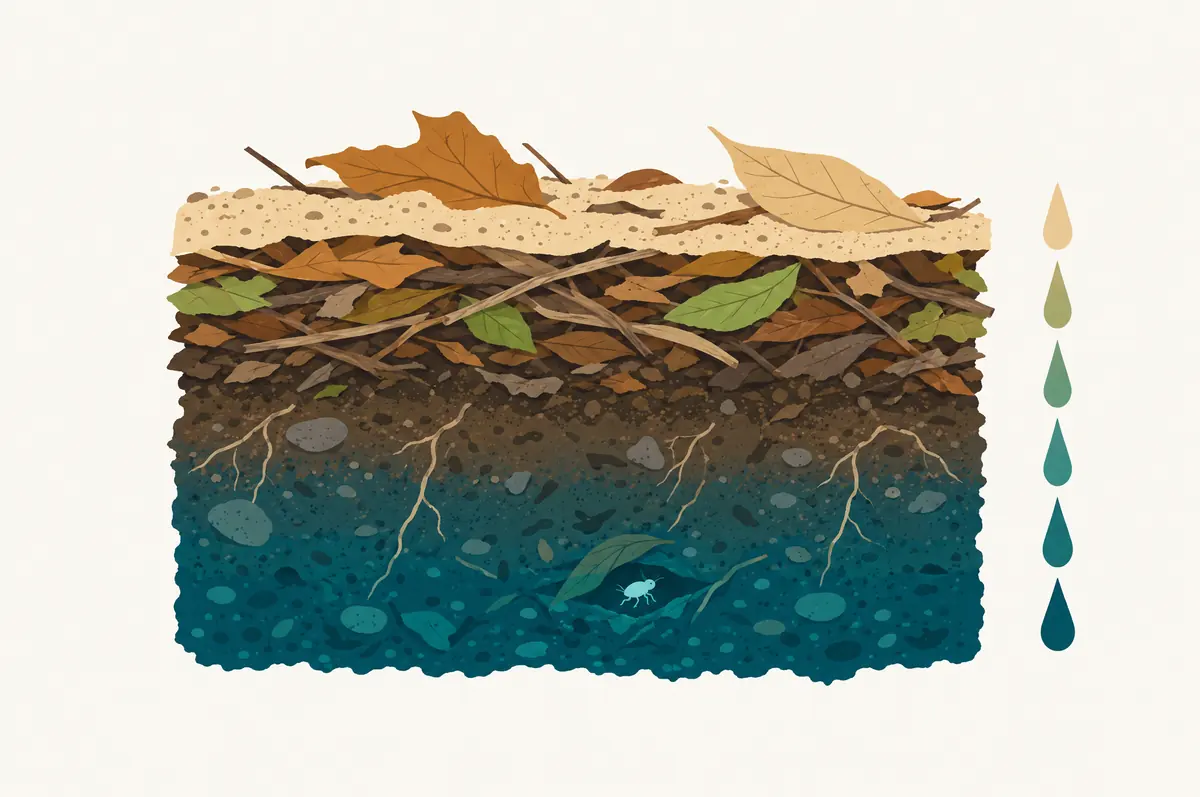
Ixodes scapularis is highly vulnerable to drying and needs relative humidity above roughly 80% in its microhabitat. That confines it to leaf litter, forest floor, dense ground cover and shaded edges. Mowed, sunny lawn is poor habitat, and ticks found in lawns are concentrated within a few meters of the woods edge. This is why landscape changes that dry the edge zone work. Drag sampling along the edge shows where nymphs concentrate.
How do you reduce deer ticks in a yard?
Remove leaf litter and brush at the lawn edge; place a wood-chip or gravel barrier about one meter wide between lawn and woods; keep grass short; stack wood neatly and away from the house; discourage deer and rodent activity near buildings. Treatment is aimed at the edge zone and ground cover in the nymph season. Vegalab tick control is in development; no Vegalab product is currently labeled for ticks. Repeat inspection each season.
What is still unknown about geraniol and blacklegged ticks?
We found no published geraniol mortality data against I. scapularis nymphs. Vegalab's planned trial adds a nymph arm to close that gap. Published geraniol endpoints come from larvae and adults of other genera. Nymphs of Ixodes differ in size, cuticle and questing behavior, so extrapolating those figures would be guesswork. Until the trial reports, no Vegalab page will state an expected result for this species, and yard programs should rely on habitat work.
Key takeaways
- The blacklegged tick life cycle usually takes two years.
- Nymphs, about the size of a poppy seed, are active from late spring into summer.
- The tick needs relative humidity above roughly 80%, which confines it to leaf litter, ground cover and shaded edges.
- Ticks found in lawns are concentrated within a few meters of the woods edge.
- Removing leaf litter and placing a wood-chip or gravel barrier about one meter wide between lawn and woods dries the edge zone.
Key facts
- Ixodes scapularis has a two-year life cycle, with nymphs peaking in late spring and early summer (Stafford 2007, Tick Management Handbook, Connecticut Agricultural Experiment Station Bulletin 1010)
- In residential properties, blacklegged ticks are concentrated at the wooded edge rather than in open lawn (Stafford 2007, Tick Management Handbook, Connecticut Agricultural Experiment Station Bulletin 1010)
- The blacklegged tick life cycle generally lasts two years, with adult females laying a single batch of eggs after feeding (US CDC, Tick Lifecycles)
How our delivery technology applies
Nymphs sit in leaf litter, a humid, organic layer that absorbs and volatilizes a neat oil quickly. Encapsulated geraniol is designed to stay in that layer longer and release as humidity and temperature change. Whether it keeps a lethal concentration across the nymph season is the open question the Ixodes arm of our trial will answer.
Questions
What does a deer tick look like?
Adult females have a dark brown to black scutum over a reddish-orange body, and males are smaller and uniformly dark. Nymphs are about the size of a poppy seed, which makes them easy to miss.
When are deer tick nymphs active?
Nymphs quest in late spring and early summer, which is the stage yard programs most need to reach. Adults are active in autumn and on warm winter days.
Are deer ticks found in mowed lawns?
Mowed, sunny lawn is poor habitat because the tick dries out easily. Ticks found in lawns are concentrated within a few meters of the woods edge. Drag sampling along the edge shows where nymphs concentrate.
Apply the yard tick reduction protocol before nymph season.