


Ants around buildings and yards
Last updated:
Ant problems are colony problems, so killing the foragers you see rarely ends them. Indoors, slow-acting baits carried back to the nest reach the queens and brood. Around buildings and yards, non-repellent perimeter treatments at the foundation, combined with sealing entry points, trimming vegetation off walls and removing moisture, address outdoor pressure. Identify the species first, because it decides which method fits.
Ant infestations are colony problems, so killing foragers rarely ends them. Control that reaches the queen and brood (baits) or that denies entry (perimeter barriers) outperforms spot sprays. Vegalab is developing an encapsulated geraniol concentrate for crawling insects, with the label and state acceptance following its trials.
Which ant species cause the most problems?
Odorous house ant (Tapinoma sessile), pavement ant (Tetramorium immigrans), Argentine ant (Linepithema humile), Pharaoh ant (Monomorium pharaonis) and carpenter ants (Camponotus spp.) account for most structural calls in North America. Argentine and Pharaoh ants form multi-queen, multi-nest colonies that can occupy entire buildings or city blocks. Carpenter ants excavate damp or damaged wood. In livestock facilities, ants raid feed, nest in insulation and wall voids, and move between barns along utility lines. Correct species identification decides whether bait, barrier, moisture repair or nest removal is the right lever.
Why do ant sprays often fail?
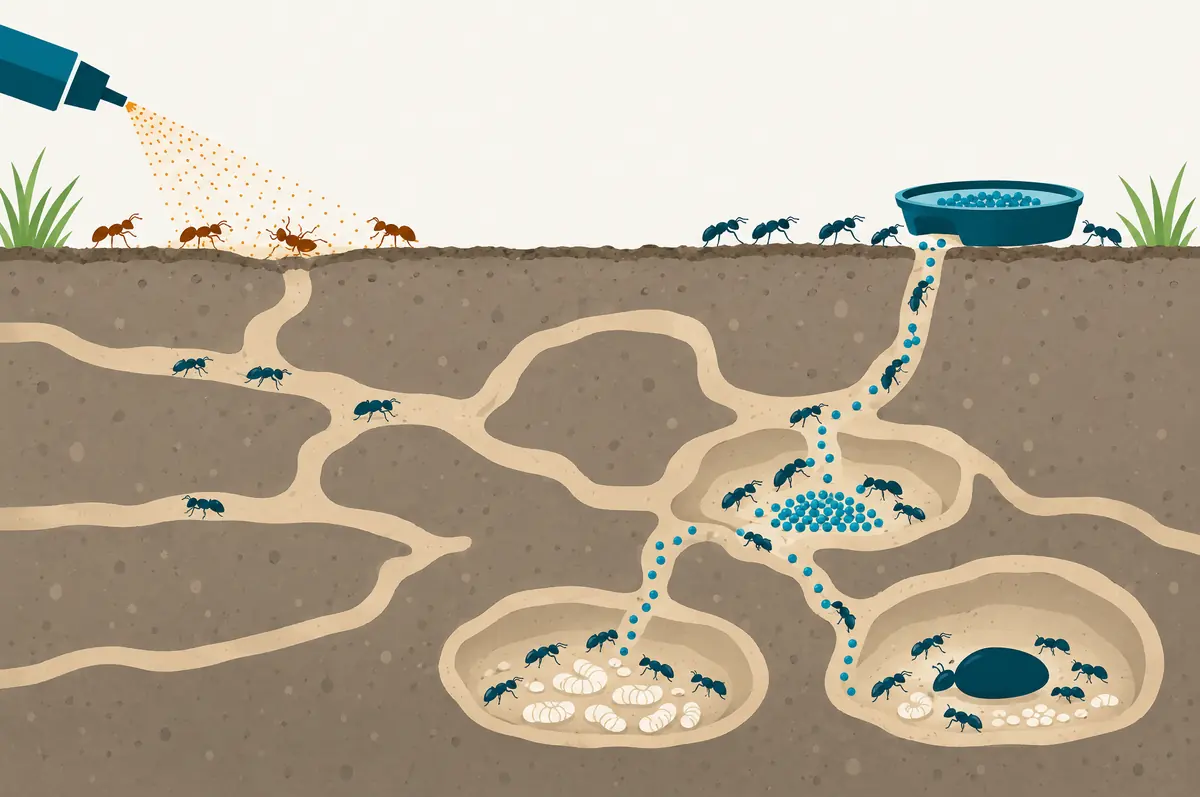
Only a few percent of a colony forages at any time. Contact sprays kill those workers and leave the queens and brood untouched. With polygynous species, repellent residues can trigger budding: the colony splits into several new nests, spreading the problem. Slow-acting baits carried back to the nest and shared by trophallaxis are the standard answer for indoor infestations. Non-repellent perimeter treatments at the foundation, combined with sealing entry points, trimming vegetation off walls and removing moisture, address outdoor pressure.
Vegalab's development program
Our field experience is that Spider Mite Control, applied at higher concentrations than the crop rate, controls ants on contact. Geraniol is already on the EPA minimum-risk active list and appears in minimum-risk products labeled for ants. We are turning that experience into a defined program: bioassays on target species, residual testing of encapsulated versus neat geraniol, and a label covering structural and premise use with state acceptance. Until that label exists, no Vegalab product is offered for ant control.
Key takeaways
- Only a few percent of an ant colony forages at any time, so contact sprays miss the queens and brood.
- Repellent residues can make multi-queen species such as Argentine and Pharaoh ants bud into several new nests.
- Slow-acting baits shared through the colony are the standard answer for indoor infestations.
- Outdoors, pair non-repellent perimeter treatment at the foundation with sealing entry points, trimming vegetation and removing moisture.
- Carpenter ants excavate damp or damaged wood, so moisture repair can be part of control.
Key facts
- Management of social urban pests relies on baits and non-repellent treatments because foragers are a small fraction of the colony (Rust and Su 2012, Annual Review of Entomology 57:355)
- Geraniol is a permitted active ingredient for minimum-risk pesticides exempt from FIFRA registration when all conditions are met (40 CFR 152.25(f)(1))
- Minimum-risk exemption also requires permitted inerts, prescribed label content and no false or misleading claims (40 CFR 152.25(f)(2) to (f)(3))
- Pharaoh ants are prone to budding into multiple colonies when disturbed (Rust and Su 2012, Annual Review of Entomology 57:355)
How our delivery technology applies
Geraniol kills ants on contact but volatilizes within days, so neat essential-oil barriers lose activity fast and can act as a repellent that pushes colonies to new entry points. A multi-layer biopolymer shell lowers vapor loss from the treated surface and releases geraniol over a longer window, which is what a perimeter barrier needs. Our program measures that residual extension against neat geraniol at defined days.
Questions
How do you get rid of ants in the yard?
Outdoor ant pressure is handled at the building perimeter. Use non-repellent treatments at the foundation, seal entry points, trim vegetation off walls and remove moisture sources. Correct species identification decides whether bait, barrier, moisture repair or nest removal is the right lever.
Why do ants come back after spraying?
Only a few percent of a colony forages at any time, so a contact spray kills those workers and leaves the queens and brood untouched. With multi-queen species, repellent residues can trigger budding, where the colony splits into several new nests and spreads the problem.
Do ant baits work better than sprays?
For indoor infestations, yes. Slow-acting baits are carried back to the nest and shared between workers, so they reach the queen and brood that sprays miss. That is why baits are the standard answer indoors.