


Do ticks die in winter?
Last updated:
No. Ticks survive winter sheltered in leaf litter and under snow, and adult blacklegged (deer) ticks become active on any winter day warm enough to move their legs, usually above freezing1,7. Canadian and Ontario health authorities say ticks can be active at any time of year when temperatures stay above freezing and the ground is free of snow2,3.
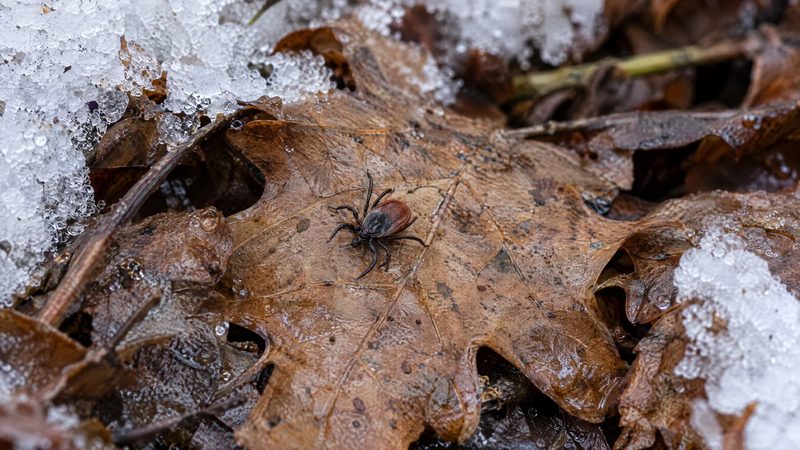
How do ticks survive the winter?
Ticks spend winter in the ground layer rather than dying off. In the blacklegged tick (Ixodes scapularis), also called the deer tick, the two-year life cycle begins in spring, when an adult female lays several thousand eggs in the leaf litter4. Larvae hatch in early summer4, and nymphs pass the winter in the leaf litter and under the snow, where field trials have measured their survival7.
Leaf litter and snow act as insulation. In field trials across Maine, snow cover and leaf litter both contributed significantly to the overwinter survival of blacklegged tick nymphs, in the south and the north of the state7. Survival in northern Maine was no lower than on the southern coast, most likely because deep snowpack protected ticks from very low air temperatures7. Tick experts at the University of Rhode Island put it plainly: ticks do not die in winter1.
In North America, adult blacklegged ticks peak in late October, stay active on any winter day above freezing, and peak again in April, with nymphs following from May1,4. In the Southern Hemisphere winter falls in June to August and the local tick species differ, so regional guidance sets the timing there.
Do deer ticks die in winter?
No. Adult blacklegged ticks left over from their fall activity period become active even in winter whenever temperatures are warm enough for them to move the muscles in their legs, usually above freezing1. Adults are found from early spring to late fall, with one peak in April or May and another in late October, while nymph numbers peak in June and early July4.
Warmer winters increase that winter activity. In a three-year study of wild-caught adult female blacklegged ticks from Atlantic Canada, warming conditions increased activity throughout the overwintering period8. Individual ticks varied widely: some stayed largely dormant for several weeks, while others were active almost daily8. During the very mild winter of early 2023, adult blacklegged ticks, which carry the Lyme disease agent, were out and biting people and pets across the eastern United States1.
Does cold weather kill ticks?
Cold slows ticks far more often than it kills them. In the Maine trials, ticks survived well even where ambient conditions were extremely cold, and the authors concluded that overwinter survival is not the only factor limiting where blacklegged ticks live7. Deep snowpack shields ticks in the litter from low air temperatures, so a cold snap above the snow does far less harm than the thermometer suggests7.
Species differ in how they meet the cold, which explains why people see different ticks at different times of year.
| Tick | Cold-season behavior |
|---|---|
| Blacklegged or deer tick (Ixodes scapularis) | Adults peak in late October and stay active on winter days above freezing1,4 |
| American dog tick (Dermacentor variabilis) | Adults active April to August, peaking in May and June; not active in October and November5 |
| Winter or moose tick (Dermacentor albipictus) | Larvae quest from late summer through fall and stay on one host all winter; rarely bites people6 |
Are ticks active in winter in Ontario and the rest of Canada?
Yes, on mild days. Ontario's provincial guidance says ticks are most active in spring and summer but can be found at any time of the year when the temperature is above freezing (0 degrees C)3. Federal guidance adds that ticks can be active whenever the temperature is consistently above freezing and the ground is not covered by snow2. People are most likely to meet ticks in spring, summer and fall, but when conditions are favorable ticks can be active in any month2.
Blacklegged tick populations are spreading in Canada, partly because of climate change, and the ticks also travel on birds and deer, so they can turn up outside known risk areas2. In Ontario, the chance is low, but an infected tick can be found almost anywhere in the province3.
How do you avoid tick bites in winter?
Treat any thawed, above-freezing day in wooded or brushy areas as tick weather1,2. The same habits that work in summer work in winter.
- Wear light-colored clothing, closed-toed shoes, long sleeves and long pants tucked into socks3.
- Use an insect repellent that lists DEET or icaridin, and follow the product label3.
- Put outdoor clothes in a dryer on high heat for at least 10 minutes before washing to kill ticks on them3.
- After being outdoors, check yourself and your children, including behind the knees, on the head, in the belly button, groin and underarms, and shower as soon as you can3.
- Check pets' skin after time outdoors, remove any ticks you find, and ask your veterinarian about options to keep ticks off them3.
- Remove leaf litter, brush and weeds at the edge of the lawn and from stone walls and wood piles, and keep a gravel or wood-chip border at least one meter wide next to woods or tall grass3.
Key takeaways
- Ticks survive winter in leaf litter and under snow; both act as insulation.
- Adult deer ticks become active on winter days warm enough to move, usually above freezing.
- In Ontario and across Canada, ticks can be active in any month when it is above freezing and the ground is free of snow.
- A mild or harsh winter does not reliably predict how bad the next tick season will be.
- Check yourself, children and pets after time outdoors in any season, and dry outdoor clothes on high heat.
References
- How bad are ticks going to be? (Weird, Warm Winter!)
- Prevention of Lyme disease
- Lyme disease
- Blacklegged Tick or Deer Tick
- American Dog Tick
- Winter Tick or Moose Tick
- Microclimate conditions alter Ixodes scapularis (Acari: Ixodidae) overwinter survival across climate gradients in Maine, United States
- Warming, but not infection with Borrelia burgdorferi, increases off-host winter activity in the ectoparasite, Ixodes scapularis
Frequently asked questions
Does a hard freeze kill ticks?
Usually not the ones sheltered in the ground. In Maine field trials, snow cover and leaf litter significantly improved overwinter survival of blacklegged tick nymphs, and survival in cold northern Maine was no lower than on the warmer southern coast because snowpack protected the ticks7.
Does a mild winter mean more ticks next year?
Can my dog pick up ticks in winter?
Does putting clothes in the dryer kill ticks?
Yes. Ontario's guidance is to put clothes in a dryer on high heat for at least 10 minutes before washing them to kill any ticks3.