


How to get rid of ticks in your yard
Last updated:
Make the yard less suitable for ticks first, then treat only the edge. Keep the core zone around the house open, sunny and mowed, place a wood chip or gravel barrier at least 3 feet wide between lawn and woods, and remove leaf litter and brush each season. Where a labeled acaricide is used, apply it to the edge zone and buffer only, timed to nymph activity.
Ticks concentrate where humidity is high and hosts pass: leaf litter, stone walls and the band where lawn meets woods. Zoning the yard moves activity areas away from those zones and focuses any treatment on a narrow band. Habitat work comes first; products come second and only where labeled.
How do you zone a yard to reduce ticks?
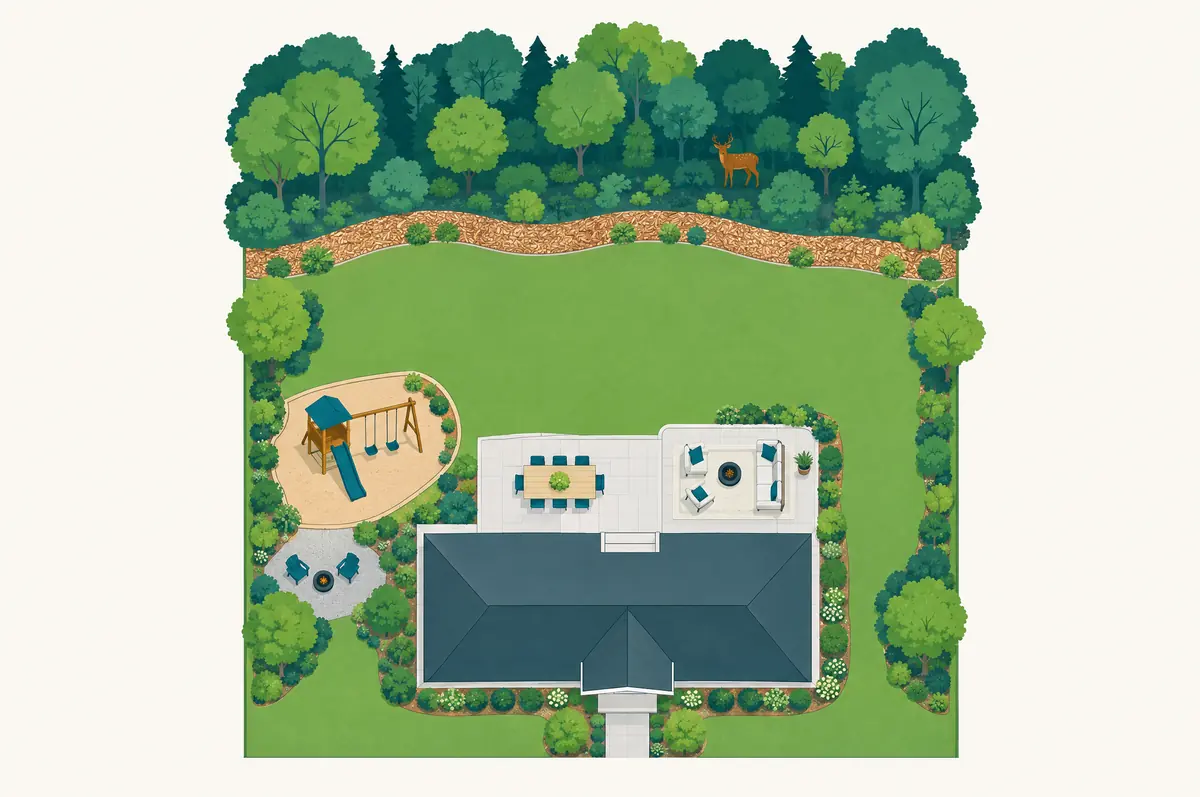
Draw the yard in three zones. The core zone is the house, patio and play areas; keep it open, sunny and mowed. The buffer is a strip at least 3 feet wide of wood chips or gravel between lawn and woods. The edge zone is the first several meters of woodland, stone walls and ornamental beds, where ticks concentrate. Move swings, seating and play equipment into the core zone and away from the edge.
Ground-level glide from shaded leaf litter over a wood-chip and gravel band onto sunlit lawn. No ticks shown.
Which habitat and host changes reduce ticks?
Remove leaf litter and brush from the edge each season. Keep grass short. Stack firewood neatly and in a dry spot, away from the house. Discourage rodents by clearing debris and securing bird feeders, which also draw mice. Deer fencing reduces the number of adult ticks introduced to the yard. Check pets and people after time in edge areas, and consult a veterinarian on pet tick prevention. Keep children's play areas in the sunniest part of the yard.
When and where should you treat a yard for ticks?
Where a labeled acaricide is used, apply it to the edge zone and buffer, not the whole lawn, at the timing the label gives for nymph activity. Use only products labeled for ticks in residential areas. Vegalab Tick Control is in development and is formulated for the tick dose range, roughly 10 to 20 times the geraniol concentration used against spider mites, so tick rates come with the tick label.
Key takeaways
- Ticks concentrate in leaf litter, stone walls and the band where lawn meets woods.
- CDC recommends a 3-foot-wide barrier of wood chips or gravel between lawns and wooded areas.
- Move swings, seating and play equipment into the open, sunny core zone, away from the edge.
- Clear debris and secure bird feeders to discourage rodents; deer fencing reduces the adult ticks brought into the yard.
- Treat the edge zone and buffer, not the whole lawn, with products labeled for ticks in residential areas.
Key facts
- CDC recommends a 3-foot-wide barrier of wood chips or gravel between lawns and wooded areas (CDC, Preventing Tick Bites).
- Blacklegged ticks favor wooded and brushy habitat with leaf litter and are uncommon in open, sunny lawns (Stafford 2007, Tick Management Handbook, Connecticut Agricultural Experiment Station).
- EPA registered nootkatone as a new active ingredient for use in insect repellents and insecticides in August 2020 (US EPA, Nootkatone registration 2020).
- In a residential field trial, lignin-encapsulated nootkatone gave 100% control of Ixodes scapularis from day 8 to 27, while an emulsifiable formulation fell from 100% in week 1 to 0% by week 3 (Bharadwaj et al. 2012, J Med Entomol 49:1035).
How our delivery technology applies
Tick treatments on the edge band fail when the active evaporates from leaf litter within days. Unencapsulated essential oils hold a few days against ticks, and a commercial botanical showed no significant residual after two weeks of weathering. Multi-layer encapsulation is designed to slow geraniol release from the deposit and protect it from UV and oxidation, following the nootkatone precedent. Our planned USDA-ARS test compares encapsulated and neat geraniol residual at days 1, 7, 14 and 28.
Questions
How do you prevent ticks in your yard?
Keep grass short and the area around the house open, sunny and mowed. Remove leaf litter and brush from the edge each season, and stack firewood neatly in a dry spot away from the house. A wood chip or gravel band at least 3 feet wide separates lawn from the wooded edge where ticks concentrate.
How do you get rid of ticks in your yard naturally?
Start with habitat and host changes: clear leaf litter, brush and debris, keep grass short, and secure bird feeders, which also draw mice. Deer fencing reduces the number of adult ticks introduced to the yard. Blacklegged ticks are uncommon in open, sunny lawns, so opening up activity areas reduces encounters before any treatment.
Should you spray the whole lawn for ticks?
No. Apply a labeled acaricide to the edge zone and the buffer, where ticks concentrate, at the timing the label gives for nymph activity. Use only products labeled for ticks in residential areas.
How do you protect pets from ticks in the yard?
Check pets after time in edge areas and consult a veterinarian on pet tick prevention. Keep play and activity areas in the sunniest, most open part of the yard, away from the wooded edge.
Pest management professionals: join our tick residual trial program.