


When are ticks most active?
Last updated:
In most of North America, ticks are most active from spring through fall, and the riskiest stretch runs from about May to July, when blacklegged tick nymphs peak1. Adult blacklegged ticks take over in October and stay active on winter days above about 40 degrees F1,3. Ticks can be active whenever temperatures stay above freezing and the ground is free of snow4.
What months is tick season?
You are most likely to meet ticks in spring, summer and fall, but when conditions are favorable ticks can be active at any time of year4. Tick season is really several overlapping seasons, because each species and each life stage (larva, nymph and adult) has its own window of activity1.
The blacklegged tick, or deer tick (Ixodes scapularis), is active year round in states such as Kentucky, with adults active from October to June and nymphs from May to August3. The lone star tick (Amblyomma americanum) and the American dog tick (Dermacentor variabilis) are spring and summer ticks: in Kentucky their adults and nymphs are active from March through September3. On the Pacific Coast, the western blacklegged tick (Ixodes pacificus) flips the pattern, with adults seeking hosts from late fall through spring2.
| Tick | Life stage | Peak activity |
|---|---|---|
| Blacklegged (deer) tick, Ixodes scapularis | Nymph | May to July in the Northeast1; May to August in Kentucky3 |
| Blacklegged (deer) tick | Adult | October to November, warm winter days, and a second peak in March to April1 |
| Blacklegged (deer) tick | Larva | Peak in August1 |
| Lone star tick, Amblyomma americanum | Adult and nymph | March through September in Kentucky3; adults from mid-April and nymphs from mid-May in Connecticut1 |
| Lone star tick | Larva | Late summer and early fall1,3 |
| American dog tick, Dermacentor variabilis | Adult | Mid-April to mid-August, peaking in June, in Connecticut and Massachusetts1 |
| Western blacklegged tick, Ixodes pacificus | Nymph | Most active March to July in northwestern California2 |
| Western blacklegged tick | Adult | Late fall through spring2 |
| Rocky Mountain wood tick, Dermacentor andersoni | Adult | Appears February or March, peaks April and May, declines by July1 |
| Brown dog tick, Rhipicephalus sanguineus | All stages | Found almost exclusively indoors in the North1; appears active year round in other states3 |
In North America, tick risk climbs from March and April, peaks with blacklegged tick nymphs from May to July, and returns with adult blacklegged ticks in October and November and on mild winter days1,3. In the Southern Hemisphere the calendar is reversed, so the equivalent late-spring peak falls around November to January.
Why are late spring and early summer the riskiest months?
In the northern states the blacklegged tick has a two-year life cycle1. Females lay eggs in May, larvae hatch in mid to late July and peak in August, and after feeding they molt into nymphs that appear the following late spring1. May, June and July are the peak months for nymphal tick activity in the Northeast1.
Nymphs drive most of the risk. They are about the size of a pinhead, hard to spot, and active in late spring and summer, when people spend the most time outdoors1. About 98% of Lyme disease cases are associated with the bite of the nymphal stage, and about 75% are linked to activities around the home such as play and yard or garden work1. In California the pattern is similar: Lyme disease cases peak from May to July, following the peak abundance of western blacklegged tick nymphs from April to June2.
Are ticks active in fall and winter?
Yes. Blacklegged tick nymphs molt into adults that appear in the fall, and adult blacklegged ticks do not hibernate: they may be active on warm winter days and again the following spring1. In Connecticut, adults are active in October and November, during warm spells from December to February, and have a second peak in March and April1. Most ticks pass the winter in a resting state, but blacklegged tick adults remain active when temperatures are above 40 degrees F3.
Adult blacklegged ticks feed mainly on white-tailed deer1. They are more often infected than nymphs, because each tick has had two chances to pick up the Lyme disease bacterium, once as a larva and once as a nymph1. Adults are larger and easier to spot, and they are active when people spend less time outdoors, so they are linked to fewer cases1.
Fall activity shows up well beyond New England. In a 2020 to 2022 field survey across Kansas and Oklahoma, blacklegged ticks and winter ticks (Dermacentor albipictus) were active in fall and winter, and adult blacklegged tick activity peaked in late October6. In the north coast and Sierra Nevada foothills of California, adult western blacklegged ticks are most active in winter2.
What weather and time of day are ticks most active in?
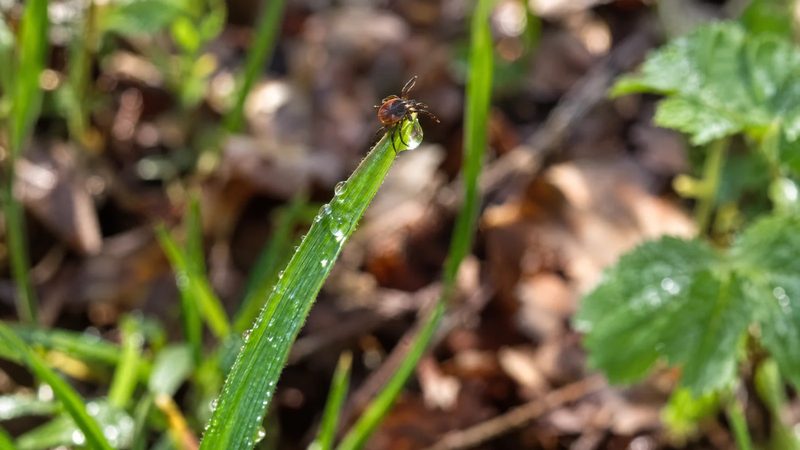
Ticks look for hosts by questing: they cling to leaf litter or vegetation with their back legs and hold their front legs outstretched1. They do not jump, fly or drop from trees; they grab passing hosts from leaf litter and grass tips, so most ticks are picked up on the lower legs1.
Humidity matters more than almost anything else. Blacklegged ticks survive poorly in dry air, and they quest lower when it is hot and dry, probably because they must descend to moist spots to rehydrate5. In the laboratory, blacklegged tick nymphs can survive more than 6 months at 93 to 100% relative humidity, but over half die in less than 4 days at 65% relative humidity1. One study summarized in the same research found that questing peaks at about 25 degrees C (77 degrees F) and drops as temperatures climb higher5.
Time of day follows the same logic. On clear, warm days, people are more likely to meet adult western blacklegged ticks in the early morning or late afternoon, because adult activity is highest when humidity is high and temperatures are cool2.
Does tick season change by region?
It does, and it is shifting. In the Kansas and Oklahoma survey, lone star ticks made up 97% of the ticks collected, and lone star ticks, Gulf Coast ticks (Amblyomma maculatum) and American dog ticks were active in spring and summer6. Lone star tick activity peaked anywhere from March to early June depending on the site, up to two months earlier than in historical studies, a change the authors attribute in part to a warming climate6.
In the far West, seasons stretch further. Western blacklegged tick nymphs in northwestern California can be found from January through October, and in central and southern California adults quest from late November until late April or early May2. The Pacific Coast tick (Dermacentor occidentalis) is active all year but most abundant in April and May1. In Kentucky, the seasonality of the Gulf Coast tick is still under study, and in other states it appears active from March to November3.
When should you check for ticks and treat the yard?
Check for ticks after every outdoor visit during the active months above, and keep checking through fall and on mild winter days in blacklegged tick country1,4. Checking for ticks and removing attached ticks promptly is probably the most important and effective way to prevent infection, because transmission of the Lyme disease bacterium takes 36 to 48 hours or more after a tick attaches1. Many blacklegged and lone star ticks survive a warm or hot wash, but they cannot withstand one hour in a hot dryer, so dry outdoor clothing on high heat when you come in1.
Around the home, woodland edges and leaf litter are high-risk areas for nymphs, and most ticks found in lawns are within 3 yards of the lawn perimeter along woods, stone walls or plantings1. Timing matters for any yard treatment: the Connecticut handbook advises targeting nymphal blacklegged ticks with one application in May or early June, an optional application in October against adults, and treatment of American dog ticks any time after adults emerge in spring1. If you use a tick product, follow the product label.
Key takeaways
- Tick risk peaks from about May to July, when blacklegged tick nymphs are active and hardest to see.
- Adult blacklegged ticks are active in October and November, on winter days above about 40 degrees F, and again in early spring.
- Lone star and American dog ticks are mainly spring and summer ticks, active roughly March through September in Kentucky.
- Ticks quest most when it is humid and mild, and hot, dry weather pushes them down into the leaf litter.
- Treat yards for nymphs in May or early June and for adults in October, following the product label.
References
- Tick Management Handbook: An integrated guide for homeowners, pest control operators, and public health officials for the prevention of tick-associated disease (Bulletin No. 1010, revised edition)
- Lyme Disease in California (Pest Notes Publication 7485)
- Ticks and Disease in Kentucky (ENTFACT-618)
- Lyme disease: Spread, prevention and risks
- The impact of temperature and precipitation on blacklegged tick activity and Lyme disease incidence in endemic and emerging regions
- Phenology of five tick species in the central Great Plains
Frequently asked questions
Is there any month with no ticks?
Not reliably. Ticks can be active at any time of year when temperatures stay above freezing and there is no snow cover4. Blacklegged ticks are listed as active year round in Kentucky3, and brown dog ticks can live and breed indoors, where they complete their life cycle in about two months under favorable conditions1.
Does hot, dry weather reduce ticks?
It reduces tick activity. A long-term study in Millbrook, New York, found that hot, dry summer weather reduced the questing activity of blacklegged tick nymphs, and in long-established Lyme disease areas, years with more hot, dry days during the nymph season had fewer cases5. Dry weather in the previous year's larval season did not reduce nymph numbers the following year5.
How long can ticks live without a host?
Longer than most people expect. American dog ticks can survive more than two years to almost three years without feeding if no hosts are available, with recorded survival of up to 540 days for larvae, 584 days for nymphs and 1,053 days for adults, although typical survival is much shorter1.