


Lone star tick: identification and yard control
Last updated:
The lone star tick (Amblyomma americanum) is an aggressive, fast-moving three-host tick named for the single white or silver spot on the adult female's scutum. Its range has expanded from the southeastern United States into the Midwest and Northeast, and all three active stages bite people, pets and livestock. Yard control relies on clearing brush and tall grass, mowing margins and limiting deer access.
The lone star tick is an aggressive, fast-moving three-host tick whose range has expanded from the southeastern United States into the Midwest and Northeast. All three active stages bite people, pets and livestock, and it tolerates drier, sunnier habitat than the blacklegged tick.
How do you identify a lone star tick?
Adult females carry a single white or silver spot on the scutum, which gives the species its name. Males have faint white markings around the edge of the body. Nymphs are small and brown without the spot, and larvae emerge in large clusters that can leave dozens of bites at once. The mouthparts are long, so attachment is firm. Correct identification matters because habitat programs differ between species, so send a specimen to an extension or diagnostic lab for confirmation.
Where do lone star ticks live?
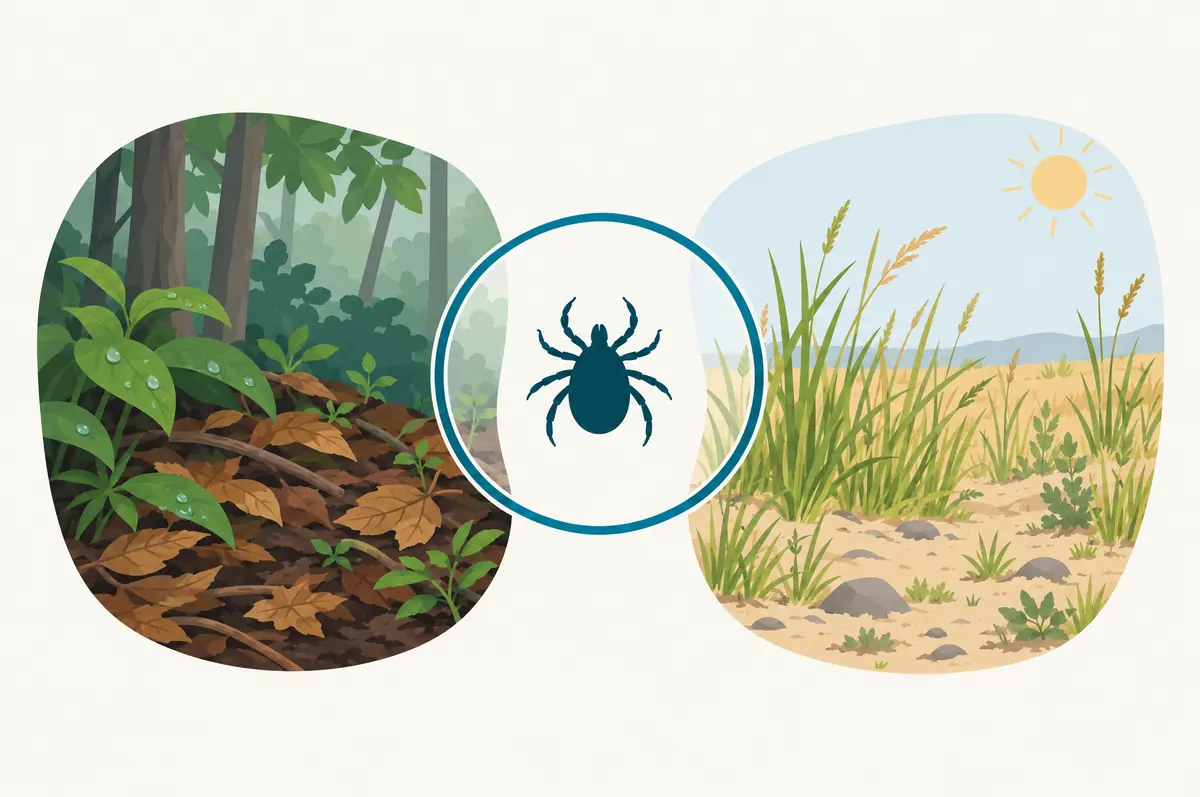
Unlike the blacklegged tick, which waits on vegetation, lone star ticks actively run toward hosts, drawn by carbon dioxide. They occupy second-growth woods, brushy old fields and woodland edges and tolerate lower humidity. White-tailed deer are the key host for adults and drive local abundance; wild turkeys also support immature stages. Populations can be very high where deer densities are high, and all stages may be active from early spring through late summer.
How do you control lone star ticks in a yard?
Habitat management carries most of the load: clear brush and tall grass at property edges, keep pasture margins mowed, and reduce deer access to yards and pens with fencing. Livestock and dog runs near woodland should sit on mowed or graveled ground. Perimeter treatment targets brush edges during peak activity. Vegalab tick control is in development and is not labeled for ticks; follow current product labels for any acaricide you use.
Key takeaways
- Adult females carry a single white or silver spot; males have faint white markings around the body edge.
- Lone star ticks actively run toward hosts, drawn by carbon dioxide.
- The species tolerates drier, sunnier habitat than the blacklegged tick.
- White-tailed deer are the key host for adults and drive local abundance.
- All stages may be active from early spring through late summer.
Key facts
- The lone star tick range has expanded north and west from the southeastern United States over recent decades (Sonenshine 2018, Int J Environ Res Public Health 15:478)
- White-tailed deer are the principal host supporting Amblyomma americanum populations (Childs and Paddock 2003, Annu Rev Entomol 48:307)
- Amblyomma americanum is an aggressive human-biting tick; nymphs and adult females bite people most often (US CDC, Where Ticks Live)
How our delivery technology applies
Because lone star ticks hunt across open, drier ground, a perimeter treatment has to hold on sunlit vegetation, where evaporation of a neat essential oil is fastest. Encapsulation slows that loss. Our tick trials will measure residual on vegetation and leaf litter so edge treatments can be judged on weeks of cover rather than days.
Questions
Do lone star ticks bite people?
Yes. All three active stages bite people, pets and livestock, and nymphs and adult females bite people most often. The mouthparts are long, so attachment is firm.
Why do lone star tick larvae leave so many bites?
Larvae emerge in large clusters that can leave dozens of bites at once. Nymphs are small and brown and lack the white spot of the adult female.
When are lone star ticks active?
All stages may be active from early spring through late summer. Populations can be very high where deer densities are high.
How do lone star ticks find a host?
Unlike the blacklegged tick, which waits on vegetation, lone star ticks actively run toward hosts, drawn by carbon dioxide. That widens the area a yard program must cover.
Start with habitat: follow the perimeter barrier protocol for brush edges.