

Coccidiosis in chickens
Last updated:
Coccidiosis in chickens comes from Eimeria parasites shed as oocysts in feces. After sporulating in warm, moist litter, each oocyst becomes infective and can survive for months, and its layered wall resists most routine disinfectants. Control rests on anticoccidial feed programs or live vaccines under veterinary direction, litter moisture management, and heat and drying of litter and houses between flocks.
Coccidian oocysts are among the hardest biological targets on a farm. Their layered wall resists most routine disinfectants, including oxidizers at practical concentrations. Coccidiosis control is led by veterinary and management programs, with disinfection in a supporting role.
Why do coccidia oocysts resist disinfectants?
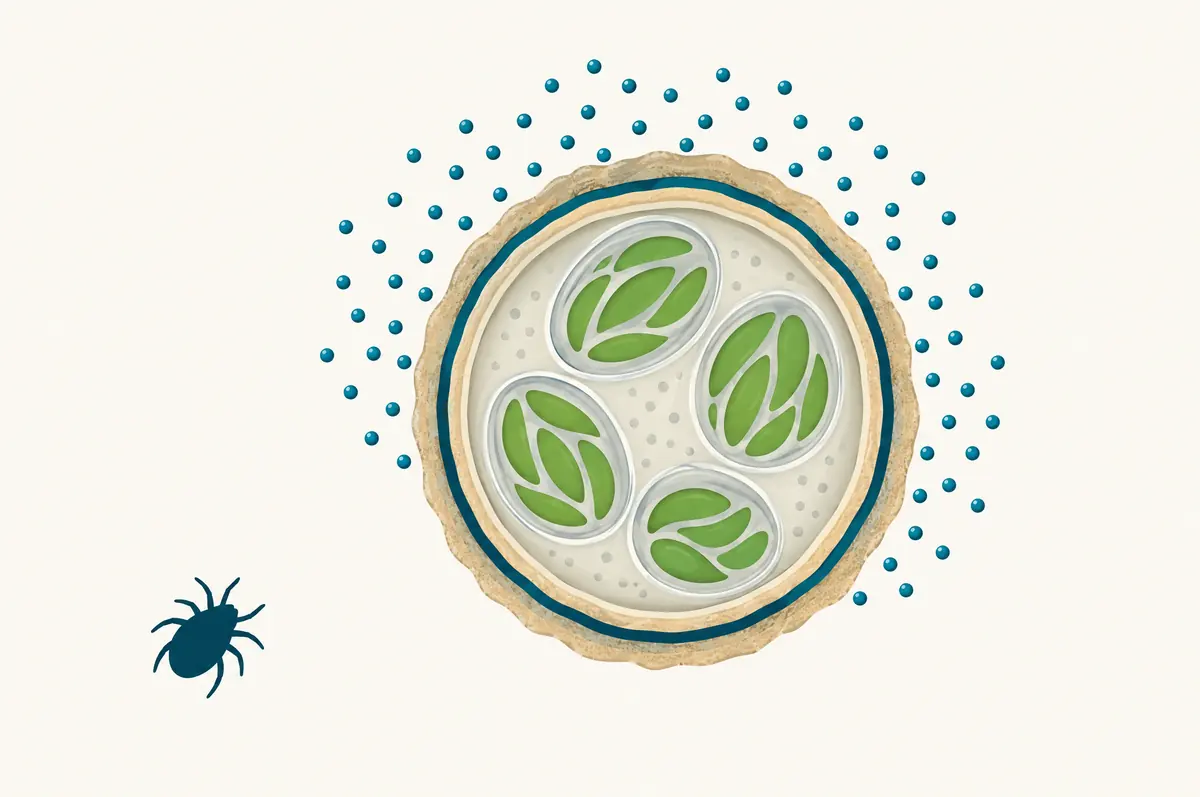
Eimeria species in poultry, cattle, sheep and rabbits, and Cystoisospora in pigs and dogs, shed oocysts in feces. After sporulation in warm, moist litter, each oocyst becomes infective. The oocyst wall is a bilayer rich in cross-linked proteins and lipids that is nearly impermeable to water-soluble chemicals. Oocysts survive for months in litter and soil. Most disinfectants that inactivate bacteria and enveloped viruses in minutes have little effect on them at label rates.
What reduces oocyst load in litter?
Heat and desiccation are the most reliable tools: steam cleaning, composting or windrowing litter to high temperature, and letting houses dry thoroughly during downtime. A small number of products carry oocysticidal claims, typically based on cresols, ammonia-releasing chemistry or specific amine formulations. In poultry, control rests on anticoccidial feed programs or live vaccines under veterinary direction, plus litter moisture management. Moving birds onto fresh or well-composted litter gives the lowest starting challenge.
Does chlorine dioxide inactivate coccidia oocysts?
Chlorine dioxide can inactivate protozoan oocysts, but only at concentration and time products far above routine surface disinfection. Water treatment research on Cryptosporidium parvum found that chlorine dioxide achieved only partial inactivation at concentrations and contact times typical of drinking water practice. Vetpure Disinfectant is positioned for bacteria, enveloped viruses and biofilm, and it fits into a coccidiosis program alongside heat, drying and veterinary control. Oocysts in litter face far higher organic load than in treated water.
Key takeaways
- Eimeria oocysts become infective after sporulating in warm, moist litter.
- The oocyst wall is nearly impermeable to water-soluble chemicals, and oocysts survive for months in litter and soil.
- Heat and desiccation are the most reliable tools: steam cleaning, composting litter to high temperature and drying houses thoroughly.
- In poultry, control rests on anticoccidial feed programs or live vaccines under veterinary direction.
- Moving birds onto fresh or well-composted litter gives the lowest starting challenge.
Key facts
- Chlorine dioxide at 1.3 mg/L for one hour produced about 90% inactivation of Cryptosporidium parvum oocysts (Korich et al. 1990, Applied and Environmental Microbiology 56:1423)
- Coccidiosis control in poultry relies on anticoccidial drugs and live vaccines (Chapman 2014, Poultry Science 93:501)
- Coccidian oocysts are resistant to many commonly used chemical disinfectants (Daugschies et al. 2002, Veterinary Parasitology 103:299)
How our delivery technology applies
The oocyst wall excludes water-soluble oxidants, which is why heat, drying and veterinary programs lead against it. In the same house, Vetpure's role is bacteria, enveloped viruses and biofilm where registered, and our encapsulation research is studying how lipophilic actives can stay in contact with litter for longer.
Questions
How is coccidiosis in chickens controlled?
Coccidiosis control in poultry rests on anticoccidial feed programs or live vaccines under veterinary direction. Litter moisture management supports it. Disinfection plays only a supporting role.
Do disinfectants kill coccidia oocysts?
Most disinfectants that inactivate bacteria and enveloped viruses in minutes have little effect on oocysts at label rates. A small number of products carry oocysticidal claims, typically based on cresols, ammonia-releasing chemistry or specific amine formulations.
How long do coccidia oocysts survive in litter?
Oocysts survive for months in litter and soil. That is why heat, composting or windrowing litter to high temperature, and thorough drying during downtime matter more than chemical treatment.
Does chlorine dioxide kill coccidia?
Chlorine dioxide can inactivate protozoan oocysts, but only at concentrations and contact times far above routine surface disinfection. Water treatment research on Cryptosporidium parvum found only partial inactivation at concentrations and times typical of drinking water practice, and oocysts in litter face far higher organic load.
Planning a between-flock program? Ask us where Vetpure fits and where it does not.