


Cockroaches in facilities
Last updated:
German cockroaches breed indoors year round near warmth, moisture and food, and many populations resist several insecticide classes, so spray-only programs fail in kitchens, feed rooms and animal housing. The working standard is a monitoring trap count, sanitation and harborage removal, baits placed and rotated by mode of action, and repeat counts to confirm the population is actually falling.
German cockroaches breed indoors year round and resist many insecticide classes, so spray-only programs fail. Sanitation, harborage reduction, baits rotated by mode of action and monitoring are the working standard. Vegalab is developing an encapsulated geraniol concentrate for crawling insects, with the label and state acceptance following its trials.
Which cockroach species infest facilities?
The German cockroach (Blattella germanica) lives only indoors, near warmth, moisture and food: kitchens, feed rooms, piggeries and animal housing. A female carries an egg case (ootheca) of about 30 to 40 eggs until hatch, and a population can move from a few adults to thousands within months. The American cockroach (Periplaneta americana) is larger, lives in sewers, drains, basements and warm service areas, and moves indoors from outside. Oriental and smoky brown cockroaches are common peridomestic species. Each has different harborage, so inspection decides placement.
How does resistance change cockroach control?
German cockroach populations carry resistance to pyrethroids, organophosphates and several bait actives, often multiple classes at once. In a controlled field study, populations with existing resistance survived single-product programs and some grew during treatment, while only a rotation of effective actives drove numbers down. Glucose aversion has also evolved against sweet bait matrices. Practical programs start with a monitoring trap count, remove harborage and food, place baits by mode of action, and confirm reduction with repeat counts rather than assuming a treatment worked.
Where does geraniol fit in cockroach control?
Our field experience is that Spider Mite Control at higher concentrations controls cockroaches on contact. Geraniol is an EPA minimum-risk active used in products labeled for cockroaches, and its mode of action differs from the neurotoxic classes cockroaches resist. That makes it a rotation candidate. The limit is residual: a neat oil loses activity in days. Our crawling insect program tests encapsulated geraniol for residual, then pursues a structural label with state acceptance. No current Vegalab label covers cockroaches.
Key takeaways
- The German cockroach lives only indoors, near warmth, moisture and food.
- A female carries an egg case of about 30 to 40 eggs, and a population can grow from a few adults to thousands within months.
- German cockroach populations resist pyrethroids, organophosphates and several bait actives, often several classes at once.
- Some strains have evolved glucose aversion and reject sweet bait matrices.
- Start with a monitoring trap count and confirm reduction with repeat counts.
Key facts
- Single-active treatments eliminated German cockroach populations only when starting resistance was low, and rotations and mixtures were undermined by cross-resistance (Fardisi et al. 2019, Scientific Reports 9:8292)
- Glucose-averse German cockroach strains reject sweet bait matrices (Wada-Katsumata, Silverman and Schal 2013, Science 340:972)
- Geraniol is a permitted minimum-risk active ingredient (40 CFR 152.25(f)(1))
- Integrated control of urban social and structural pests depends on sanitation, baiting and monitoring rather than broadcast sprays (Rust and Su 2012, Annual Review of Entomology 57:355)
How our delivery technology applies
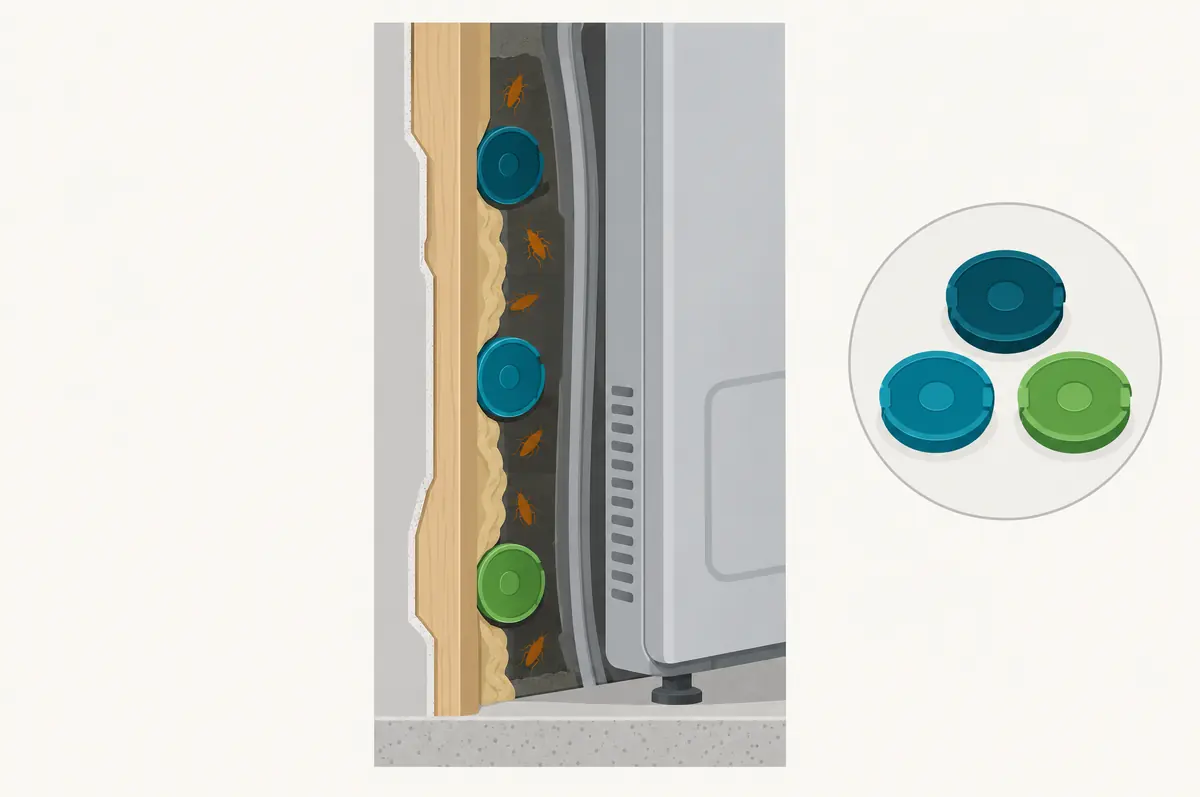
Cockroaches rest in cracks and voids that a spray reaches once. A residual deposit must stay active on that surface long enough for insects to contact it on later nights. Neat geraniol evaporates within a few days. Encapsulation in multi-layer biopolymer shells holds the active in a less volatile form on the surface and releases it over time, and capsules can be sized to lodge in crevices. Residual is reported at defined days against a neat control.
Questions
Why do cockroach sprays stop working?
German cockroach populations carry resistance to pyrethroids, organophosphates and several bait actives, often multiple classes at once. In a controlled field study, resistant populations survived single-product programs and some grew during treatment. Only a rotation of effective actives drove numbers down.
Why do cockroaches ignore bait?
Glucose aversion has evolved in German cockroaches, so some strains reject sweet bait matrices. Rotating baits by mode of action and confirming results with trap counts addresses this.
Where do American cockroaches come from?
The American cockroach is larger than the German cockroach and lives in sewers, drains, basements and warm service areas. It moves indoors from outside, so inspection decides where to place control.
How fast do German cockroaches multiply?
A female carries an egg case of about 30 to 40 eggs until hatch. A population can move from a few adults to thousands within months.
Pest management professionals can apply to join our cockroach residual trials.