

Curcumin absorption explained
Last updated:
Curcumin is the main curcuminoid in turmeric root (Curcuma longa). It is poorly absorbed for three reasons: it barely dissolves in water, about 90% degraded within 30 minutes in a pH 7.2 buffer at body temperature, and the curcumin that is absorbed is quickly converted to glucuronides and sulfates in the gut wall and liver.
Curcumin fails on three delivery fronts at once: it barely dissolves in water, it degrades within minutes at intestinal pH, and what is absorbed is quickly conjugated. That is why oral doses of several grams produce low or undetectable plasma levels of free curcumin. It is a food and supplement ingredient, not an approved drug.
What is curcumin?
Curcumin (368 Da) is the main curcuminoid in turmeric root (Curcuma longa), alongside demethoxycurcumin and bisdemethoxycurcumin. It shows anti-inflammatory and antioxidant activity in many cell assays, but it is also flagged by medicinal chemists as a pan-assay interference compound: it is unstable, reactive and aggregates, so many in vitro hits may not reflect a specific mechanism. Human trial results are heterogeneous and often use differently formulated products, which makes pooling difficult.
What is curcumin's regulatory status?
Turmeric is a food and spice. Curcumin is permitted as a food color in the EU (E 100) with an acceptable daily intake of 3 mg/kg body weight set by EFSA, and it is widely sold as a dietary supplement ingredient in the US. It has no approved medicinal indication in the US or EU, and it is not on the WADA Prohibited List. Cases of liver injury associated with high-bioavailability turmeric supplements have been reported, which regulators in several countries have reviewed.
Why is curcumin poorly absorbed?
Aqueous solubility is in the low microgram per milliliter range or below. In phosphate buffer at pH 7.2 and 37 C, about 90% of curcumin degraded within 30 minutes, mainly to ferulic acid and vanillin-type products. Absorbed curcumin is converted to glucuronides and sulfates in the gut wall and liver. Co-administration of 20 mg piperine raised curcumin exposure about 20-fold in humans by inhibiting glucuronidation, which also illustrates the drug-interaction risk of that approach.
Which formulation routes are in use?
Marketed approaches include phospholipid complexes, colloidal dispersions with gum ghatti, micellar solubilization with polysorbate, cyclodextrin inclusion and polymer nanoparticles. Reported exposure gains range widely and are often measured against a poorly absorbed reference, so fold-increase figures should be read with the comparator in mind. A second question is what to measure. Many studies report total curcuminoids after enzymatic deconjugation, which inflates apparent exposure compared with free curcumin. Formulators and buyers should confirm which analyte, which comparator and which dose were used before comparing products.
Key takeaways
- Curcumin barely dissolves in water, degrades quickly at intestinal pH and is rapidly conjugated after absorption.
- Piperine raised curcumin exposure about 20-fold in humans by inhibiting glucuronidation, which also shows the drug-interaction risk of that approach.
- Fold-increase figures are often measured against a poorly absorbed reference.
- Many studies report total curcuminoids after deconjugation, which inflates apparent exposure compared with free curcumin.
- Curcumin has no approved medicinal indication in the US or EU.
Key facts
- Curcumin degraded about 90% within 30 minutes in pH 7.2 phosphate buffer at 37 C (Wang et al. 1997, J Pharm Biomed Anal 15:1867)
- Piperine at 20 mg increased curcumin bioavailability about 2000% in human volunteers (Shoba et al. 1998, Planta Med 64:353)
- Poor absorption, rapid metabolism and rapid elimination limit curcumin bioavailability (Anand et al. 2007, Mol Pharm 4:807)
- Curcumin is classed as an unstable, reactive, pan-assay interference compound with no double-blinded placebo-controlled trial success (Nelson et al. 2017, J Med Chem 60:1620)
- EFSA set an ADI of 3 mg/kg bw/day for curcumin as food additive E 100 (EFSA ANS Panel 2010, EFSA Journal 8(9):1679)
How our delivery technology applies
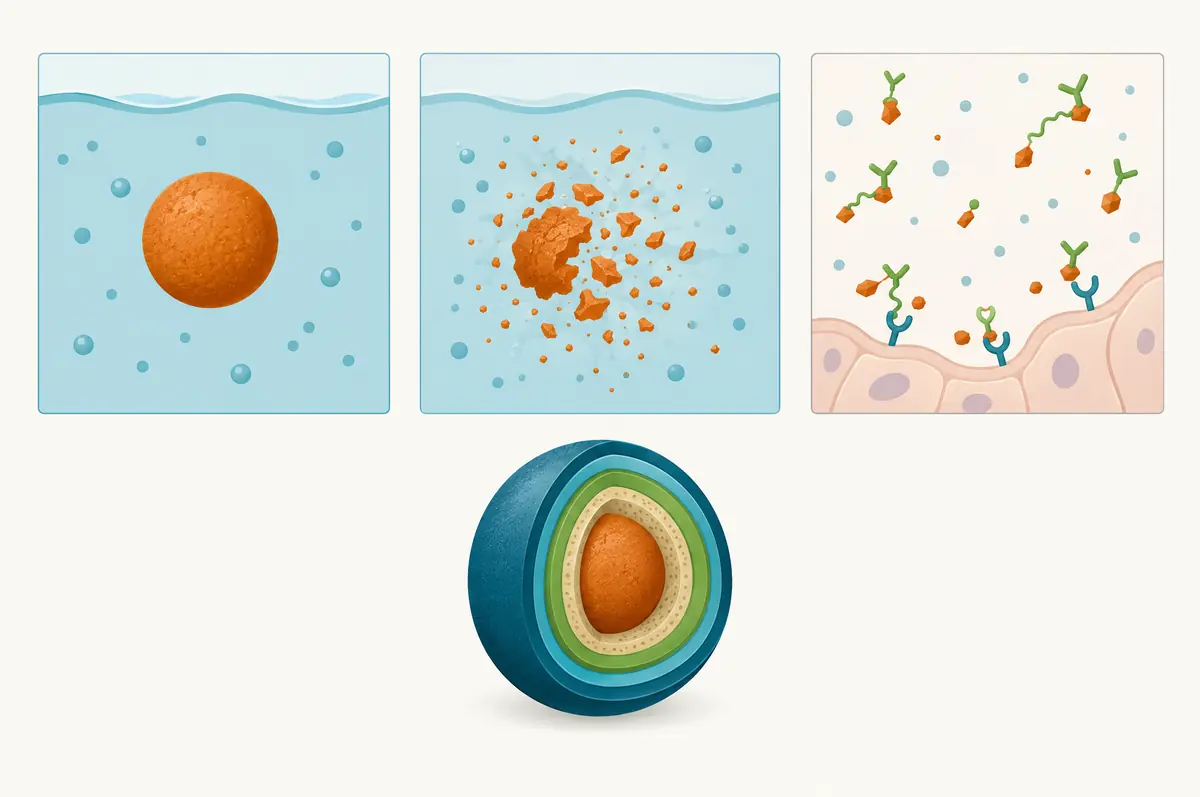
Curcumin is a strong case for multi-layer encapsulation because two of its three failures happen before absorption. A lipid core keeps curcumin in solution; an acid-stable inner layer and an outer layer that releases in the small intestine limit time spent at neutral pH in free form; mucoadhesive polymers hold particles at the epithelium. Encapsulation does not stop hepatic conjugation, so the realistic goal is higher and more consistent free curcumin exposure, measured against a defined comparator.
Questions
What is curcumin's bioavailability?
Low. Curcumin barely dissolves, degrades quickly at intestinal pH and is rapidly conjugated, so plasma levels of free curcumin are low or undetectable. Encapsulation does not stop conjugation in the liver.
Does piperine improve curcumin absorption?
In human volunteers, piperine raised curcumin exposure about 20-fold by inhibiting glucuronidation. The same mechanism illustrates the drug-interaction risk of that approach.
How should curcumin bioavailability claims be compared?
Confirm which analyte, which comparator and which dose were used. Many studies report total curcuminoids after enzymatic deconjugation, which inflates apparent exposure compared with free curcumin, and fold-increase figures are often measured against a poorly absorbed reference.
Is curcumin an approved drug?
No. Turmeric is a food and spice, curcumin is permitted as a food color in the EU (E 100) and it is sold as a dietary supplement ingredient in the US. Cases of liver injury associated with high-bioavailability turmeric supplements have been reported and reviewed by regulators in several countries.
Request a feasibility study for a pH-protected, lipid-core curcumin format.