


Why is berberine poorly absorbed?
Last updated:
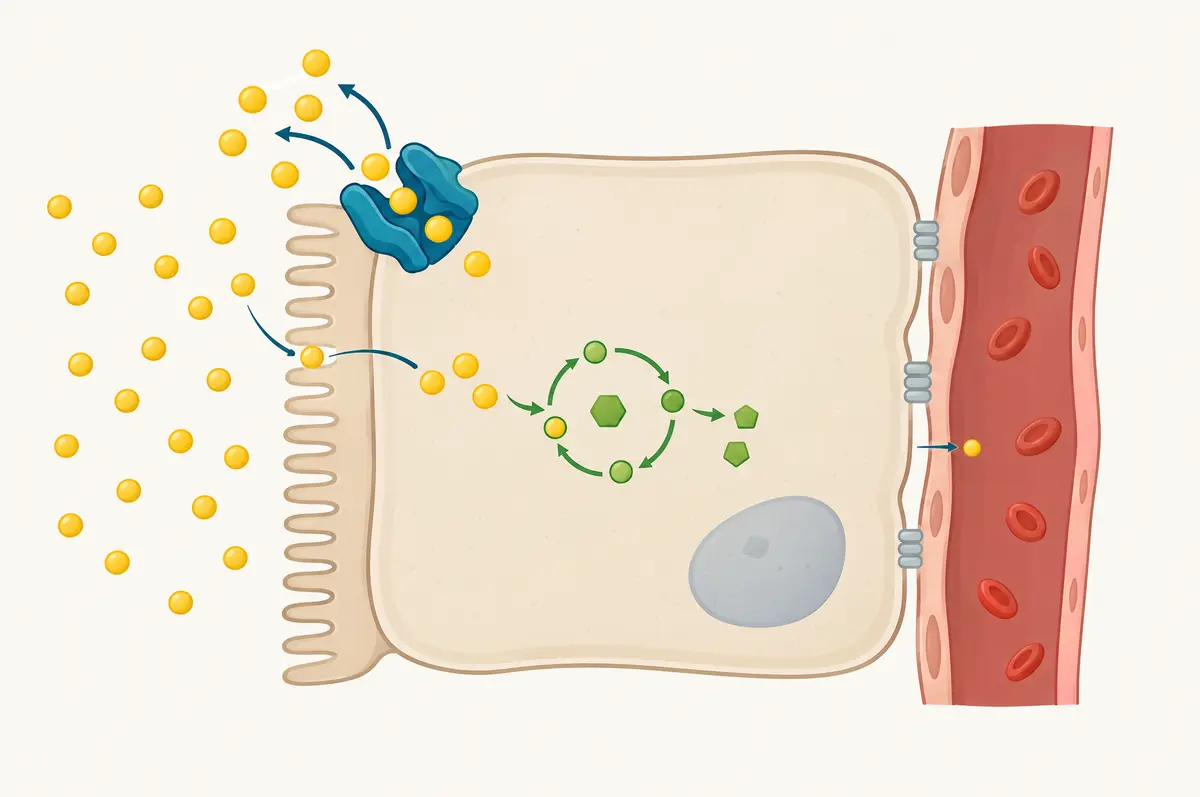
Berberine is a permanently charged isoquinoline alkaloid from Berberis, Coptis and goldenseal. Its salt dissolves in water, but the positive charge makes it poorly permeable, P-glycoprotein pumps it back into the gut lumen, and the gut wall and liver metabolize much of the rest. In rats, absolute oral bioavailability was 0.68%, with the gut wall responsible for most of the loss.
Berberine reaches blood poorly: oral bioavailability in rats is under 1% because of efflux by P-glycoprotein and extensive first-pass metabolism in the gut wall. It is sold as a dietary supplement in the US, and it inhibits drug-metabolizing enzymes, which makes drug interactions a real formulation and labeling issue.
What is berberine?
Berberine is a permanently charged isoquinoline alkaloid (cation 336 Da) from Berberis, Coptis and goldenseal. In cells and animals it activates AMPK and affects glucose and lipid metabolism, and it acts on the gut microbiome, which may explain effects despite low plasma levels. Randomized trials in people with type 2 diabetes and dyslipidemia, mostly from China, report changes in glucose and lipid markers. Those are trial findings in defined patient groups, not a basis for disease claims on a supplement.
What is berberine's regulatory status?
In the US berberine is a dietary supplement ingredient. In China, berberine hydrochloride is a long-established over-the-counter medicine for diarrhea. It is not an approved drug in the US or EU and not on the WADA Prohibited List. Berberine inhibits CYP3A4 and CYP2D6 in human studies and is contraindicated in pregnancy in several herbal monographs because of concerns about bilirubin displacement in newborns. Formulators must also consider label warnings on medication use and pregnancy in each market.
What limits berberine absorption?
Berberine is water-soluble as a salt but poorly permeable because it carries a permanent positive charge. It is actively pumped back into the gut lumen by P-gp, and it is metabolized in the intestinal wall and liver to demethylated and conjugated products. In rats, absolute oral bioavailability was 0.68%, with the gut wall responsible for most of the loss. High doses split over the day and gastrointestinal side effects such as constipation and cramping are the practical consequences.
Which formulation routes are in use?
Researchers have tested P-gp inhibiting excipients (for example TPGS), phospholipid complexes, solid lipid nanoparticles and dihydroberberine, a reduced prodrug with better permeability that converts back to berberine. Each changes exposure but none has an approved drug precedent. Split dosing with meals is the usual label approach to manage gastrointestinal effects. Because berberine is bright yellow and intensely bitter, taste masking also matters for any format other than a capsule. Any exposure gain should be interpreted alongside the interaction data: raising systemic berberine also raises its capacity to inhibit CYP enzymes, which is a labeling question as much as a formulation one.
Key takeaways
- In rats, berberine's oral bioavailability was 0.68%, limited by P-glycoprotein efflux and first-pass metabolism in the gut wall.
- In cells and animals it activates AMPK, and it also acts on the gut microbiome.
- Berberine inhibits CYP3A4 and CYP2D6 in human studies, which makes drug interactions a formulation and labeling issue.
- It is a dietary supplement ingredient in the US and not an approved drug in the US or EU.
- Raising systemic berberine exposure also raises its capacity to inhibit CYP enzymes.
Key facts
- Absolute oral bioavailability of berberine in rats was 0.68%, explained by extensive intestinal first-pass elimination (Liu et al. 2010, Drug Metab Dispos 38:1779)
- Berberine activates AMPK in cell and animal models of insulin resistance (Lee et al. 2006, Diabetes 55:2256)
- A randomized trial reported lower fasting glucose and HbA1c in people with type 2 diabetes taking berberine (Yin et al. 2008, Metabolism 57:712)
- Berberine reduced CYP2D6, CYP2C9 and CYP3A4 activity in healthy volunteers (Guo et al. 2012, Eur J Clin Pharmacol 68:213)
How our delivery technology applies
Berberine's barrier is the epithelium, not dissolution. A multi-layer particle can carry berberine with an efflux-modulating lipid layer and a mucoadhesive outer shell, raising local concentration at the gut wall for longer so that efflux pumps are less able to return every molecule to the lumen. Slower release may also reduce gastrointestinal discomfort from a high local bolus. Interaction risk does not disappear with better absorption; it may increase, and labeling must reflect that.
Questions
What is berberine's bioavailability?
In rats, absolute oral bioavailability of berberine was 0.68%. The study explained this by extensive first-pass elimination in the intestine, and efflux by P-glycoprotein also returns berberine to the gut lumen.
Do phospholipid complexes improve berberine absorption?
Researchers have tested phospholipid complexes alongside P-gp inhibiting excipients such as TPGS, solid lipid nanoparticles and dihydroberberine. Each changes exposure, but none has an approved drug precedent. Any exposure gain should be read alongside the interaction data.
What is dihydroberberine?
Dihydroberberine is a reduced prodrug of berberine with better permeability that converts back to berberine. Like other routes tested, it changes exposure but has no approved drug precedent.
Does berberine interact with medications?
Berberine reduced CYP2D6, CYP2C9 and CYP3A4 activity in healthy volunteers, and these enzymes metabolize many drugs. Label warnings on medication use and pregnancy must be considered in each market. Better absorption does not remove interaction risk; it may increase it.
Scope an efflux-aware berberine formulation with our development team.