


What is spermidine?
Last updated:
Spermidine is a small, water-soluble polyamine present in all cells and in foods such as wheat germ, soybeans, aged cheese and mushrooms. In yeast, flies, worms and mice, spermidine supplementation induced autophagy and extended lifespan. In people, the largest randomized trial, SmartAge, found no effect on memory performance after 12 months compared with placebo.
Spermidine is not a hard molecule to absorb; it is a small, water-soluble polyamine. The formulation problem is that supplements deliver it from wheat germ extract at low milligram doses, and the main human memory trial did not find a benefit. It is a food supplement ingredient, not an approved drug.
How does spermidine work?
Spermidine (145 Da) is a polyamine present in all cells and in foods such as wheat germ, soybeans, aged cheese and mushrooms. Cellular spermidine declines with age in several tissues. In yeast, flies, worms and mice, spermidine supplementation induced autophagy and extended lifespan, and in mice it improved cardiac function markers. Gut bacteria also produce polyamines, so intake is only one source. The mechanism most cited is inhibition of acetyltransferases, which shifts cellular protein acetylation toward autophagy.
What does the human evidence show?
The largest randomized trial, SmartAge, gave older adults with subjective cognitive decline a spermidine-rich wheat germ extract for 12 months and found no effect on memory performance compared with placebo. Observational data link higher dietary intake with lower mortality, but these cannot establish cause. In the EU, spermidine-rich wheat germ extract is on the Union list of novel foods. It is not an approved drug and not on the WADA Prohibited List.
Where is the delivery challenge?
Unlike most compounds in this library, spermidine is soluble and readily absorbed. The practical issues are dose (extract products typically supply about 1 mg per serving), the taste and odor typical of polyamines, reactivity with carbonyl-containing ingredients, and making a synthetic form that meets novel food rules in each market. Pages that claim a bioavailability breakthrough for spermidine are addressing the wrong problem. Stability testing should focus on odor development and interactions with other actives.
Which formulation routes are in use?
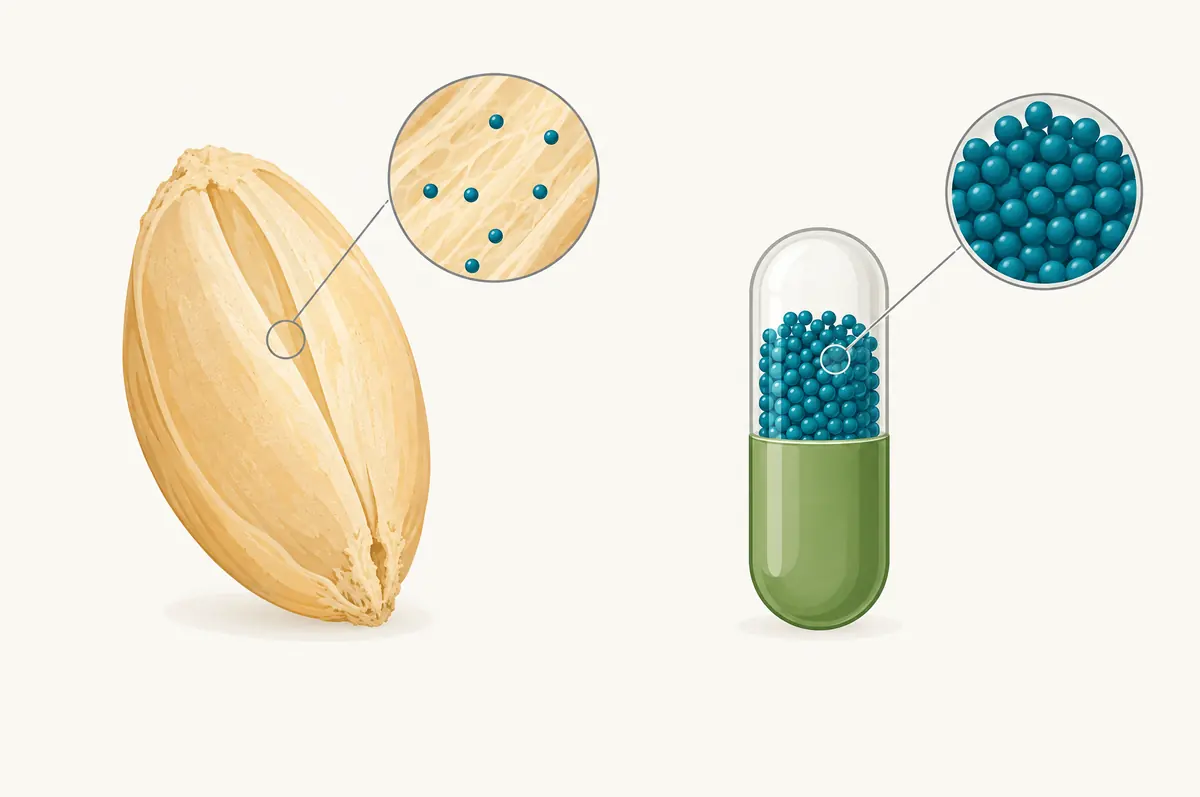
Most products are capsules of wheat germ extract. Synthetic spermidine salts are sold in some markets. Combination products pair spermidine with other autophagy-linked ingredients, which raises compatibility questions. Formats that combine spermidine with other actives must be tested for interactions, since polyamines can react with aldehydes and reducing sugars. Stability testing should track odor development, discoloration and assay loss at accelerated conditions. Where a synthetic form is used, its novel food or equivalent status needs to be confirmed in each target market before launch, because the EU authorization covers the wheat germ extract.
Key takeaways
- Spermidine is a 145 Da polyamine found in wheat germ, soybeans, aged cheese and mushrooms.
- Cellular spermidine declines with age in several tissues.
- Spermidine induced autophagy and extended lifespan in yeast, flies, worms and mice.
- The SmartAge randomized trial found no effect on memory performance after 12 months.
- Spermidine-rich wheat germ extract is on the EU Union list of novel foods.
Key facts
- Spermidine induced autophagy and extended lifespan in yeast, flies and worms (Eisenberg et al. 2009, Nat Cell Biol 11:1305)
- Dietary spermidine improved cardiac function and extended lifespan in mice (Eisenberg et al. 2016, Nat Med 22:1428)
- In the SmartAge randomized trial, 12 months of spermidine supplementation did not change memory performance in older adults with subjective cognitive decline (Schwarz et al. 2022, JAMA Netw Open 5:e2213875)
- Spermidine-rich wheat germ extract is authorized on the EU Union list of novel foods (Commission Implementing Regulation (EU) 2017/2470, as amended)
How our delivery technology applies
Encapsulation here delivers product quality. A multi-layer shell masks polyamine odor and bitterness, separates spermidine from reactive carbonyl ingredients in combination products, and lets a concentrated synthetic or extract form fit a small capsule or a liquid. Spermidine absorbs readily, so the value sits in stability, taste and format.
Questions
Which foods contain spermidine?
Wheat germ, soybeans, aged cheese and mushrooms contain spermidine. Gut bacteria also produce polyamines, so intake is only one source.
Is spermidine well absorbed?
Yes. Spermidine is soluble and readily absorbed, so absorption is not the problem. The practical issues are the small amounts that wheat germ extract supplies, the taste and odor typical of polyamines, and reactivity with carbonyl-containing ingredients.
Does spermidine improve memory?
The SmartAge trial gave older adults with subjective cognitive decline a spermidine-rich wheat germ extract for 12 months and found no effect on memory performance compared with placebo. Observational data link higher dietary intake with lower mortality, but they cannot establish cause.
How does spermidine induce autophagy?
The mechanism most cited is inhibition of acetyltransferases, which shifts cellular protein acetylation toward autophagy. This was shown in yeast, flies, worms and mice.
Building a spermidine product? Ask us about taste-masked and combination-stable formats.