

Last updated:
White mold is a fungal disease caused by Sclerotinia sclerotiorum that causes watery stem, pod and crown rot with fluffy white mycelium and hard black sclerotia. It infects through senescing flowers, so control is preventive: protect early to mid bloom, open the canopy, keep it dry during bloom and rotate away from broadleaf hosts for three to five years. Once mycelium is visible on a stem, that stem is lost.
Crops affected
What causes white mold?
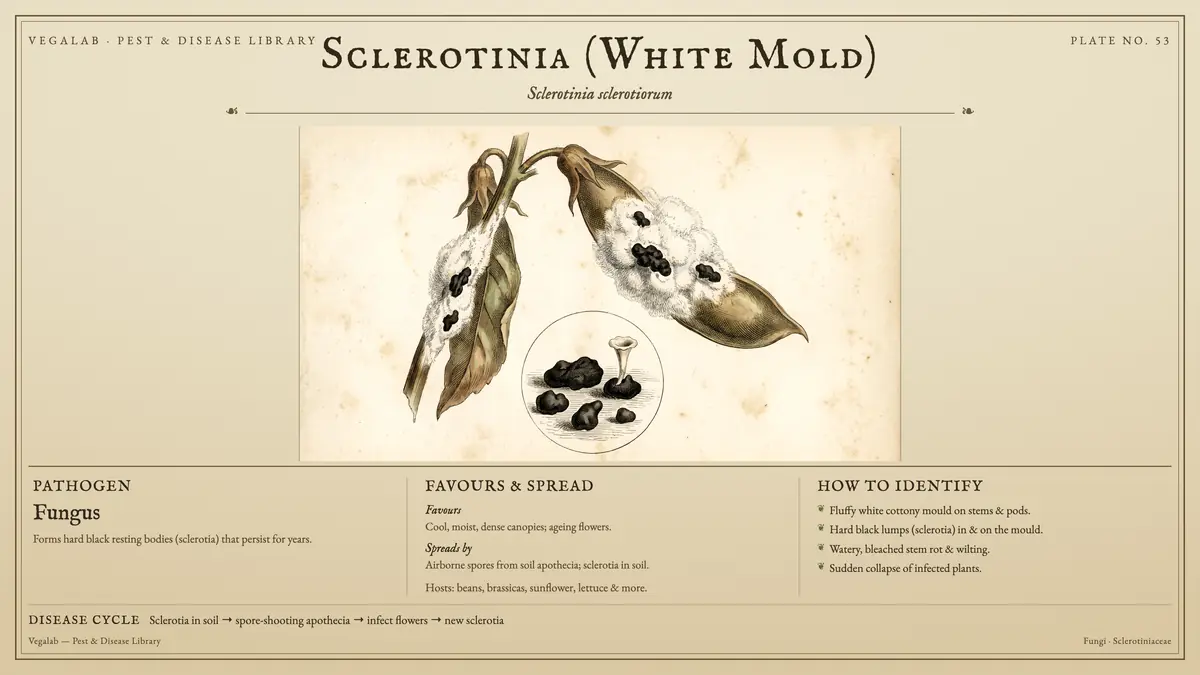
Sclerotinia survives in soil as hard black resting bodies (sclerotia) that germinate to infect senescing flowers and tissue contacting the soil. From those infection courts it spreads into stems, pods and crowns, especially under cool, humid, dense-canopy conditions.
What does white mold look like?
- Water-soaked lesions on stems, pods, crowns or leaves that rot rapidly.
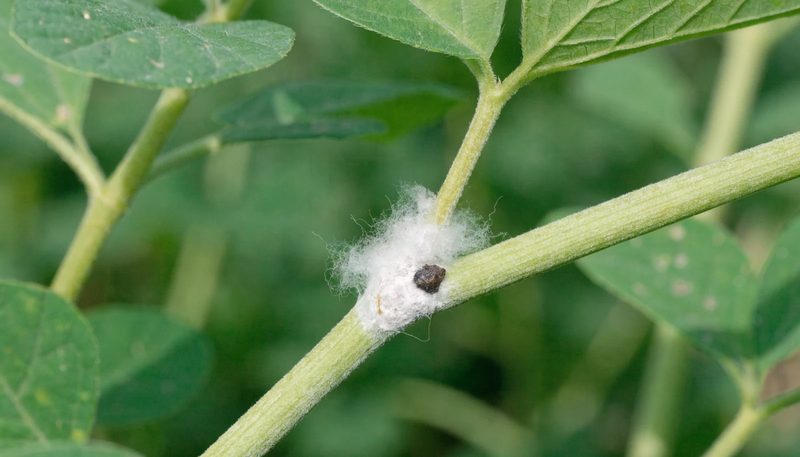
- Fluffy white cottony mold on infected tissue in humid conditions.
- Hard black sclerotia (like rat droppings) inside stems or on the surface.
- Sudden wilting and collapse of individual plants or patches.
How does white mold spread?
Sclerotia survive years in soil; under cool, moist conditions they germinate to release spores that infect flowers/senescing tissue, then the fungus colonizes stems and pods and forms new sclerotia. Bloom is the critical infection window.
What conditions favor white mold?
Cool, wet, humid weather; dense canopies that stay wet; flowering stage; and fields with a history of white mold (sclerotia in soil).
What damage does white mold cause?
Rots stems, pods and crowns, killing plants and destroying yield; sclerotia persist to infest future crops. Severe in dense, high-yield canopies.
When should you scout for white mold?
Watch the bloom window in cool, wet seasons; assess canopy density and field history; act preventively at early bloom rather than after collapse.
How do you control white mold?
- Protect the bloom infection window preventively;
- open canopies and improve airflow;
- manage irrigation to reduce canopy wetness;
- rotate away from susceptible hosts;
- bury or avoid spreading sclerotia.
How do you get rid of white mold?
- Protect the flowers, not the leaves. Sclerotinia sclerotiorum infects almost exclusively through senescing petals and flower parts. The application window is early to mid bloom, and missing it is the most common reason a program fails.
- Open the canopy. Wider rows, lower seeding rates and upright varieties dry the canopy microclimate and shorten the wet period the fungus needs.
- Irrigate to keep the canopy dry during bloom · time and volume matter more than total water.
- Rotate away from broadleaf hosts for three to five years. The sclerotia survive in soil for years, and the host list is wide: beans, canola, sunflower, lettuce, brassicas, potato, carrot.
- Remove and destroy infected debris rather than incorporating it shallowly, and clean equipment moving between blocks.
- Support the plant's own resilience. Balanced calcium and potassium nutrition and an active soil biology give a crop that holds up better under disease pressure - a program input, not a rescue treatment.
White mold is a disease you manage before you see it. Once the fluffy white mycelium is visible on a stem, that stem is lost - the fungus has already colonized the vascular tissue and nothing applied to the outside reverses it. Everything effective is either preventive or aimed at the next crop.
Rescue applications after symptoms appear are the most commonly wasted spend on this disease. Budget the bloom-timing application instead.
Are white mold, sclerotinia stem rot and cottony rot the same disease?
The names track the crop rather than the organism. Sclerotinia sclerotiorum is called white mold in beans and soybean, sclerotinia stem rot in canola and soybean, cottony rot in carrot and lettuce, and simply sclerotinia in vegetables. Lettuce drop is the same fungus at the crown.
Two details matter across all of them. The sclerotia - hard black resting bodies the size of a rodent dropping, formed inside infected stems - are how the fungus survives between crops, and they persist in soil for several years. And infection needs a sustained wet, cool period: roughly 12 to 24 hours of moisture at 15–25 °C. That combination is what makes bloom-stage weather forecasts the most useful predictive tool you have.
What else looks like white mold?
- **vs. gray mold (Botrytis):** botrytis sporulates gray-brown and dusty; sclerotinia mycelium is bright white and cottony, and only sclerotinia forms hard black sclerotia inside the stem.
- **vs. Phytophthora stem rot:** phytophthora lesions are dark, water-soaked and usually start at or below the soil line; sclerotinia starts at a node or flower scar higher up.
- vs. anthracnose: anthracnose produces sunken lesions with concentric fruiting structures, not external white growth.
- vs. drought or lodging injury: split the stem. Sclerotia inside are conclusive.
See Gray Mold (Botrytis), Phytophthora and Anthracnose.
How does white mold show up in each crop?
- Soybean and dry bean: white mold or sclerotinia stem rot - lesions at nodes after canopy closure, worst in high-yielding dense stands in a cool wet flowering period
- Canola and oilseed rape: sclerotinia stem rot · petals stuck to leaf axils after flowering are the infection route, which is why petal-fall timing drives the program
- Sunflower: head rot and mid-stem rot, the head rot form being the more destructive
- Lettuce: lettuce drop · the whole plant wilts and collapses at the crown, often the first plant symptom growers see
- Carrot and celery: cottony rot, frequently expressing in storage rather than in the field
- Brassicas, potato and tomato: stem and crown rot at or above the soil line, with the white mycelium visible in humid conditions
The wide host range is why rotation has to be planned around broadleaf crops as a group, not around a single crop. A bean–canola–sunflower rotation is three susceptible hosts in a row.
Where do biologicals fit against white mold?
There is a genuine biological approach to this disease, and it is worth being precise about what it does. Some soil-applied microbial agents parasitise the sclerotia sitting in the soil, reducing the reservoir of resting bodies available to germinate in future seasons. That is a multi-season pressure-reduction strategy operating on the inoculum, not a rescue treatment for a crop that is already infected.
The distinction matters commercially. Applied to residue and soil after harvest, or ahead of a susceptible crop, this approach works with the biology of the disease. Applied to a canopy showing symptoms, it will not reverse infection any more than anything else will. Alongside it, supporting the crop's own resilience - balanced calcium and potassium nutrition, an active soil biology, and a canopy structure that dries quickly - is what a program input is for.
Anyone promising eradication of sclerotinia from a field is overselling. The sclerotia persist for years, the host range is wide, and the honest goal is keeping pressure below the level where it costs yield.
Recommended Vegalab solution: Spore Control
Spore Control · natural broad-spectrum fungicide (thymol) applied preventively at early-to-mid bloom under favorable (cool, wet) conditions, with coverage into the lower canopy; combine with airflow and irrigation management.
| Role | Product | Use |
|---|---|---|
| Primary control | Spore Control |
By crop
How do you prevent white mold next season?
Rotation away from susceptible hosts, canopy/airflow management, irrigation timing to reduce wetness, sanitation, and preventive sprays in the bloom window.
Key takeaways
- Sclerotinia infects almost exclusively through senescing petals and flower parts, so early to mid bloom is the application window.
- Infection needs roughly 12 to 24 hours of moisture at 15 to 25 °C.
- Sclerotia persist in soil for several years; rotate away from broadleaf hosts for three to five years.
- Rescue applications after symptoms appear are the most commonly wasted spend on this disease.
- Splitting the stem and finding black sclerotia inside is conclusive.
Claims and product availability vary by jurisdiction. Always read and follow the product label.