


Barn flies: how to control them
Last updated:
Barn fly control is won in the manure and wasted feed where larvae develop, not with adult sprays. House flies breed in moist manure and spilled feed; stable flies breed in wet mixes of hay, manure and urine around bale feeders and calf hutches. Remove or dry breeding material weekly, use parasitoid wasps, apply larvicides or biological agents where breeding stays, and save rotated adulticides for peaks.
Fly control on farms is won or lost in the manure and wasted feed where larvae develop. Adulticide sprays alone select for resistance and do not keep pace with breeding. Sanitation, larval control, biological agents and targeted adult tactics form the working program.
How do house flies and stable flies differ?
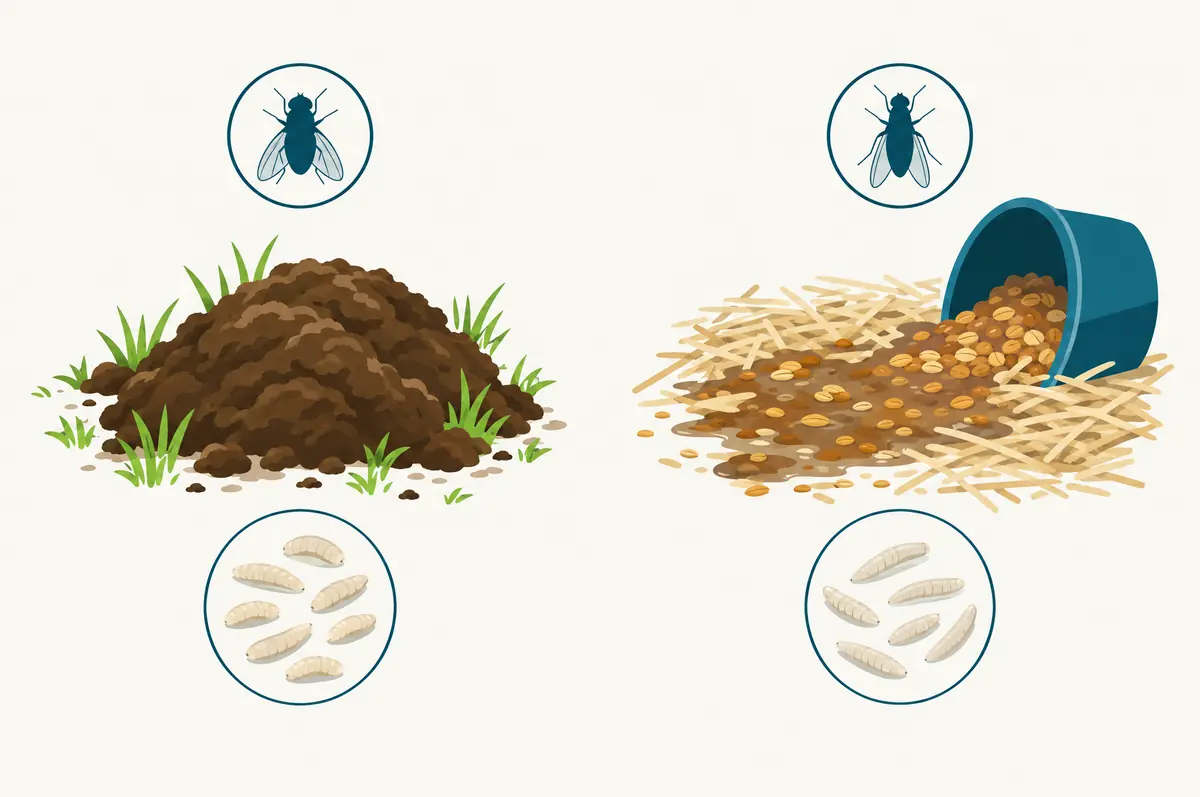
The house fly (Musca domestica) is a non-biting fly that breeds in moist manure, spilled feed and decaying organic matter, completing egg to adult in about 7 to 10 days in warm weather. It is a nuisance and a neighbor-relations issue for poultry, swine and dairy units. The stable fly (Stomoxys calcitrans) bites cattle and horses, mainly on the legs, and breeds in wet mixtures of hay, manure and urine, especially around round-bale feeding sites and calf hutches. Stable fly pressure reduces weight gain and milk yield.
Why do fly sprays stop working?
House flies have developed resistance to organophosphates, pyrethroids, neonicotinoid baits and several larvicides wherever these were used heavily. Spraying adults treats the visible minority of a population while larvae in manure continue to emerge. Programs that last remove or dry breeding material weekly, use parasitoid wasps such as Spalangia and Muscidifurax, apply larvicides or biological agents where breeding cannot be removed, and reserve adulticides for peaks, rotated by mode of action.
Can nematodes control fly larvae?
Entomopathogenic nematodes such as Steinernema carpocapsae infect insect larvae, and research has tested them in manure and litter. Results in fly breeding media are variable because manure chemistry, ammonia, moisture and temperature affect nematode survival. Vegalab's Larva BioControl contains S. carpocapsae and is currently labeled for crop and plant use. Premise use against fly larvae in manure and litter requires a label amendment and state acceptance and is in development.
Key takeaways
- House flies complete egg to adult in about 7 to 10 days in warm weather.
- Stable flies bite cattle and horses, mainly on the legs, and reduce weight gain and milk yield.
- Stable flies cost US cattle production an estimated 2.2 billion dollars per year.
- House flies have developed resistance to most insecticide classes used heavily against them.
- Parasitoid wasps such as Spalangia and Muscidifurax are part of programs that last.
Key facts
- Stable flies cost US cattle production an estimated 2.2 billion dollars per year (Taylor, Moon and Mark 2012, Journal of Medical Entomology 49:198)
- Manure management and biological control underpin poultry fly programs (Axtell and Arends 1990, Annual Review of Entomology 35:101)
- House fly resistance has been documented to most insecticide classes used against it (Scott et al. 2013, Pesticide Biochemistry and Physiology 107:377)
- Entomopathogenic nematodes, as macroscopic biological control agents, are exempt from FIFRA registration (40 CFR 152.20(a))
How our delivery technology applies
Nematodes applied to manure face desiccation, heat and ammonia within hours, and many die before finding a host. Encapsulation of infective juveniles in a hydrated biopolymer matrix can buffer moisture and slow release into the breeding medium. For volatile contact actives used as space or surface treatments, a shell extends residual. Both routes aim at the same problem: keeping the agent alive or active long enough to meet larvae emerging over days.
Questions
Why don't fly sprays work in barns?
Spraying adults treats the visible minority of a population while larvae in manure keep emerging. House flies have also developed resistance to organophosphates, pyrethroids, neonicotinoid baits and several larvicides wherever these were used heavily.
Where do stable flies breed?
Stable flies breed in wet mixtures of hay, manure and urine. Round-bale feeding sites and calf hutches are the main hot spots, so sanitation there differs from house fly targets.
What parasitic wasps control barn flies?
Parasitoid wasps such as Spalangia and Muscidifurax are used in fly programs that last. They work alongside weekly removal or drying of breeding material.
How fast do house flies breed?
In warm weather, house flies complete egg to adult in about 7 to 10 days. That pace is why breeding material needs removing or drying every week.
Dairy, feedlot and poultry operators can apply to host Larva BioControl manure trials.